
PICK OF THE WEEK
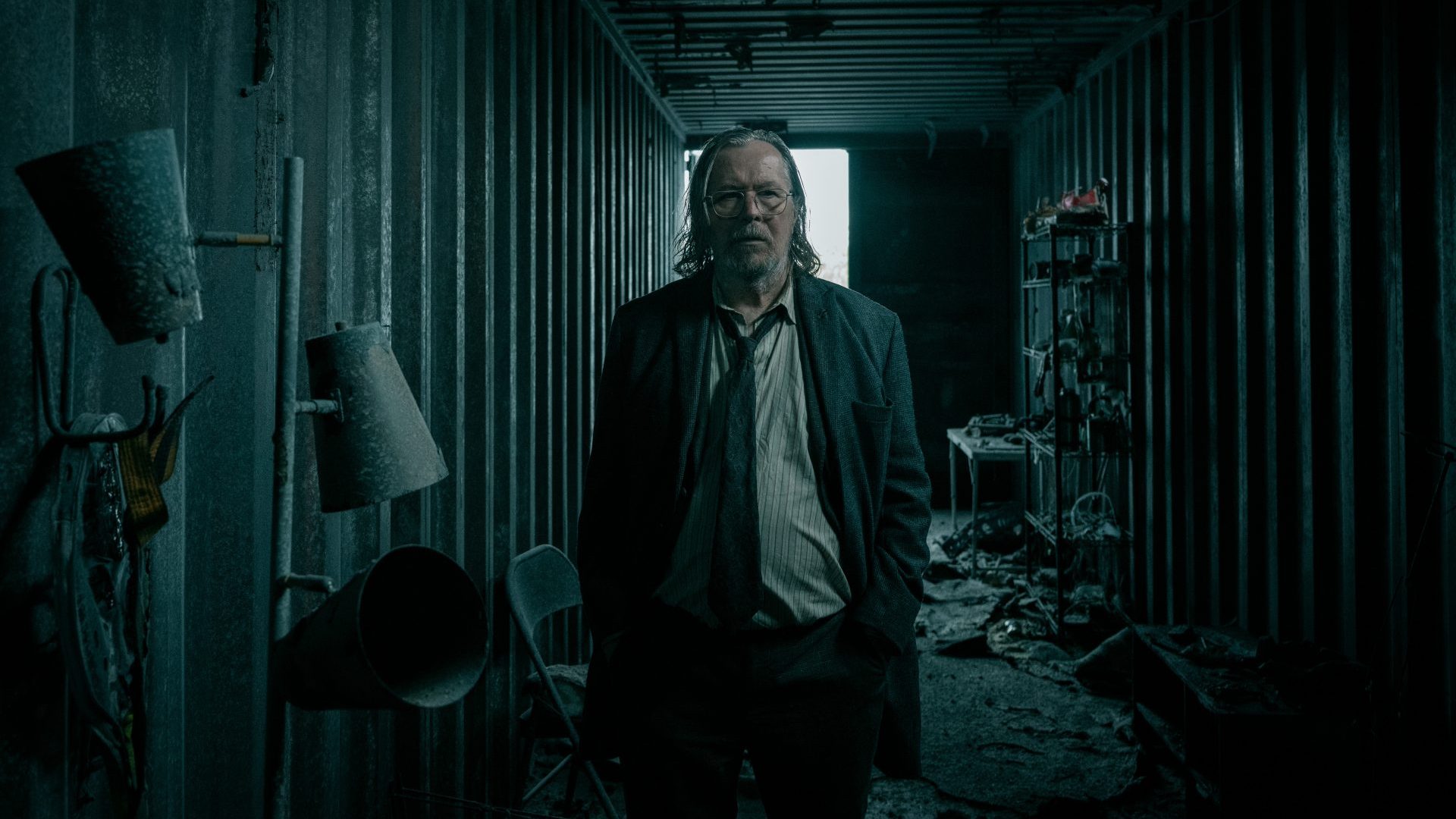
Slow Horses (Apple TV)
Spooks now occupy the commanding heights of British culture. On November 5, Keira Knightley and Ben Whishaw return in Joe Barton’s excellent Black Doves (Netflix) – by coincidence, the publication date of The Taper Man, the second George Smiley novel by Nick Harkaway, John le Carré’s son (the first, Karla’s Choice, was excellent).
Also on the horizon: Legacy of Spies (BBC/MGM+), starring Matthew Macfadyen as George Smiley, Hugh Laurie as Control, Charlie Hunnam as Alec Leamas and Dan Stevens as Bill Haydon. The Night Manager (BBC/Prime Video) is returning for a third season – and Channel 4’s splendid GCHQ thriller, The Undeclared War, starring Simon Pegg, deserves to do the same. As for our espionage novelists: Charles Cumming, Merle Nygate and Charles Beaumont are all in the international top tier.
Indeed, it seems entirely apt that it should be Sir Gary Oldman, so compelling as Smiley in Tomas Alfredson’s Tinker Tailor Soldier Spy (2011), who let slip in an interview on September 4 his understanding that the new James Bond had been cast. “So my fingers are crossed for Jack,” he said, referring to his Slow Horses co-star Jack Lowden.
Meanwhile, as we wait for the white smoke – habemus Bondum – here comes season six of that consistently terrific series, based on the blockbuster Mick Herron franchise, in which Oldman plays crumpled spymaster Jackson Lamb, and Lowden is River Cartwright, banished from MI5’s plush HQ “the Park” along with his fellow “slow horses” – misfits, losers and exiles – to the shabby offices of Slough House in the City of London.
In the latest tranche of six episodes, based on Herron’s Joe Country (2019) and Slough House (2021), Diana Taverner (Kristin Scott Thomas) is at last installed as the service’s “First Desk”. What Lamb – her verbal sparring partner and occasional strategic ally – wants to know is: why are his offices up for sale and the records of his team being wiped? And why, for that matter, are ex-horses like poor old Struan Loy (Paul Higgins) being assassinated?
There’s a welcome return for Sid Baker (Olivia Cooke) – presumed dead in season one – alongside all the surviving regulars, including the anxious chatelaine of Slough House, Catherine Standish (Saskia Reeves); Roddy Ho (Christopher Chung); Shirley Dander (Aimee Ffion Edwards); and the magnificently gnomic JK Coe (Tom Brooke).
Also back on the scene: River’s ruthless mercenary father Frank Harkness (Hugo Weaving) – “not everything’s about you and your daddy issues!” says Lamb with characteristic empathy – and the spectacularly sleazy ex-home secretary Peter Judd (Samuel West), who may or may not bear a passing resemblance to Herron’s Oxford contemporary, Boris Johnson.
It is extraordinary to reflect that this adaptation, now firmly part of the cultural landscape, was only launched in 2022. The seventh season was confirmed back in July – and, on the day after Saul Metzstein scooped up the Emmy for drama directing, Apple TV confirmed the eighth. The horses shall ride again.
Suggested Reading


The Bayeux Tapestry and the continuing allure of all that Norman wisdom
BOOK
Redwood: The Untold Story of the Cold War’s Most Extraordinary Spy, by Ben Macintyre (Viking)
More British espionage – but of the non-fictional variety. Ben Macintyre is not only a writer of beautiful prose but touched by genius in his capacity to find the connective tissue between human foible and geopolitical thunder.
In this case, he has unearthed a truly astonishing story in which the sexual impotence of a particular Russian spy is the droopy butterfly wing that triggers a chain of momentous events whose strategic consequences are felt to this day.
In October 1981, Vladimir Kuzichkin, a Soviet spy, presented himself at the British embassy in Tehran. “I am KGB,” he declared. “I am close to breaking point. I need to defect. I can supply you with important information.”
What Kuzichkin also revealed was that erectile dysfunction was wrecking his wellbeing and his marriage, and that he hoped that western medicine could rid him of this crippling challenge to his ancestral Russian sense of masculinity.
As always, Macintyre is a magus of narrative, focusing upon the personal relationship between the double agent and subsequent defector – codenamed “Redwood” (somewhat unfortunately, in view of his affliction) – and his MI6 handler, Ian McCredie, with whom the author spoke at length.
The treasure that Kuzichkin had to offer was comprehensive intelligence on the Soviet-sponsored Tudeh communist party, regarded by many in the western intelligence community as a significant rival to the Ayatollah Khomeini’s fledgling Islamic revolutionary regime. In 1979, the USSR had invaded Afghanistan. Might Iran be next?
The CIA and MI6 agreed that Kuzichkin should be despatched in person to Islamabad to brief the Iranians – who rolled up the Tudeh network hide and hair, tortured many of its members and slaughtered thousands. As Macintyre ruefully reflects, the lasting consequence of this ruthless decision by western spies was not to weaken the USSR but – by helping Khomeini – “to reinforce a totalitarian religious dictatorship that has terrorized its people and destabilized the world ever since.”
Bathos is notoriously difficult to capture but Redwood does so to masterly effect: capturing both the farcically intimate motive for Kuzichkin’s betrayal of his country and the deadly gravity of what followed. How different history might have been, Macintyre wonders, if Viagra had existed in 1981. His terrific book has already been longlisted for this year’s Baillie Gifford Prize: it deserves to win.
Suggested Reading

What happens when the world stops reading books?
THEATRE
Tartuffe (Remixed) (Marylebone Theatre, London, until October 24)
Hot on the heels of Martin Crimp’s modern adaptation of The Misanthrope at the National Theatre, starring Sandra Oh, Molière’s classic satire on religious hypocrisy, first performed in 1664, is wonderfully transposed by Darren Raymond to a contemporary wedding in London in which Sinclair (Ivandro Da Cruz Leite), from a British-Nigerian family, is preparing to marry Adanna (Sara Mokonen), whose background is British-Caribbean.
At the Bride Price Ceremony, the formal occasion at which the groom’s family offers gifts to the bride’s, Adanna’s formidable father Oga (Usifu Jalloh) introduces Pastor Blake (Mark Rylance): an oleaginous Anglican vicar with extraordinary dentures – a dead-ringer (if you’re old enough to remember) for Dick Emery’s buck-toothed cleric – who is clearly up to no good but has the patriarch wrapped round his greedy white finger. “I care not for luxury and ting,” he says in a ghastly attempt to mimic Black patois.
The pastor’s first scheme is to persuade Oga that Sinclair is not fit to be his son-in-law – “It is for flesh and not God he yearns” – and then insidiously present himself as a more suitable groom. Along the way, he plans to con Oga and his family out of all their wealth.
Raymond is artistic director of Intermission Youth, an artistic collective that has helped more than 8,000 young people with its programme of creative work that uses Shakespeare as a starting point for dramatic exploration. Rylance and his late wife, Claire van Kampen, were supporters of the company from its inception.
To have an Oscar- and Olivier-winning actor, former artistic director of the Globe Theatre and (arguably) the greatest living Shakespearean playing a broad comic role might have skewed the whole production. But Rylance visibly relishes being part of an ensemble – mostly composed of fellow supporters of Intermission.
Jalloh and Nakeba Buchanan as his wife Elmire are especially good, as is Morenike Onajobi as Adanna’s tell-it-how-it is friend Kemi. Suzette Llewellyn as Elmire’s mother, known to all as Grandma, steals scene after scene. “Miss Pontius Pilate – shame on you!” she says to her daughter when she tries to persuade her that the pastor is a wrong’un.
The designs by ULTZ, Maybelle Laye and Shola Ajayi – some handcrafted in Lagos – are glorious, and the music and dance leaven the serious interrogation of both white colonialism and the timeless capacity of crooked churchmen to fleece the faithful. The production also marks the fourth anniversary of the Marylebone Theatre, fast becoming one of the capital’s most exciting venues. Go see.
FILM
La Femme Infidèle (selected cinemas; BFI Player, October 2)
In contrast to François Truffaut, Jean-Luc Godard, Éric Rohmer and Jacques Rivette, Claude Chabrol has never truly been granted a settled role in the mythology of the Nouvelle Vague. According to the great American film critic Andrew Sarris, “he was forced to accept commissioned projects to keep his hand in” – interpreted by many as a way of implying that Chabrol was not quite the full artistic ticket.
So here is a happy opportunity to revisit this 1969 masterpiece of compressed emotion, in which insurance broker Charles Desvallées (Michel Bouquet) hires a private detective to follow his wife Hélène (Stéphane Audran, who was married to the director at the time) – and then confronts her lover, Victor Pegala (Maurice Ronet).
At first, after Victor pours him a bourbon, Charles pretends that he is complaisant about Hélène’s infidelity – “we have a very free arrangement…We tell each other everything. I just had to meet you.” Victor tells him that they met at the cinema, where he sensed “a sort of availability.” The humiliated husband replies, deadpan: “How very amusing.”
In Bouquet’s sphinx-like reserve, punctuated only by occasional sardonic asides to his faithless wife – and a lone act of terrible violence – La Femme Infidèle delivers one of the most memorable portraits of the cuckold in all art: evocative of Tolstoy’s The Kreutzer Sonata (1889), Ford Madox Ford’s The Good Soldier (1915), David Lean’s The Passionate Friends (1949), Pinter’s Betrayal (1978) and Julian Barnes’s Before She Met Me (1982).
Yes, this is exalted company. But Chabrol’s movie merits inclusion. Just watch the profoundly subtle exchanges between Charles and Hélène in the final scene; the silent understanding as their eyes meet and they grasp fully the price they and their son must now pay for all that has happened. Cinema of the highest order.
 Most popular

Emily Maitlis’s diary: As I was saying to George Clooney just the other day…

Why Slavoj Žižek probably hates you

There’s only one reason Trump went to Ireland – it wasn’t to meet the Taoiseach
A new film about Elon Musk reveals him as so awful it’s almost tragic. Almost