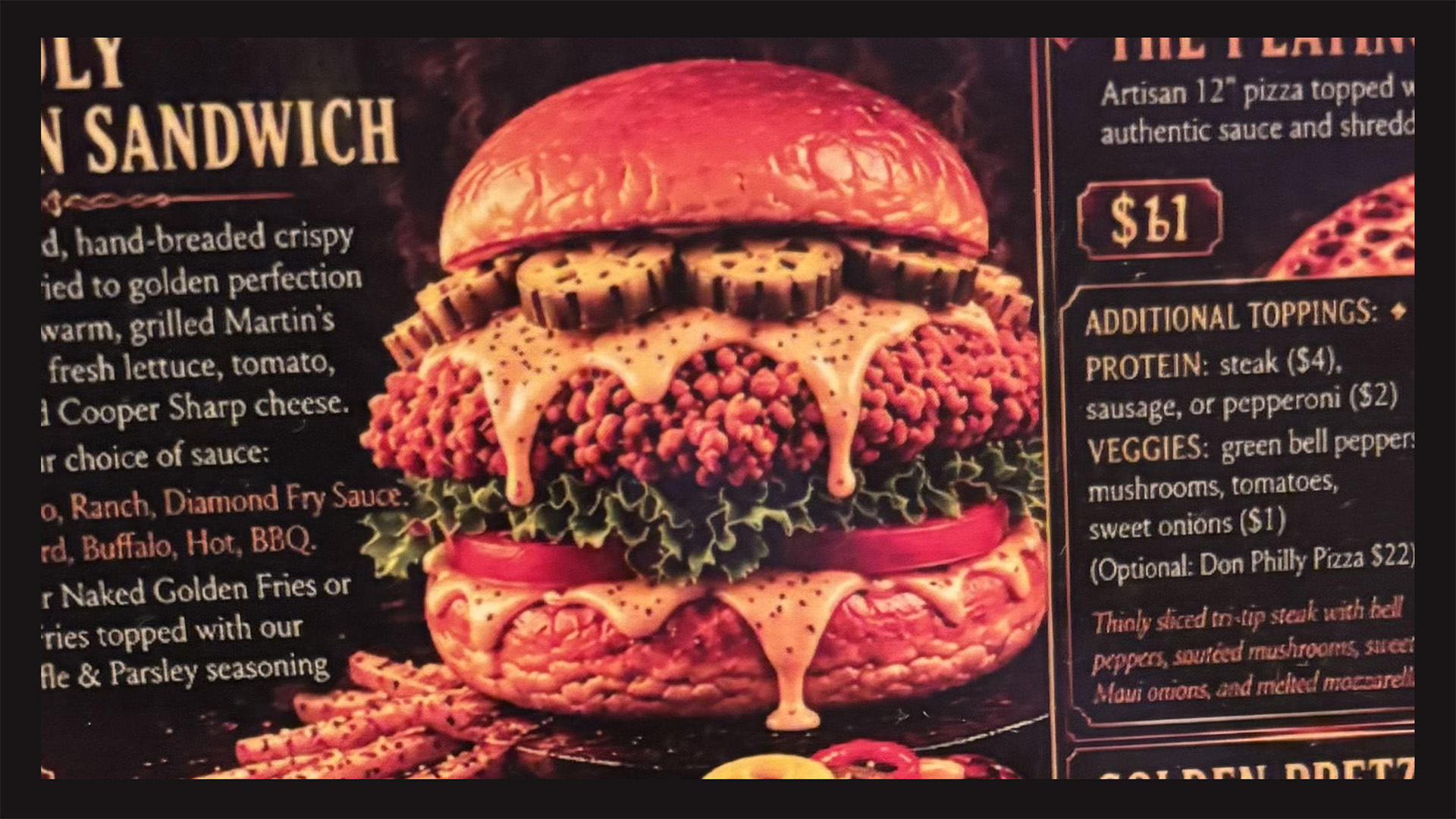
An independent cafe in Liverpool has gone viral for all the wrong reasons. Is it because of its commitment to the terrible theory that giving food items stupid names (such as “the heart attack” or the “dirty scouser”) will make you order them? Or because of the cafe’s awful name: Calm Ya Baps?
Surprisingly, although these factors certainly didn’t help, no. It’s because Calm Ya Baps used AI to create their menu and branding, and the good people of the internet have rightfully decided that enough is enough. We need to end the scourge of AI posters once and for all.
If you don’t know how to spot an AI poster, here’s the rundown. Firstly, there will be so many colours and graphics attacking your eyeballs that a rave would look like a Quaker meeting in comparison. There will also probably be gibberish text, and at least one object that will be so hard to decipher it may make you question if you’re having a stroke
It’s hard to walk down a British high street now without encountering this sort of AI slop, particularly outside takeaways and cafes. And it turns out that it might not be the marketing masterstroke you think it is.
“Dog shit AI slop for a menu. I’d walk straight out seeing that mess. Slop menu, slop food,” posted one user, referring to Calm Ya Baps. The comment sparked an onslaught of people from across the world admitting that they, too, subconsciously boycott businesses that use AI to advertise their products.
“If I’m looking for a quick bite and I see ANY instance of ai to promote the food they could have LITERALLY JUST TAKEN A PICTURE OF. I find someplace better,” said one user from Washington DC.
Suggested Reading

Worried about the AI apocalypse? You’re already living in it
The reason so many people are disgusted is not necessarily because they have a moral objection to AI, or even because using it comes across as lazy. No, it’s because AI has a particular weak spot when it comes to food: it cannot seem to generate a picture of a burger or hot dog without making it look like something you’d find growing in the corner of a damp cellar.
In the hyperrealistic but unmistakably fake pictures of food that litter AI menus and posters, the texture can resemble cockroaches, faeces, or some sort of alien life form not yet discovered. Sometimes the images inexplicably feature clusters of holes or circular bumps, triggering trypophobia, an aversion to patterns of small holes.
As one commenter writes: “AI food gives me the same feeling i get when i look at a cluster of holes. trypophobia ass shit. literally the complete opposite of appetizing. if i see this eldritch horror outside your store i am turning 360 degrees and walking away”
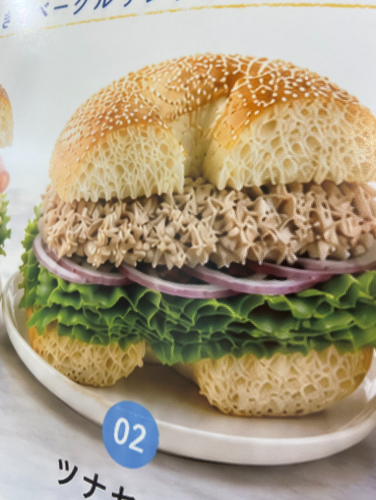
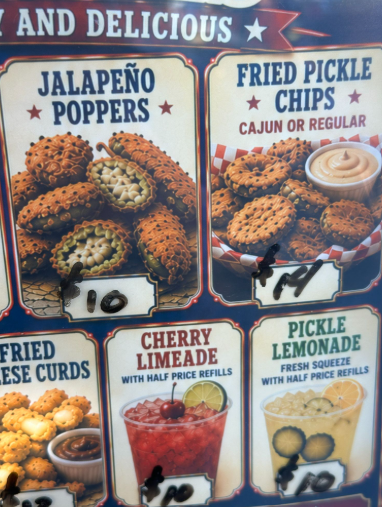
So why does it do this? According to a New York Times report on AI food slop, data scientist and AI expert Jon Krohn explains that early AI models were particularly bad at rendering texture, often relying on repetitive elements that made food resemble maggots or mould.
And there’s a reason we find this so repulsive: our survival instincts have evolved to make us suspicious of food that looks rotten, diseased or otherwise likely to send us to an early grave.
I asked a local cafe near my house why they had replaced their simple chalkboard, which listed the prices of sandwiches and pastries, with a garish AI display featuring fake pictures of food they don’t even sell. The response was simple: they couldn’t afford to hire a graphic designer or local artist (who, as a side note, are the real losers in all this), and AI meant they could compete with the big chains by having their own personalised signs and artwork.
Look, it’s hardly a secret that small businesses are struggling at the moment, and the promise of getting professional-looking marketing for free is understandably tempting. But none of that really matters if the finished product is, at best, sloppy and homogenous and, at worst, triggers customers’ evolutionary instinct to vomit and/or run screaming from the premises.
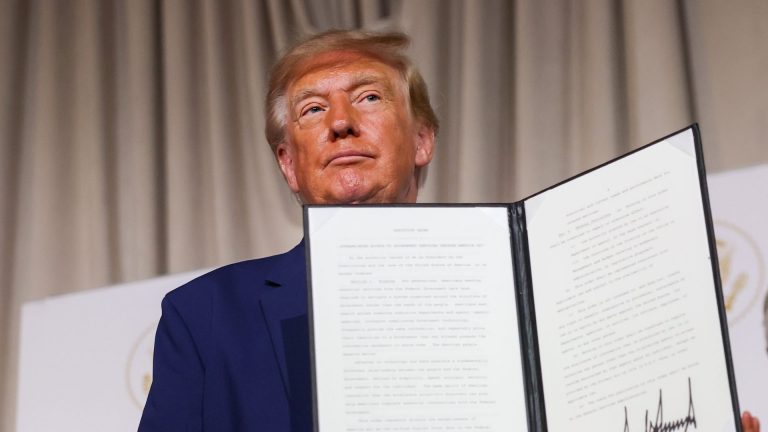
And as we become more AI-savvy as a society, these posters and images are starting to function as a sort of class marker. AI-made art and posters have become increasingly associated with the political right and, often, with a certain sort of tacky, low-budget aesthetic.
When I attended the Unite the Right march to report on it, I couldn’t believe how many AI-generated British bulldogs plastered onto Union Jacks there were. MAGA has a particular penchant for grotesque AI-generated clips of Trump, and across the world everyone from toddlers to nonagenarians are getting their brains rotted by poor-quality videos of Jesus saving a kitten or fruits cheating on each other. Of course, a cultural backlash was coming.
AI art is bad. It’s bad because it takes work away from real artists, flattens our culture into an endless feedback loop of knock-off Disney animations, and, not to mention, consumes vast amounts of energy. And even when it’s used for something AI is supposedly good for, like helping small businesses save money, it can end up costing them customers instead.
The only comforting thing is that, in a world where it sometimes feels like the robots are taking over, our human instincts still seem to work. We can look at a picture of an egg with the texture of a wasp’s nest and know, on some ancient level, that something has gone deeply, horribly wrong.
Take that, robots.
 Most popular

Burnham is already winning the new Brexit wars


Reform and the Greens are fading – the real fight is Tory v Labour
I was at Eton with Charles Spencer – this is how it explains his battle with the royals


The uncomfortable truth about Ariana Grande