
PICK OF THE WEEK
Digger (general release)
In the third act of Alejandro G Iñárritu’s eighth feature film, the initially enigmatic Kenny (Jesse Plemons) makes a blink-and-you’ll-miss-it allusion to Neil Postman’s seminal work of cultural analysis, Amusing Ourselves to Death (1985). In the age of mass electronic media, Postman argued, narrative, spectacle and sensation were supplanting rational inquiry and democratic deliberation.
This is the master key – in a story strewn with clues and easter eggs – that unlocks the mystery box of this magnificent, deranged, go-for-broke movie. Digger is engineered to be divisive (its ad campaign is already leaning into the polarised response of reviewers), which, in the era of star ratings and herd behaviour, is positively refreshing.
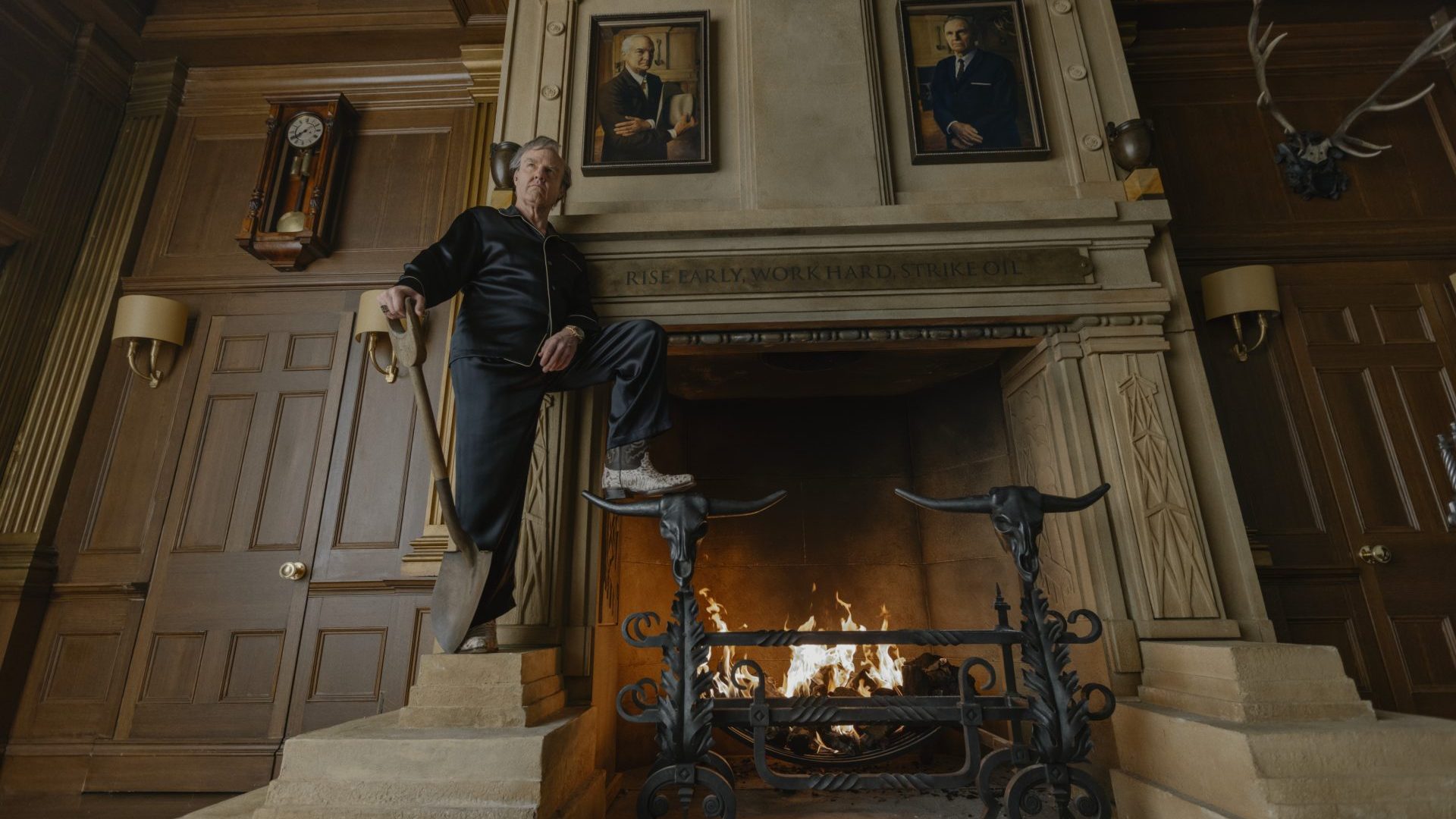
Digger Rockwell (Tom Cruise, tremendous), an ageing Texan oil tycoon, is having a bad day. His beloved 30-year-old cat Maggie, slumping in his arms, is close to death. Meanwhile, the billion-dollar drilling operation his company operates in Greenland has been rocked by an explosion, propelling a huge iceberg called “Judy”, five times the size of Washington DC, towards Norway.
Distrusting the security of the White House situation room, the mortally ill President Compson (John Goodman) – “a lump down there the size of a raccoon!” – brings his cabinet to Rockwell’s mansion, which is less a home than a monument to taxidermy, with stuffed reptiles hanging upside down from the ceiling and a full-length mirror framed with antlers.
What follows is a satirical sequence that does for climate cataclysm what Kubrick’s Dr Strangelove (1964) did for the nuclear apocalypse. Digger’s chief safety scientist Ganesh (Riz Ahmed, brilliant as always) sets out the potential scale of the disaster which, beyond a catastrophic loss of life, is likely to rack up a bill of more than $18 trillion: what the president calls “a great big old dildo of a pickle.”
The trigger-happy military chief, Colonel Fitzgerald (Robert John Burke), wastes no time: “Let’s bomb the shit out of it!” Instructed to close out the meeting with a prayer, the president’s pastor starts speaking in tongues.
Digger, on the other hand, identifies a more devious strategy. “Panic, Mr President,” he says, “is a resource.” And, like all resources, he believes it must be mined and exploited. The point is not to avert Armageddon but to own it.
The first step is to activate a top-secret firewall that will covertly control what words, phrases and claims can be used on social media. “They know the facts,” he tells Ganesh over Scotch and tuna on his private jet. “The story is yet to be told.”
At the heart of the movie is a very big twist that will infuriate some and delight others – one that I shall not spoil. Two hints: think Karel Reisz’s The French Lieutenant’s Woman (1981); and look out for the poster of John Cassavetes’ Opening Night (1977). If you know, you know…
Thanks to Emmanuel Lubezki’s cinematography and the production design of Dennis Gassner and Richard Johnson, Digger feels like the aesthetic work of Wes Anderson’s evil twin. The performances are all first-class: Goodman is having a ball as a gargoyle gerontocrat, and Sandra Hüller, so good in Project Hail Mary, excels again as Digger’s half-sister Emma.
Like Yorgos Lanthimos, Iñárritu – with four competitive Oscars already on his mantelpiece – has stayed true to his arthouse roots, and in Cruise has a bold accomplice who, belching capitalist fire in a fat-suit, combover hairpiece and gaudy bolo tie, is every bit as daring as he was when flying F/A-18 jets at eight G in Top Gun: Maverick (2022).
Digger is a film with absolutely zero interest in pleasing the algorithm or the lowest common denominator of critical opinion. The passions it has unleashed are a much-needed reminder of the difference between confected culture wars and authentic argument about art. Remember when intelligent disagreement was the whole point?
Suggested Reading

How Salman Rushdie rose again
STREAMING
East of Eden (Netflix)
Though posterity has favoured The Grapes of Wrath (1939), John Steinbeck considered his late-career epic, published in 1952, to be “the book”: the great work that was always “waiting to be written.”
Elia Kazan’s cinematic adaptation of 1955 was the only movie starring James Dean that the actor lived to see released but encompassed barely a quarter of Steinbeck’s sweeping dynastic saga. Now, 71 years later, the director’s granddaughter, Zoe Kazan has settled unfinished family business in this terrific seven-episode version of Steinbeck’s panoramic novel and its portrayal of half a century of American life, from the aftermath of the civil war to 1918.
Explicitly modelled on Genesis, it re-tells the story of the Fall as Adam Trask (Christopher Abbott) falls madly in love with his Eve, Cathy Ames (Florence Pugh), who crawls, horribly injured, up the steps of the family ranch in Connecticut. To the fury of his half-brother Charles (Mike Faist), he tends her through convalescence – and then marries her.
In this respect, the Adam and Eve tale quickly merges with the story of Cain and Abel, as the newlyweds leave Charles behind and head off to the Salinas Valley in California (where Steinbeck grew up). Cathy gives birth to twins, Caleb and Aron; but feeling trapped, shoots her husband (though not mortally) and disappears, only to resurface as “Kate Albey”, working in the Salinas brothel of Madam Faye (Martha Plimpton).
There has been a mostly manufactured controversy – more of a culture scuffle, really – over Kazan’s rendering of Cathy, who is unequivocally monstrous in the novel. Ruthless, deceitful and incapable of lasting attachment she remains. But her conduct is contextualised by the traumas in her past and, in Pugh’s mesmerising performance, given subtlety, ambiguity and emotional depth.
Ciarán Hinds steals his scenes as Samuel Hamilton, the Irish patriarch who is Adam’s neighbour, friend and mainstay in the valley. Also excellent is Hoon Lee as the Trasks’ Chinese American housekeeper Lee, the true conscience of the novel and a character shamefully absent from the 1955 movie.
Lee becomes a surrogate parent to Cal (Joseph Zada) and Aron (Joe Anders), determined to prevent them from repeating the Cain-and-Abel rivalry that scarred the previous generation. To him is entrusted the story’s governing principle – based on his personal translation of the Hebrew word timshel as “thou mayest” – that people are morally autonomous and by no means doomed by the sins of their forebears.
It is a credit to Kazan and her formidable cast that this weighty theological message is so smoothly embedded in a series that, as it veers from the beauty of the American landscape to the Gothic interiors of Cathy’s demi-monde, is never less than compelling.
Suggested Reading
The Slow Horses ride again in Britain’s spy renaissance
EXHIBITION
Renoir and Love (The National Gallery, London, until January 31)
Never before seen in this country, Dance at the Moulin de la Galette (1876), on loan from the Musée d’Orsay in Paris, is reason enough to see this sumptuous exhibition.
As I wrote of the Bayeux Tapestry last month, the impact of the canvas’s physical presence – the vividness of the guinguette or open-air café in Montmartre, of the sun-dappled dancers, of the seated figures absorbed in one another’s company – makes clear what Walter Benjamin was driving at when he coined the idea of the “aura” of original art that cannot be captured in reproductions.
In the pantheon of Impressionists, Pierre-Auguste Renoir (1841-1919) was a bridge between, on the one hand, 18th century painters such as Watteau and Boucher and their traditional depiction of fêtes galantes (courtship gatherings) and, on the other, his modernist admirers, notably Picasso and Matisse.
What is too often dismissed as sentimentality emerges in these galleries as something quite different: a sharp eye for intimacy, for flirtation, for the pleasures of friendship and conversation. Look at Spring (The Conversation) (1876), in which a man and a woman, separated by a fence in a lush garden, are transfixed by one another; or the two young women conversing in Confidences (1876-78); or the relaxed body language of the trio in Lunch at the Restaurant Fournaise (1875), as rowers pass by, visible through the riverbank pergola.
A perfect artistic treat for the autumn.
EXHIBITION
Korea (The British Museum, London, until January 31)
Four years after the V&A’s dazzling Hallyu! celebration of the Korean wave, this is a more serene but no less captivating evocation of the peninsula’s culture from 300 BC to 2019 – most of its 185 exhibits drawn from the bequest of the late Samsung chairman Lee Kun-Hee.
The early standing Buddhas of the 8th and 9th centuries are exquisite, followed by the distinctive jade-green celadon stoneware that flourished during the Goryeo dynastic era from 918 to 1392; expressions, too, of a devout Buddhist sensibility.
Especially beautiful is the 14th century copy of the Avatamsaka Sutra (Flower Garland Sutra) – originally composed about 500 years after the death of the historic Buddha – meticulously transcribed by hand in gold on indigo paper and dedicated to a samjung daegwang (triple grand official).
Neo-Confucianism became dominant under the Joseon dynasty of 1392 to 1897, from which epoch there are many stunning pieces: Banquet at Sungjeongjeon (1710), depicting a royal celebratory feast; the magnificent folding screen Ten Symbols of Longevity (1800-1900); and the quasi-comical Tiger and Magpie, a 19th century ink and colour rendering of minhwa folk art traditions.
Though the story told in these galleries is one of constant international cultural exchange through the centuries, the presence towards the end of the show of Kim Insoong’s Woman in a Red Dress (1965) marks a radical step towards westernisation; followed, of course, by the no less dramatic reciprocal influence of South Korean culture in Europe and America today.
In a normal year – without the Anglo-Norman embroidery on display in a gallery 100 metres or so away – this would have been the museum’s exhibition of 2026.
But this has been far from a normal year, and not only at the British Museum: to mention only a few of its highlights, Tracey Emin at Tate Modern, Zurbarán at the National, Whistler at Tate Britain, and Marilyn Monroe at the National Portrait Gallery, with Nan Goldin at the Hayward and Van Eyck at the National still to come.
 Most popular
The problem is they just don’t care about us any more


The New World at 500: Independence isn’t our marketing slogan. It’s our business model


Churchill, the Beatles, St George: All the English heroes who aren’t actually English

Sorry Nigel, but the polls show you’ve had it