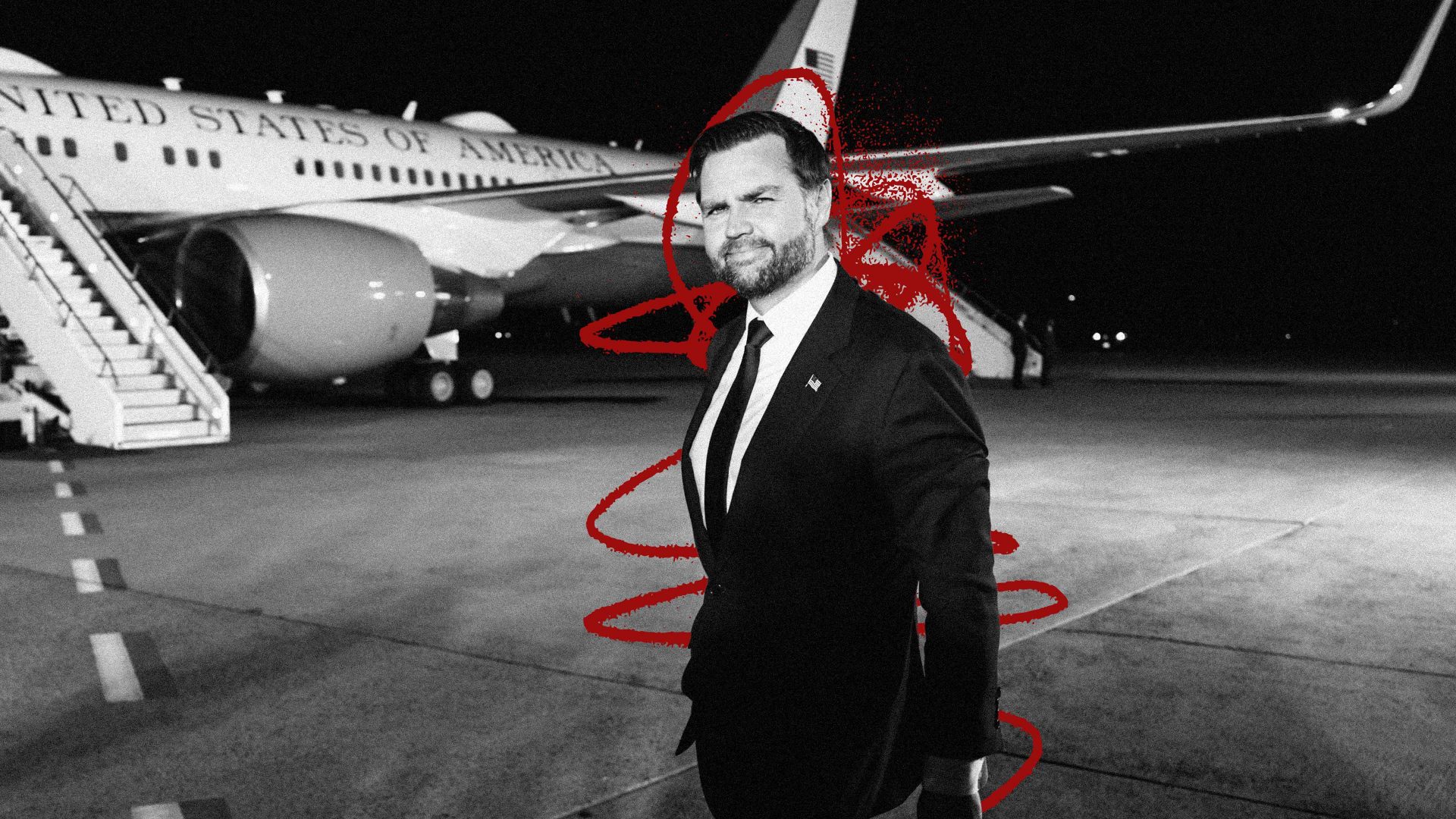
Last month, I finally got round to finishing Communion, JD Vance’s account of how he returned to Christianity. And I have to admit: I thoroughly enjoyed it.
As readers of his earlier memoir Hillbilly Elegy (2016) will know, the vice-president can write. Not as well as Barack Obama, whose Dreams From My Father (1995) remains the gold standard, alongside, perhaps, Theodore Roosevelt’s The Rough Riders (1899). But well enough to make vivid his path back to religion.
Two impressions linger. First: I was genuinely impressed by Vance’s command of theology, scripture and the writings of St Augustine, St Thomas Aquinas, Pope Leo XIII, GK Chesterton, CS Lewis, Basil Mitchell and (especially) René Girard.
Second, I finished the book thinking: there’s no way this guy can win the presidency.
Why so? Because, irrespective of where he came from, Vance now lives exclusively in his head. He is fixated by identity, status and, not surprisingly, the social dynamics of his rise from poverty in Appalachian Ohio and Kentucky to the vice-presidency, aged only 40.
This helps to explain why, in interviews, he is both fluent and testy. He is constantly weighing every phrase – his own and other people’s – for its code and impact. He smiles implausibly even as he seethes.
He is, in other words, compulsively self-reflective. Donald Trump, in contrast, has rarely, if ever, paid a visit to the dark interior of his own tangerine-thatched head. The anterior cingulate which generates the alarm of uncertainty and the prefrontal cortex which examines it: these are neurological zones to which the president is a contented stranger.
Suggested Reading

Watch out – Trump could use the mid-terms to trigger a political crisis
All of which is to say that I think Vance totally lacks the instinctive showmanship and demotic touch required to unite the Republican Party, let alone to become the 48th president. His sense of humour is stilted, his rhetoric stentorian and the scale of his ego grating rather than funny.
It is true that Marco Rubio, the secretary of state, is lining himself up more or less openly as an alternative GOP nominee and has narrowed the polling gap that separates him from Vance. Whether or not his formal, restrained manner would be a better bet in a ferocious presidential race is another matter entirely.
But it is also worth bearing in mind that no incumbent vice-president of a main party has sought and been denied the top spot on the ticket since Alben Barkley in 1952 (the Democrats ended up selecting Adlai Stevenson who lost – twice – to Dwight D Eisenhower).
To summarise: given the state of the US economy, the disaster of the Iran war, the probable losses that the Republicans will suffer in November’s mid-terms, and the VP’s liabilities as a candidate, the 2028 presidential election really ought to be a cakewalk for the Democrats.
But Vance has a crack unit working covertly on his behalf; a vast national network of fanatical operatives dedicating themselves to the task of ensuring that he cannot lose. Not since Richard Nixon’s “plumbers” and “ratfuckers” has there been such a formidable group of saboteurs and wreckers working for a Republican victory.
Who? Well, the Democrats themselves, of course. Just when they should be crafting an irresistible offer to the voters, and summoning a high level of collective self-discipline, they have decided instead to dump the boring old “administration-in-waiting” stuff for the behaviour of a campus sit-in and Maoist “struggle session”.
On August 4, Abdul El-Sayed won the party’s senate primary in Michigan by the narrowest of margins and will now face the Republican Mike Rogers on November 3. To be fair, he has panache and wit and was up against a much better-funded opponent in Haley Stevens.
But the demographics of his support were ominous for the Democrats: white liberal graduates and Muslim citizens backed him, and white and black working-class voters didn’t.
El-Sayed brought plenty of baggage to the contest, too: notably his remark after the Hezbollah-inspired terrorist attack in March on Temple Israel synagogue in West Bloomfield, where 140 children were present, that “hurt people do hurt people”.
He also associated himself closely with the online sensation Hasan Piker, who often livestreams for 10 hours a day on Twitch, and is notorious for a long and ever-increasing list of outrageous statements. To give you just a flavour: “I would vote for Hamas over Israel every single time”; “millionaire, billionaire WASP fail-sons” should only be allowed to “do date rape to other billionaire/millionaire fail daughters”; “It doesn’t matter if rape happened on October 7th”; and – most famously – “America deserved 9/11”.
Suggested Reading
Rubio got Cuba, but Vance got Iran: Trump auditions his successors
Piker’s defenders inside the Democratic tent say that he is simply the left’s version of Joe Rogan. But is that true?
Rogan’s unscientific claims about public health policy during the pandemic were indeed a disgrace. But, as the world’s most successful podcaster drags on a spliff and talks about archery, UFOs and MMA, he is not (in contrast to Piker) calling Jews “inbred hicks” or “pig dogs”; or saying: “I don’t give a fuck what black people care about”; or talking about going “back to a better time when lynchings were happening.”
For a candidate as astute as El-Sayed to embrace a figure like Piker is unfathomable. It is statements like these – and they keep coming – that can wreck an entire political brand by association and make left wing extremism the story, rather than Republican failure.
More recently, the Democrats’ gubernatorial primary in Wisconsin was also a bin-fire as the strong favourite, Francesca Hong, was found to have called for the police to be defunded; talked about her half-white son from a previous marriage continuing “my proximity to whiteness”; and even demanded the cancellation of Thanksgiving.
Hong was beaten, but only by a whisker – 0.4 percentage points, a little over 3,000 votes. The real question is: why did she get so close and why is a party that has so much to gain, and so very soon, taking such deranged risks?
At the heart of all this is a series of potentially disastrous misunderstandings. First of all, there is the surge of the Democratic Socialists of America who now include among their 130,000 members New York City mayor Zohran Mamdani; likely contender for the 2028 Democratic presidential nomination, Alexandria Ocasio-Cortez; and her fellow member of the Congressional “Squad”, Rashida Tlaib of Michigan.
For a taste of what the DSA believes, listen to David Remnick interviewing its co-chair, Megan Romer, on the episode of The New Yorker Radio Hour posted on August 7. Asked about open borders, Romer talks about phased reform before “flipping the switch”. October 7, she says, was “inevitable”; and had she been able, she would have attended the pro-Hamas rally in Times Square the day after the atrocity. And – guess what? – she does indeed support collective ownership of the means of production, which is not yet a big issue in the big seven swing states.
The root problem is a misunderstanding of how, precisely, the era of hypermodernity and populism has changed politics. For a start, Mamdani’s success has to be parsed with care. The mayor is a generational talent, possessed of a personal magnetism that cannot simply be replicated at will. As Max Weber warned in Economy and Society (1922), the defining characteristic of charisma is that it is vanishingly rare, “outside the realm of everyday routine”.
Nor does it follow from MAGA’s success that the DSA is simply its symmetrical equivalent. For a start, the populist right has prevailed in two presidential elections. No socialist candidate has secured more than 6% in such a race – and that was Eugene Debs in 1912.
Yes, Trump’s electoral successes have shown that radicalism can prevail and that not all campaigns are necessarily won from the centre. But it should be obvious that not every radicalism is identically appealing.
Suggested Reading


Trump has made his biggest, most dangerous mistake yet
AOC, who is rightly feared by the GOP as a potential Democratic nominee, clearly intuits this, which is why, in an interview with ABC’s Jon Karl on August 9, she said that “Woke One was crazy!”
This did not quite do the trick. Too many people lost their jobs, were silenced, or had their lives turned upside down by purity codes and campus intolerance for the high season of wokeness – say, 2020-23 – to be brushed aside with a chuckle. There is a reason why MAGA’s ugly “Kamala is for They/Them, President Trump is for You” ad campaign in 2024 was so successful.
What is most infuriating is that there is a straightforward slam dunk of an electoral strategy waiting for the Democrats to pursue unambiguously: one that is fiercely opposed to the Trump elite’s corruption, the billionaire class, and the tech oligarchs now fleecing ordinary Americans. The lesson of Péter Magyar’s defeat of Viktor Orbán and Nigel Farage’s declining popularity is that, especially when voters are hard-up, their tolerance of bribery, venality and political self-enrichment collapses.
In his brilliant new book What Happened to Liberal Democracy?: Remaking a Politics of Shared Prosperity, the Nobel prize-winning MIT economist Daron Acemoglu absolutely nails the problem and offers parties such as the Democrats an indispensable blueprint for power.
It is high time, he writes, for the centre-left to ditch its counter-productive fixation with “intense social engineering”, to focus anew upon “people without college degrees in blue-collar or service-sector jobs… who have increasingly turned away from liberal policies” and to forge “a unifying narrative that highlights the common ground among diverse communities, so that liberal values can spread from the bottom up via deliberation.”
In his championship of a new “working-class liberalism” – one committed to “pro-worker AI”, to “protecting individual freedoms from the pressures of some antiliberal communities” and to erring “on the side of allowing the expression of disagreeable viewpoints” – he offers the most refreshing version of a new progressivism that I have encountered in years.
The Democrats can adopt such a model or carry on as they are, engaging in a riotous and undisciplined carnival of ideological fun and games that will only convince precisely the voters they most need to reach that they are not serious people.
It is as if all too many of them have forgotten that, in November 2024, 77 million Americans decided that they would rather welcome back to the Oval Office a man twice impeached, found liable for sexual assault by jury and convicted on 34 felony counts, than elect another Democrat as Joe Biden’s successor. That degree of brand contamination is never corrected by doing as you please.
So imagine, if you will, the following scene, on the west front of the US Capitol, just after midday on January 20, 2029. At the invitation of chief justice John Roberts, the victor says: “I, James David Vance, do solemnly swear that I will faithfully execute the Office of President of the United States, and will to the best of my ability, preserve, protect and defend the Constitution of the United States.”
Now: how does that make you feel?