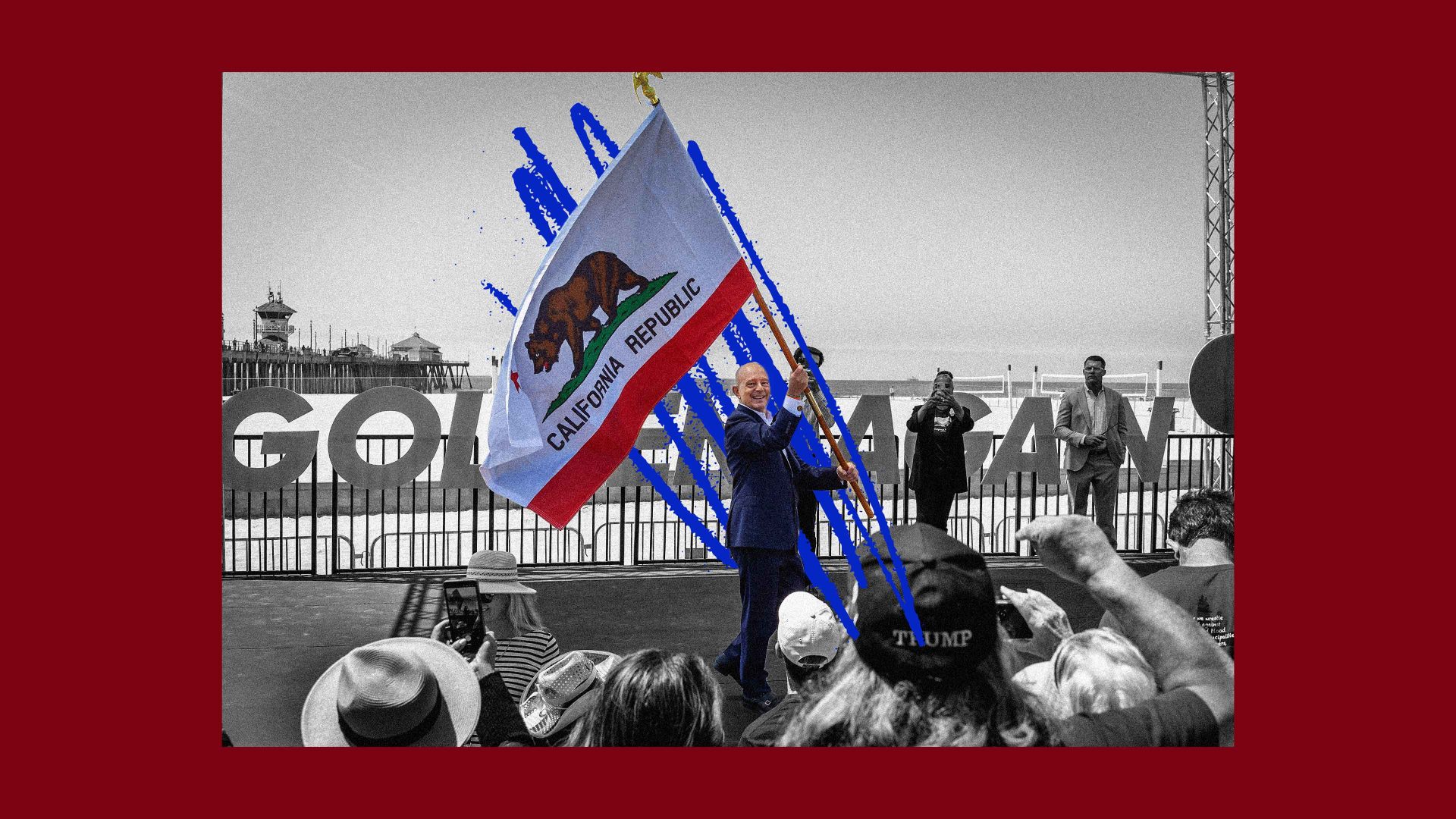
On June 2, Steve Hilton, the British-born former senior adviser to David Cameron, has a decent chance of moving significantly closer to becoming the next governor of California. The Republican contender has only been a US citizen since 2021. In this case, the over-used words “only in America” really do apply.
As ambitious as the 56-year-old maverick of the right has always been, I doubt that this was on the back of his career plan envelope when he joined Conservative Central Office in the 1990s. However did he get here?
In the Golden State’s peculiar “jungle” primary system, the first round of voting narrows the field down to two – of whatever party – from which the electorate will pick Gavin Newsom’s successor on November 3. At the time of writing, most opinion polls have Hilton ahead of, or tying with, Xavier Becerra, who was health and human services secretary under Joe Biden. Occasionally, the billionaire Democrat Tom Steyer still nudges into the top two.
In April, the Democratic field was thrown into disarray when the party’s front-runner, Eric Swalwell, dropped out of the race and resigned his seat in Congress amid accusations of sexual misconduct. With all the usual caveats, it seems probable, if not certain, that Hilton will now make the run-off.
California is a very liberal state and no Republican has won a gubernatorial race since Arnold Schwarzenegger in 2006. The logic of the case is that, in November, Hilton would lose handily to more or less any Democratic opponent. But the fact that he has got so far, against such odds, has rattled his opponents – and inspired Republicans, fretful about the implosion of Donald Trump’s presidency, to take a closer look at what he is offering.
Full disclosure: I have known and liked Hilton for more than 30 years. On Brexit, Covid restrictions, the fairness of the 2020 presidential election and Trump’s fitness for office, we have disagreed profoundly. I think his lifelong disdain for government officials – a fixation he shares with Dominic Cummings – is glib (policies, however well-designed, do not deliver themselves).
He has a volcanic temper, which led to his arrest in 2008 at Birmingham New Street station as he was rushing to make a train, could not find his ticket and went ballistic. It was unfortunate that, at the Tory Party conference only hours before, Cameron had condemned the “culture of incivility” in a speech Hilton had helped to draft. After profuse apologies, he escaped with an £80 penalty notice.
Yet I am not surprised that, at this particular political moment, he is prospering as a candidate. Hilton has always been almost preternaturally optimistic, an energiser in any room he enters. One pointed example: on the final day of the 1996 Conservative conference in Bournemouth, I remember standing outside the venue, and watching a dismal cluster of Tory-branded balloons being released over a glowering grey sea.
A group of young party officials watched this depressing spectacle with the gaunt faces of first world war infantry officers awaiting the whistle to go over the top. They all knew how good Tony Blair was and what a terrible reckoning lay ahead.
But Hilton – at that stage the point man between the party and the ad company M&C Saatchi – was having none of it. “Hey!” he piped up. “Just imagine how great it’s going to be next year when we’ve won!”
As he has said repeatedly – and honestly – on the Californian campaign trail, he is no tribalist. When I first got to know him, there were as many Labour figures as Tories in his friendship group. Shortly before the 2010 election, he met Blair privately to discuss the challenges of government. His running mate in this contest is Gloria Romero, a former Democratic state senate majority leader.
What baffles many of his former colleagues from the Tory-Lib Dem coalition era is how the strategist who drove the modernisation of the Conservative Party between 2005 and 2010 has ended up as a Republican running for office in the age of MAGA, fulsomely endorsed by Trump (“a truly fine man, one who has watched as this once great State has gone to Hell.”) When I asked a former member of Cameron’s cabinet last week what he made of it all, the response was simply: “I can’t even.”
Hilton’s evolution has indeed been dizzying. Disgusted by William Hague’s “skinhead conservatism” after the party’s 1997 landslide defeat, he distanced himself from the Tory movement and allegedly voted Green in 2001.
Suggested Reading

Xi gave Trump nothing
Once Cameron was elected leader, he returned to the fold and set about detoxifying the party brand, prioritising diversity in the ranks of its parliamentary candidates, putting the NHS at the centre of Tory messaging, urging his boss to champion the rights of gay people and embracing environmentalism (“Vote Blue, Go Green”). This was the high season of husky photo-ops, “hug a hoodie” and recycled trainers, and Hilton was at the heart of it all.
In No 10, he wore T-shirts and padded around shoeless. This inspired satirical representation in The Thick of It’s Stewart Pearson (Vincent Franklin) – “Let’s imagineer a narrative” – and the character of “Jed” in the Spectator’s “Tamzin Lightwater” diary (supposedly the journal of a Tory official but anonymously written by the magazine’s acclaimed columnist Melissa Kite).
In the end, Hilton only lasted two years in No 10, falling out with Andy Coulson, Cameron’s comms chief, and losing a turf war to the late Jeremy Heywood, who was Downing Street permanent secretary, on his way to becoming cabinet secretary. When he announced in March 2012 that he was taking a “sabbatical” and joining his wife, Rachel Whetstone, in California, where she had a senior global role at Google, it was assumed, correctly, that he would not be coming back.
In fact, Hilton had held private talks with Boris Johnson about becoming his deputy mayor. In the end, however, both men realised that this would be a provocation too far for Cameron.
Instead, he taught at Stanford, engaged with Silicon Valley, and in 2015 published More Human, which, in the true spirit of the West Coast techno-optimism of the time, sought to marry free-market entrepreneurialism to New Age compassion: “what makes us human: people, relationships, spontaneity, emotions”.
I recall Hilton visiting London to publicise the book: tanned, content with life and favouring saffron T-shirts that evoked the spirit of Hare Krishna. But it was in that same year that a figure who had saffron-coloured skin but nothing else in common with Krishna consciousness descended the golden escalator at Trump Tower – and changed everything.
By his own admission, Hilton had never given much thought before to the idea of “populism” – but, once he did, he was all in. In 2017, he launched a Sunday evening show on Fox News called The Next Revolution, which ran until 2023, when he left to focus on his policy research institute, Golden Together (in effect, a ginger group for his gubernatorial run).
And now he is seeking to take command of a state that, were it a nation, would be the fourth richest on earth, and has 39 million inhabitants. He wants to roll back the ideology of “climatism” and “decarceration” (reducing the prison population). Whatever happened to “going green” and “hugging hoodies”?
It would be idle to deny that there have been significant shifts in Hilton’s worldview. But – to a greater extent than has been acknowledged – there is a through-line in his ideological trajectory that explains how his thinking has changed and, more significantly, suggests a possible post-Trump path for Republicans that remains populist but untethered from the savagery of the culture wars.
‘Trump has badly neglected
the working-class coalition
that helped him to win in 2024. Hilton still thinks it is the Republican future’
As the son of Hungarian refugees, Hilton has an instinctive suspicion of state authority, doctrinal capture of institutions and apparatchiks of all kinds. He refers to the crushing by the Soviets of the Hungarian uprising in 1956 more than to any other historical event; most recently, in his passionate sympathy for Iranian protesters slaughtered by the mullahs.
In principle, libertarianism is an impossible sell in California. But that was before the state became as well-known for those fleeing its crime, unaffordable housing, and urban squalor – especially tech workers, professionals and retirees with equity – as for those queuing up to share in the Pacific dream.
Why, given its GDP of $4.3tn, does California have an unemployment rate of 5.3%, behind only Delaware and the District of Columbia? Why, given that it has the highest state tax rate in America, are its public services, house-building record and infrastructure so poor? Launched in 2008, the so-called “bullet train” project intended to link San Francisco to Los Angeles is now expected to cost $126bn and has not yet begun to lay track: a potent symbol of inertia, union control and over-regulation that has now reached crisis point in the housing sector.
With all this in mind, Hilton has planted his standard in the terrain of “abundance” – precisely as the liberal commentators Ezra Klein and Derek Thompson did on behalf of Democrats in their best-selling book of the same name published last year.
Not surprisingly, the Republican contender goes much further in his promises of deregulation, tax cuts and the slashing of bureaucracy. In a risky echo of Elon Musk’s catastrophic rampage through the federal administration, he has set up a CAL-DOGE to identify “corruption, fraud and waste” pre-emptively so that he can get to work on day one in the governor’s office in Sacramento with a screed of executive orders. Remind you of anyone?
Yet the more striking feature of Hilton’s campaign is how – well – un-Trumpian it has been; or, perhaps more accurately, post-Trumpian. He stays as clear as humanly possible from the culture war confrontations that the president so loves. On abortion, he respects California’s settled position on reproductive rights, entrenched by Proposition 1 in 2022 (though he has come unstuck over the potential extradition to Louisiana of mail-order abortion providers).
On the environment, he challenges what he considers the absurdity of importing oil to California – causing, he says, much greater emissions than in-state extraction of fossil fuels. He supports hydroelectric power; the sequestration of CO₂ from natural gas power plants in underground caverns; the proliferation of rooftop solar panels; and a renewed drive for nuclear energy. This is a million miles distant from Trump berating the United Nations about climate change as “a hoax made up by people with evil intentions”.
On immigration, he has criticised Democratic politicians for thwarting ICE agents, but said on The New Yorker Radio Hour podcast posted on May 4 that the confrontations in Los Angeles last summer were “a horrible spectacle to see”. On ethnicity, one of his slogans is El Futuro es Latino (“the future is Latino”): words that would never pass the lips of Trump or anyone in his inner circle.
His campaign book Califailure (2025) is densely wonkish and policy-rich in a way that would send the president off to sleep in a New York minute. Trump is openly bored by “affordability”. Hilton mentions it at every opportunity – with particular reference to the high price of gas in his state.
The president has badly neglected the multiracial working-class coalition that helped him win in 2024. Not so Hilton, who still believes it is the future of the GOP.
You don’t have to buy into this package to recognise that it is very different indeed to the scolding nativism of JD Vance, the antisemitic conspiracism of Tucker Carlson or – worst of all – the Hitler-worshipping “Groyperism” of Nick Fuentes. As for Marco Rubio, Vance’s main rival for the 2028 nomination: who can really say what he believes?

Whatever happens on June 2, Hilton’s campaign is a Hail Mary pass. All precedent suggests that Newsom will hand over to another Democrat when he vacates the governorship in January and begins his own bid for the presidency in earnest.
But the bedlam that has beset his party in the face of this upstart challenge from the right is a warning that Trump’s shambolic second presidency and the likely humiliation of the Republicans in the mid-terms are no guarantee of victory for the Democrats in 2028. They have to get their own house in order – and very quickly.
Péter Magyar’s electoral destruction of Viktor Orbán has shown that the populist right has no providential right to power. In the UK, the prospective return of Andy Burnham to Westminster is energising hitherto-despondent progressives.
In the US, Democratic governors such as Josh Shapiro and JB Pritzker are producing fresh ideas. Rahm Emanuel, Barack Obama’s former chief of staff, is bracingly candid. Zohran Mamdani has demonstrated the power – the necessity – of charisma and authenticity in contemporary public life.
Yet it is a mistake to assume that the post-Trump Republicans will all be theocrats backed by militiamen (though some of them may well be). It is not only progressives who are thinking deeply about what comes next. Hilton may not win himself. But he could be on to a winning formula.