Listen to this 24-year-old man in Suffolk who had been in care most of his life:
“When you spend your entire life running and you feel like you’re this gazelle, and you’re being hunted by lions your entire life, and things are all of a sudden safe and secure, it is difficult to fall into a habit of thinking positively. I noticed that I still try to self-sabotage my life in certain ways. I’ve always tried to be everything my father isn’t. So I tried to be good, I tried to be kind.”
Listen to this 23-year-old woman from London:
“The hard thing is that you are told this simple story when you are younger: go to college, go to uni and get a job. But that is not the case at all. I feel like I did what I was told to do. But it has been almost a year since I graduated with a first-class degree and I am still struggling to secure a role.
“It has been hell, honestly. The job market is so competitive and difficult. Most jobs require experience. I cannot even get into entry-level roles or internships. I am a wheelchair user, and it can be very difficult to find jobs that meet my accessibility needs.”
Listen to this 21-year-old woman who cares for her sister:
“When I was younger, I was told: ‘don’t be surprised if you wake up one day and your sister’s dead.’ I was told that from such a young age. So then I got into the habit of waking up at night to then go into my sister’s room to make sure she’s still breathing, to make sure she’s still there. I care for my older sister and help my parents to support her. I’ve really been the older sister since I could learn to walk.
“The last six years have been a lot worse. I struggled a lot with mental health and still am. But she was, she is, a very high flight risk. She used to run away from high school to try and end her life. She would OD (overdose). She got sectioned.”
Listen to this 19-year-old man from Glasgow:
“There is a table of, like, 32 kids. And I’m there, I’m not a confident writer to begin with. I can write. I can make it legible – if I take my time. So I’m standing there trying to take the orders from these kids who are screaming at me. They’re impatient, because they had to wait a while to get seated. The menu changes every single day, so I don’t know what any of the things are.
“I’m autistic. I eat like a seven-year-old – it’s just pizza and chicken. I’ve only just started eating proper food. I’m trying to push myself out of it. So how am I supposed to write down these things I’ve never heard of? What the fuck is bruschetta? I got shouted at by the manager. I was too embarrassed to go back. I know pushing your limits is a good thing, but I knew my physical limits and mental limits at the time, and that wasn’t it.”
What do these young people have in common? They are all not in education, employment or training, so they are NEETs. And the UK has nearly one million of them.
Suggested Reading

The death of the after-school job
That is 13% of the 16-24 population. In the Netherlands they make up just 4% of that group. So this is a choice. It is our choice as a country.
And as these four stories show, young NEETs are not one block, but have different backgrounds and different challenges to overcome. Some are close to getting a job and just need a small final step, others are a long way away and need tailored long-term support.
We spoke to 400 of them across the UK over the last few months as part of Alan Milburn’s independent review into young people and work, commissioned by the government. The interim report is published this week.
Shuab is a member of the Milburn Review’s expert panel. Peter is a former adviser to Keir Starmer and Tony Blair, and a former headteacher.
We began the journey with a media narrative about this generation ringing in our ears: they are “snowflakes”, an entitled generation who don’t know what a hard day’s work looks like.
What we found, as you can see from the four stories, was something quite different. We can honestly say that not one of the young people we met – whether those who had been in care, carers, those with neurodiversity, those with mental health issues, those living in poverty – struck us as being a snowflake. Instead, this is a story of almost unimaginable resilience, often against very difficult odds.
More than that, we saw bags of untapped potential. The young man in Newcastle cooking fresh pasta for his family every night. The 12-year-old girl in Clacton learning Russian at home on her own. The young man in Wrexham who had rescued two horses and had built them a functioning shed to live in. So much talent, so little chance to build on it.
‘This generation has faced a unique set of challenges that mean it is not over-the-top to say that for them, the social contract has been broken: Covid, loneliness, social media, economic shocks, off shoring of entry-level jobs and the destruction of social spaces where young people can find purpose’
Too many snakes, not enough ladders
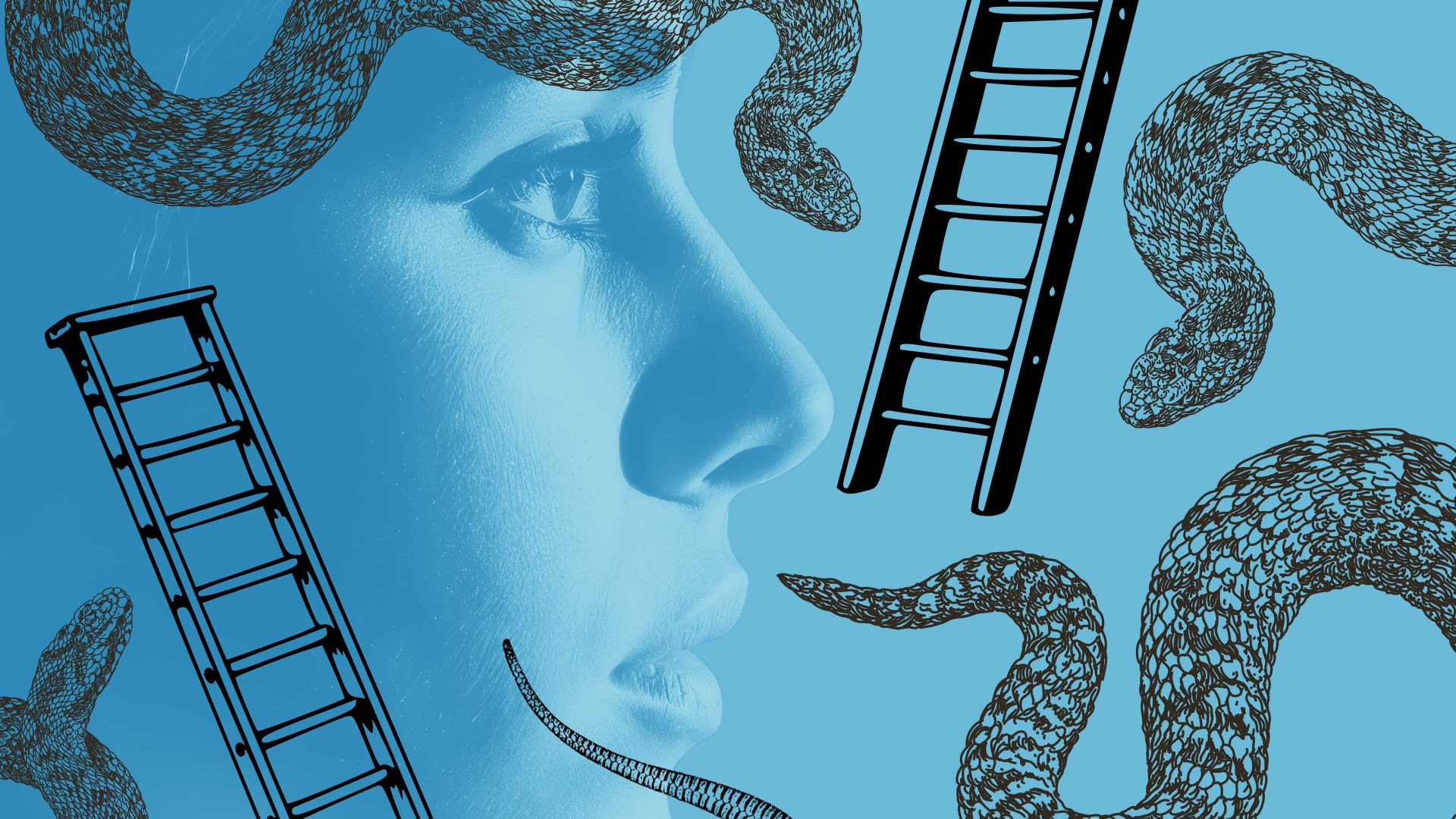
The truth is that this generation faces too many snakes and not enough ladders. There are many barriers in these young people’s lives, and like snakes, they strike suddenly, raise their head, move silently, squeeze their prey, flick their tongues.
Having spoken to so many young people, we felt there was a compelling case for saying that this generation has faced a unique set of challenges – snakes if you like – that mean it is not over-the-top to say that the social contract has been broken: Covid, loneliness, social media, economic shocks, offshoring of entry-level jobs and the destruction of social spaces where young people can find purpose.
For too many young people, school is not a ladder. We asked young NEETs to describe school in one word. A deluge of unhappiness came back.
“Horrible,” “traumatic,” “awful,” “terrible,” “dreadful,” “depressing,” “shite.”
“Torture,” “hell,” “bullying,” “mistreated,” “alienated,” “abusive.”
“Stressful,” “overwhelming,” “draining,” “exhausting,” “hard,” “Pressurising,” “tiring.”
“Anxiety-fuelled environment,” “unhelpful,” “unsupportive,” “unaccommodating,” “judgmental.”
“Dull,” “repetitive,” “slow,” “waste of time.”
And almost universally they said that it “did not prepare me for what was to come”. The source of this anguish was a litany of often traumatic school experiences. Being labelled a “retard” for being in the bottom set. Being put in isolation for days on end for minor school uniform infringements. Being made to feel stupid because they were not on track for university, with no other options promoted.
Suggested Reading

The dream is no longer to be the boss – it’s to be the intern
With few exceptions, the young people we spoke to had not had a sense of purpose or a recognisable pathway while at school. And very few had any work experience. If we were being harsh, we would say that school has become a pipeline to unemployment.
So the leap to what comes next is often brutal. As one young person put it: “School just ended, with an assembly, and that was it. It’s just: OK, now I’m an adult, get a job.”
Many tried a college course and dropped out. Many got to the third year of a degree and dropped out. Many tried multiple courses.
The rejection economy
After that, they start looking for jobs. Across the country, young people told us the same thing, again and again. “We’ve applied for hundreds of jobs, and we just get ghosted.” No reply. No feedback. The job market is another snake. The silent, deadly hiss of rejection.
Young people feel they are trapped. As one put it: “They say experience is key – but how am I supposed to get experience without a job?”
And those setbacks, particularly for those who have had many in their lives already, can lead to a loss of confidence and a retreat from the outside world. This is the rejection economy.
The bedroom generation
When we asked young people in their early 20s to walk us through what they had done since being 16, the answer was startling in many cases.
One 22-year-old who we spoke to in Bristol is a good example. “Left school, went to college for three months, dropped out, got a job for a few months.”
“What happened next? We asked. “Nothing,” came the answer.
“Nothing?” “I did nothing.” For five years.
This is the bedroom generation. A generation who got used to spending hours on their own during Covid, and now find that their only safe space – their cocoon – is the bedroom. A place of PlayStation and Netflix, vaping and YouTube, Pot Noodles and Deliveroo, porn and influencers, chatting online with mates and selling clothes on Vinted.
So many of the young people we have spoken to had spent months and years doing this. It is what happens when every alternative has been closed off – the death of Saturday jobs, the silence after job applications, the services that don’t reply. The bedroom wins because nothing outside was asking them to show up.
The dopamine treadmill – taught helplessness
Most of what happens in that bedroom is online. It is a dopamine treadmill. If you are looking for some of the biggest snakes, it’s the social media companies who know they are stealing the childhood of millions. They are preying on young people, preying on vulnerability, creating and then preying on hopelessness.
We have looked at the algorithms, looked at what young people are fed, talked to the young people themselves and this is the unmistakable conclusion. These companies are deliberately, strategically and for commercial benefit taking away agency from young people, and keeping them stuck in a rut.
Building ladders
The young people we spoke to were vocal about what they wanted: they wanted to get out of the rut.
They want school to provide more work experience, more applied learning, more signposted options, more chances to develop interests and passions.
They want a ladder at moments of transition so that they can navigate college courses, get a first job, move out of care into living independently. They need an adult they can trust, to support them, just like the many people we met on our travels, working in extraordinary charities.
Suggested Reading

How to put the wind back in Britain’s sails
They want to be more sociable and less lonely. They crave more spaces, youth centres, and opportunities. Many commented on their town being dead for young people.
Perhaps most of all, they wanted entry-level jobs to be real entry-level jobs, where they don’t have to have years of experience and where in many cases they can be supported into work, where employers see the potential in them.
We thought it was useful to provide a traffic-light system to show how far away a young person was from employment so that the ladders of opportunity could be tailored to their needs.
Red indicates young people with complex challenges to deal with. They are often carrying severe mental ill-health, trauma, unstable housing, or are recent care-leavers. Many are exhausted before any conversation about employment begins. They want to work, but first need some semblance of security in their lives.
Amber indicates young people who are close to work, but stuck behind some specific and often practical barriers. They may have missed English or maths GCSE by a single grade. They may need a qualification, a reference, a placement, an interview or someone to explain which route actually leads where. They often have ambition, but may need to build momentum or “soft skills”.
Green describes young people who, by any reasonable measure, are ready to work. Many have qualifications, experience and a clear idea of what they want to do. But they are still not landing a job. For this group, the barrier is not readiness. It is access and practical advice. Or sometimes something seemingly simple. In Suffolk, one young person described being trapped between needing a driving licence in order to be able to work and needing work to afford the driving lessons and licence: “I’m stuck in a vicious loop.”
At the end of our journey, we were struck by two things. How resilient and surprisingly optimistic these young people were, despite all the pressures. And second, how much needs to change in a system that just isn’t working – school, transitions, mental health, work – so that there are more ladders and fewer snakes.
The young people we listened to changed us. We were both moved and saddened on many occasions by what we heard. It has made us more convinced than when we started our journey that this is the cause of our age.
Young people have told us with an irresistible force that change is needed. Now is the time – before it’s too late – to give young people their future back.
Peter Hyman is a former adviser to Keir Starmer and Tony Blair, and a former headteacher. He is author of the Substack Changing the Story, where you can download the report.
Shuab Gamote is a member of the expert panel for the Milburn Review into young people and work. He is a former political leadership scholar at the Blavatnik School of Government