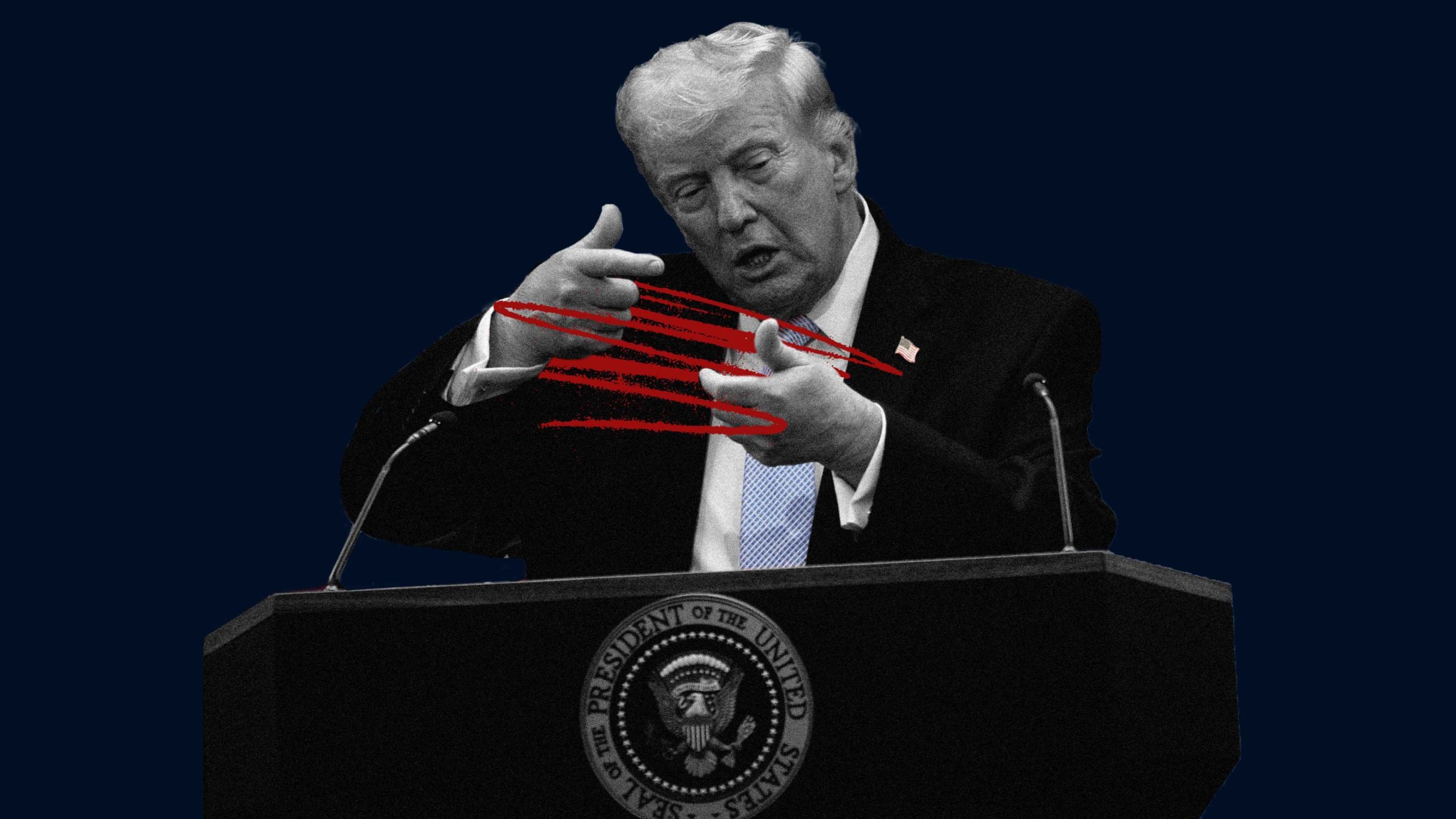
Reports that the Trump administration is preparing for a fresh military campaign in Iran after the midterm elections raise an immediate, troubling question: to what end? Whether escalation brings renewed airstrikes or boots on the ground, the fundamentals on the ground have not shifted in Washington’s favour.
The biggest mystery of all is why? Why would Trump want to do this now, when the fundamentals on the ground have not shifted in his favour? Why tie this to domestic US politics when the war – and the impact it has had – is so unpopular?
To say the situation has not improved for Trump is an understatement.
In recent weeks, we have seen the impact Iran’s proxies in Yemen, the Houthis, have had on regional security, striking targets including airports and military bases inside Saudi Arabia. The situation has been deemed so bad that America withdrew diplomats and troops.
Major sporting and public events scheduled to take place in the Kingdom have been postponed. Given the enormous cash involved – Riyadh has been known to drop $55 million on hosting pro wrestling events – these decisions will not have been taken lightly.
This only adds to the quagmire that is Trump’s war on Iran and raises a stark question, as Aaron David Miller, a former US Middle East negotiator explains: “What would a more intensive comprehensive military campaign achieve that couldn’t be achieved between Feb 28 and April 7?”
“There is no historical precedent for a short campaign transforming a country like Iran politically,” Miller continues. “He has a recency bias of thinking he can have a short, sharp campaign like in Venezuela. But Iran is not Venezuela.”
Suggested Reading

The riots in France are being stoked by Russia and Iran
The Iranians still hold significant leverage and would be able to inflict pain on America and the West. The IRGC has proven itself willing to absorb a huge amount of pain. While America outguns Iran in every metric militarily, that isn’t always a helpful datapoint.
“There is an enormous difference between a country seeking to fundamentally alter the political and cultural leadership of another through force and a country fighting for its very existence,” says William Alberque, NATO’s former director of arms control. “It’s not as simple as a toe-to-toe fight. Things like the theatre of war, what strategic advantages a country has, how resilient its population might be, all these things affect the balance one way or another.”
The theatre is a place where Iran already holds a significant strategic advantage. Between its own military might and the support of the Houthis, Iran can hit targets in Saudi Arabia, Israel and even Europe. In all instances, Tehran has a higher tolerance for risk in what it sees as a fight for survival.
The other area where Iran has proven its strategic power is its ability to choke global shipping routes. We have all become familiar with the negative consequences of the Strait of Hormuz being closed or traffic being restricted.
While Iran’s grip here has loosened somewhat, it wouldn’t take much for this to reverse, should the war escalate. “The US and Iran are not the only stakeholders here,” says Saleem Khan at Pole Star Global, a maritime intelligence company.
“The shipping industry is very nervous about risk these days. If insurance spikes or their business requires travelling near or through active war zones, they will almost certainly take longer routes, adding weeks of travel, costing more in fuel, delays in shipments and scarcity of goods. All of this massively impacts the cost-of-living for people in America and the West.”
The “chokepoint theatre of war,” as one analyst described it, has also expanded since America began dropping bombs in February. It is no longer just the Strait of Hormuz that is being weaponised against the US. The Bab al-Mandab Strait, the port city of Mokha in Yemen and the wider Red Sea have also come under pressure from the Houthis, disrupting international trade to America’s detriment.
Back to the core question of what the US can feasibly do, Trump has few options to achieve his previously stated objectives.
Suggested Reading


Why is Trump fiddling US casualty numbers in the Iran War?
The most severe would be a full-scale invasion of Iran. It would cost America money and lives, something the country would struggle to stomach. The thought is unlikely to motivate many to vote Republican in the midterms, or beyond and would doubtless drive Trump’s dire approval ratings even lower.
It would almost certainly cost American lives, too, which seems a folly in an already-unpopular war. It’s hard to see any version of this that makes the majority of Americans change their minds on what has already been a disastrous military campaign.
He could also escalate once more in order to force Iran to negotiate. It hasn’t worked so far, so who knows what it would take, given the dim view of America in the eyes of Tehran. Any negotiated settlement would likely require American concessions, which, ultimately, would mean a strategic loss for Trump.
“Trump’s problem is there is no Hollywood ending for this war,” says Miller. “So his only option, other than admitting his errors, is to keep striking Iran, probably with little effect.”
It is also worth noting that an expansion of the conflict would have geopolitical consequences. What would Trump ask of his allies this time? How would he respond if they fail to meet his demands? What might he ask of his regional allies, Israel and Saudi Arabia – and how would they work together?
What role would he ask Vladimir Putin to play? Perhaps an intermediary, welcoming him back into the international community? Could the IRGC activate wider terrorist networks to carry out attacks elsewhere – including in the US?
These are all real possibilities. Which brings us back to the initial question: why would Trump want to do this now, and for whom would he be doing it? Answers on a ballot paper.
 Most popular

Nigel Farage’s attack on the RNLI and co is a new low even for this bottom-feeder

I was at Eton with Charles Spencer – this is how it explains his battle with the royals

‘The deep state stole my mini-budget’: An exclusive extract from Liz Truss’s new book

18 things that will absolutely, definitely happen if Trump gets whopped in the midterms