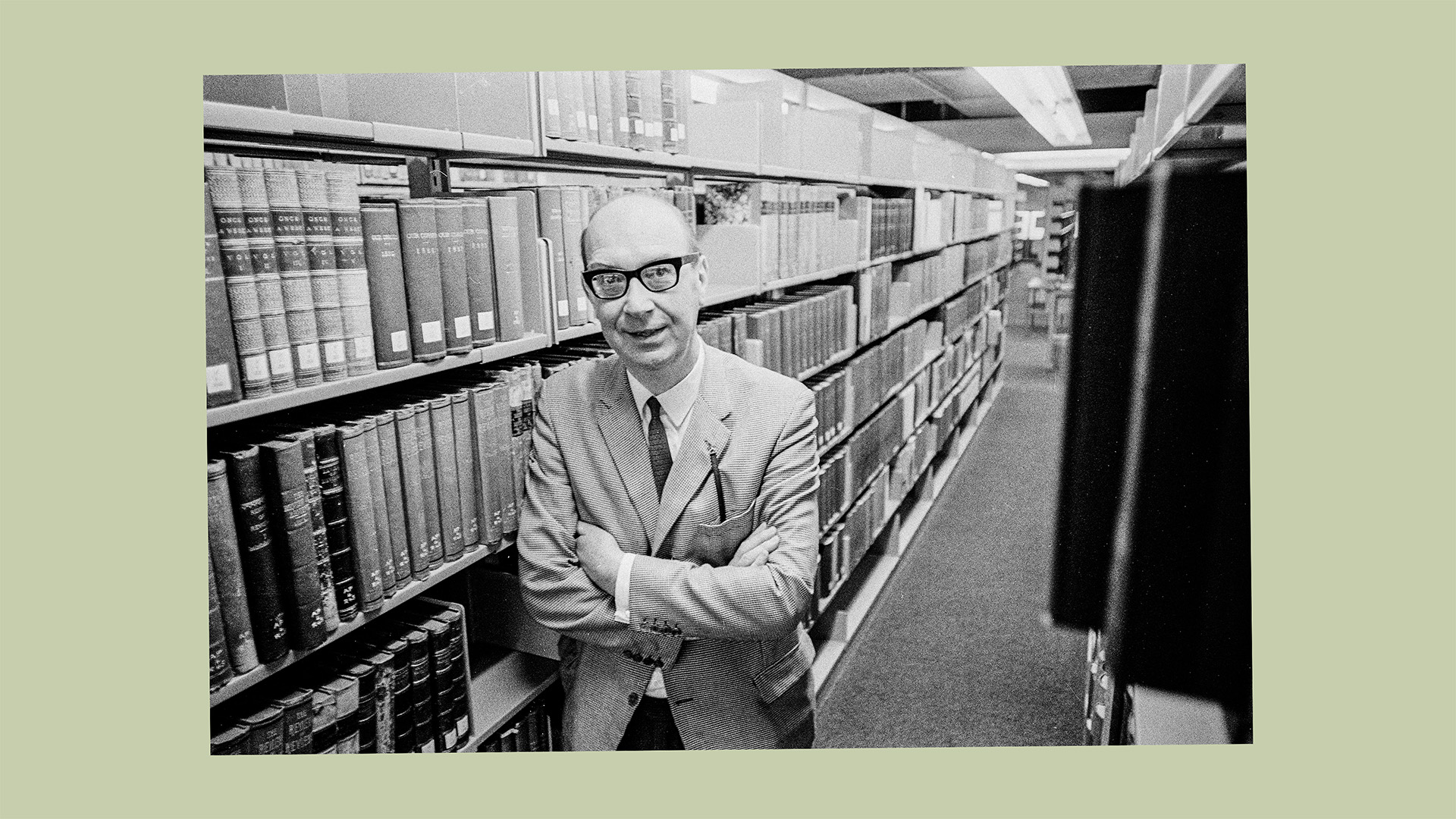
Philip Larkin once said that deprivation was for him “what daffodils were for Wordsworth”.
I first encountered Larkin in a GCSE English anthology, where his 1959 poem Afternoons sat among the inevitables: Keats and Byron etc. Their poems arrived draped in romance and flowery grandeur, but Larkin’s was wry, unromantic; about prams, washing lines and municipal parks. It was unlike anything I had read.
Not a word was wasted. He became my favourite poet almost immediately.
Larkin, it turns out, is also the favourite poet of our new prime minister, Andy Burnham. Burnham read English at Cambridge – reportedly enjoying Shakespeare, Dickens and, above all, Larkin – making him the first PM in modern times to have studied English rather than law, economics or PPE.
Now, we cannot start claiming that this will set Burnham out as a radically different or more cultured prime minister than his predecessors – but we also cannot ignore that the art we identify with tends to reveal something about how we see the world. If Burnham identifies with Larkin, it is worth asking why.
Suggested Reading

Why philosophers can’t explain the power of music
“There’s a quote by another poet called Adrian Mitchell, who said that most people ignore poetry because most poetry ignores most people. And if you think about it, Burnham has essentially applied that thesis to British politics,” James Underwood, a former academic who has written a book on Larkin’s early work, told me.
“Larkin is, for want of a better word, the laureate of ordinary people. He hated the idea of writing poems for a small metropolitan audience, he said that he wanted people in pubs to talk about his poems.”
It is an observation that explains Burnham’s politics almost better than any manifesto can: while Larkin insisted that poetry should concern itself with lives that literature had too often overlooked, Burnham’s central message in his successful bid for No 10 is that Westminster has ignored precisely those places and people for too long.
Young mothers assemble
At swing and sandpit
Setting free their children.
Behind them, at intervals,
Stand husbands in skilled trades,
An estateful of washing…
This is an excerpt from Afternoons (1959), and it is difficult to read without thinking of Burnham’s much-discussed “Makerfield Test”: politics judged not by Whitehall insiders but by whether it improves the lives of families like these.
What else draws comparison between the two, for Underwood?: “Larkin really is the poet of the England outside of London. He was born in Coventry, he lived in various towns and cities away from the metropolis, he spent half his life living in Hull. In the Whitsun Weddings, which is one of Larkin’s greatest poems, he shows us glimpses from a train going from Hull to London.
Suggested Reading


Andy Burnham’s ruthless reckoning for the Starmerites
“He talks about canals with floatings of industrial froth, and nondescript new towns, dismantled cars. I actually couldn’t help but think of that poem as I watched the live footage of Burnham’s train on its journey from Manchester to London on the day that he was sworn in as an MP.”
There is another Larkin poem that feels especially revealing: Going, Going. It is, in effect, the unexpurgated version of the prologue Larkin wrote for the government’s 1972 report How Do You Want To Live?, and is a melancholy inventory of a country that seems to be fraying at the edges.
Their kids are screaming for more –
More houses, more parking allowed,
More caravan sites, more pay
More than 50 years later, it reads like it could be ripped straight from a Burnham speech.
It is worth acknowledging that Larkin’s reputation is now highly contested: the racist and sexist views revealed most starkly in his letters after his death have rendered him a highly problematic figure in recent years. Whether one can separate the art from the artist, though, remains a philosophical question for another day.
Nevertheless, what has always drawn me to Larkin’s poetry is that there is no sentimentality in his work, and no condescension either. He writes about shopping centres, housing estates, and train stations and with the same seriousness that earlier poets reserved for mountains or ancient Greek myths.
His gift was not simply observation but an ability to show that an ordinary Tuesday in Hull could be every bit as revealing, and as important, as a battlefield or a love affair. In that sense, Larkin is one of the few writers who makes me feel genuinely patriotic.
Underwood argues that Larkin had little patience for literary theory, ideology, or writing designed to impress a narrow intellectual class. There is an echo of that instinct in Burnham’s politics too., it begins with concrete places, recognisable lives, and practical grievances.
Suggested Reading


Do you care that Burnham is a Catholic? You should
I asked Underwood which Larkin poem every politician should read. His answer was not one I expected. The Mower is only a few lines long, describing Larkin’s horror after accidentally killing a hedgehog while mowing his lawn. It ends:
we should be careful
Of each other, we should be kind
While there is still time.
It is difficult to imagine a more radical sentiment.
Will a fondness for Philip Larkin make Andy Burnham a better prime minister? Almost certainly not. But to love Larkin is to believe that ordinary lives are worthy of serious consideration, and that the places beyond London are not merely bits of background scenery.
Burnham often (okay, constantly) says he wants to take power out of Westminster and put it into every postcode. Larkin attempted something remarkably similar in literature. He took poetry out of the drawing rooms and handed it back to the housing estates.
Perhaps the true measure of success for his government will be if Burnham can do for politics what Larkin did for poetry.