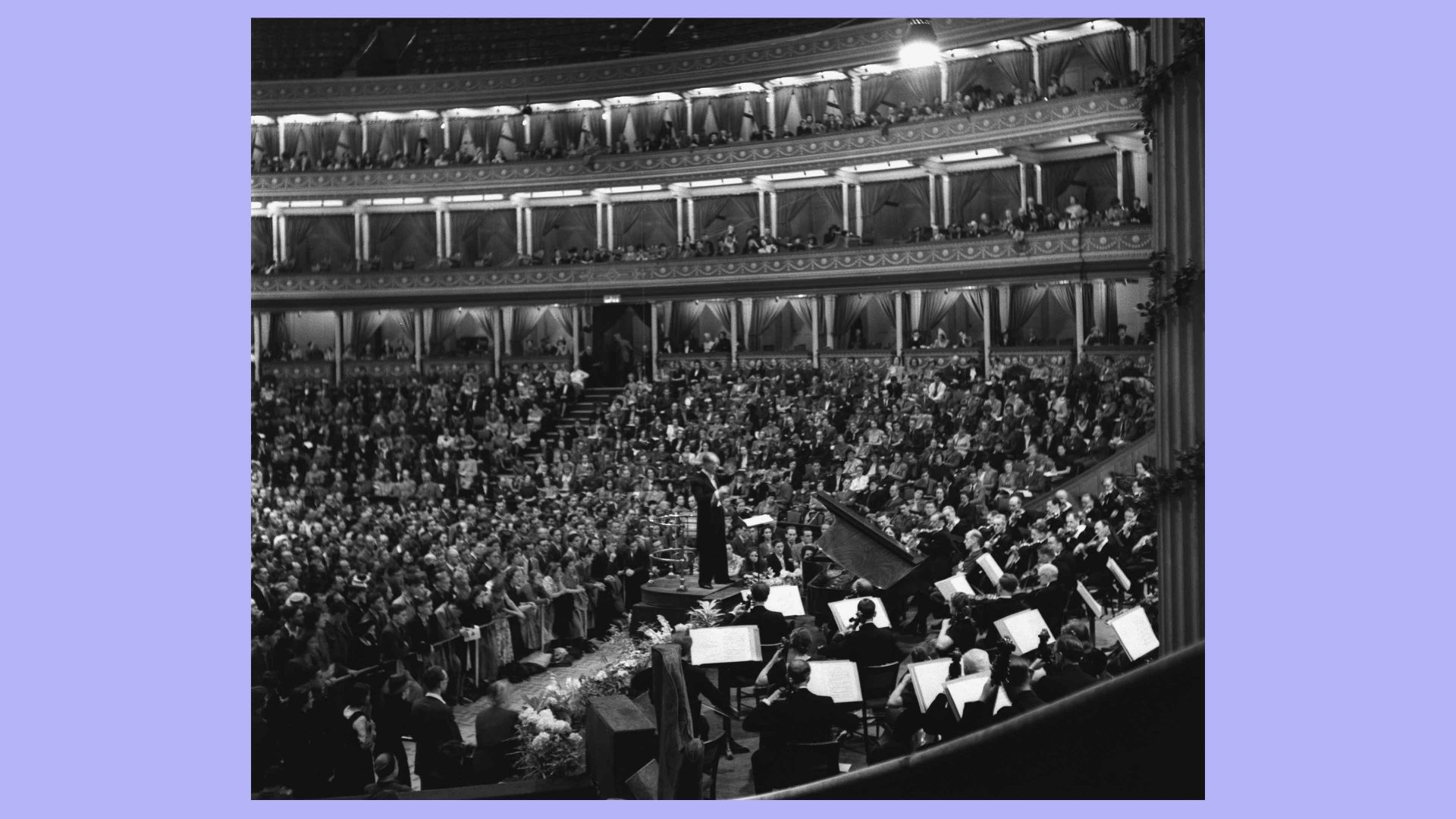
The Proms started last Friday. This eight-week festival of music has an interesting history. “Promenade concerts” were outdoor performances held in London’s pleasure gardens from the mid-18th century. They were known as “promenades” because the listeners were free to stroll around.
In their modern form, initiated by Sir Henry Wood in 1895, audiences weren’t free to roam. These Proms were intended to widen musical appreciation.
Wood explained the project in Reithian terms: these nightly concerts were meant to “train the public by easy stages” until there was a wide audience for music. Some 131 years later, that mission remains.
But why is music, and particularly classical music, worth promoting and celebrating? Why does it play such a central role in so many people’s lives?
How could Olivier Messiaen and a group of chamber musicians have found the motivation to perform his Quartet for the End of Time in a Nazi prison camp? Why were classical concerts organised by Myra Hess in London’s National Gallery during the second world war so popular even as the Blitz raged around them?
Suggested Reading
Artificial intelligence and artificial philosophy
It’s possible to live without music; my mother did: I don’t know what kind of music she liked, and I don’t remember her choosing to listen to music or even owning an LP.
In contrast, my grandfather, a self-taught pianist and later a record producer, made his living from it. In 1965, he co-produced Paul Simon’s record, The Paul Simon Songbook. In his early 80s he still practised piano four hours a day. He listened, too. His life was far richer for music.
When I interviewed the persecuted comedian Zarganar, whom the Myanmar authorities imprisoned, he told me he’d survived two years of solitary confinement and torture by making a primitive instrument from a bowl and some rubber bands and using it to compose songs.
Many of the greatest philosophers have been closely involved with music. Jean-Jacques Rousseau was a music tutor, and composed operas; Jeremy Bentham was a talented violinist, performing Handel sonatas at dinner parties when he was just seven; Friedrich Nietzsche was a composer and a close friend of Richard Wagner. Arthur Schopenhauer played the flute; Ludwig Wittgenstein could whistle entire Schubert symphonies from memory.
More recently, Roger Scruton composed operas, and Martha Nussbaum devotes much of her time to opera singing.
Suggested Reading

There is a moral argument for paying reparations over slavery
Philosophers have occasionally attempted to answer the questions, “What is music?”, “Why does music matter?” and “How can apparently meaningless sounds achieve such profundity?” Their answers, however, are mostly disappointing.
Schopenhauer thought it was the highest art form because it permitted a special kind of connection with ultimate reality, with what he called The Will, the life force that animates everything. But what if you don’t accept the metaphysical beliefs on which his theory rests?
Other philosophers tell us that music is a special kind of organised sound, or that it’s the expression of emotion, or the representation of emotions, or a complex pattern of overlapping tensions and resolutions designed to evoke feelings using forms that have a cultural history, and so on. But no theory captures music and the fact that apparently meaningless sounds can be deep or a source of great joy.
Nietzsche thought life without it would have been a mistake. That’s hyperbole and goes too far. But music remains a wonderful mystery; like so much we value.