It’s an old truism in sport and in politics that the best defence is a good attack. That’s certainly something the UK’s leading Brexiteers seem to have taken to heart over the last decade – not least in their relentless fury at anyone who disagrees with their own personal vision for Brexit, or even anyone who just points out that none of them seem to agree on what, exactly, that looks like.
But even by their own standards, the Brexit brigade seems to have come out swinging against Andy Burnham’s eagerness to reopen the Brexit debate – or at least to consider a wider range of options as to what the future relationship between the UK and the EU should look like.
In his barnstorming Labour Party conference speech, Burnham was careful not to pin this down too specifically. He couldn’t have been clearer when he admitted that “Brexit has done more harm than good”, but he committed only “to lay out to the country what I believe the different options are for Britain’s long-term relationship with our European partners” to “see if we could find consensus”.
On Monday – after throwing another grenade into the debate when he told Alastair Campbell and Rory Stewart’s The Rest Is Politics podcast it was “clear” that Russia had interfered in the 2016 referendum – the prime minister urged MPs to face up to the damage caused by Brexit. He said it had resulted in “a decade of drift and division”, adding that failing to pursue a better deal with the EU at their summit on November 20, which will feature the signing of deals agreed by his predecessor, Keir Starmer, would be a “major dereliction of duty”.
While insisting “Nobody is talking about a referendum” – at least not yet – he continued: “Our immediate priority is securing a successful outcome at the summit, and I believe we should then set up a serious dialogue about the different options for our relationship in the long term. At every stage, the British public will be the boss.”
But before Burnham even rose in the Commons on the first day MPs returned to parliament after conference season, leading Brexiteers were already pouring vitriol all over the very idea of working out what might work best for British businesses and consumers.
Boris Johnson was the first out of the traps, dedicating the peroration of his Saturday column in the Daily Mail ostensibly singing Kemi Badenoch’s praises to a vow to fight for Brexit. “If Andy Burnham wants to fight an election on reversing Brexit, I say bring it on, baby,” he wrote. “We will fire up that bus – the bus of truth – and we will win again.”
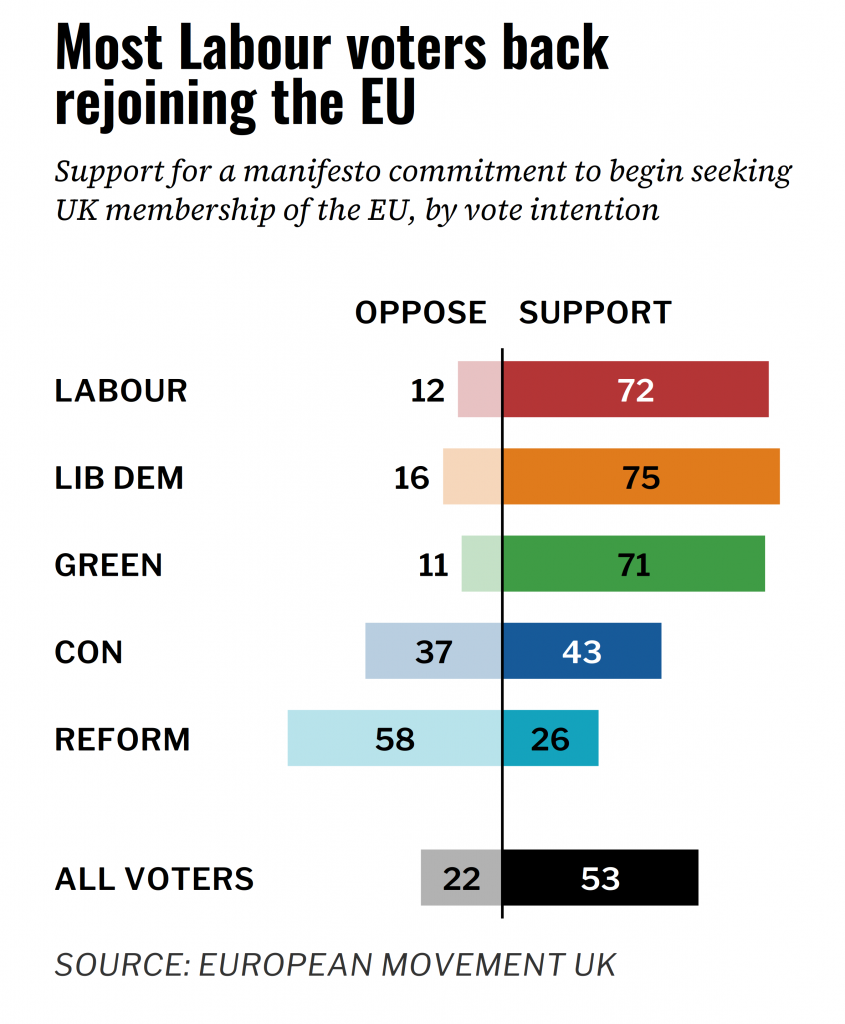
As is often the case with Johnson, especially when he is firing off copy for his unloved Mail column, the message is roughly there, but his heart doesn’t seem to be in it. Johnson must be aware that not only does his post-partygate unpopularity mean he is unlikely to swing undecided voters, but that polling is wildly against the Brexiteers in any case. Many of the oldest voters who formed the core of the 2016 Vote Leave coalition have died, while many of the younger ones have changed their minds.
Claiming the Brexit bus as “the bus of truth” also feels like a desperate bit of bait, especially as almost every senior figure involved in the Leave campaign has admitted its claim of delivering an extra “£350m a week” for the NHS was at best misleading and at worst an outright lie.
Johnson had three years as prime minister to find that money, and barring emergency pandemic funding, he failed. It took a Labour government to start reversing a decade of shortages in NHS funding, and repairing the damage is proving to be slow work.
This intervention feels like a half-hearted effort from a man slipping into irrelevance. But his was not the only attempt to get ahead of Burnham: current politicians were swift to get in on the act.
In her speech at the Conservative conference last Wednesday, Badenoch declared that reopening Brexit would be too much of a faff, telling delegates: “Can you imagine having to go through that again? So much time lost arguing with ourselves, arguing with the EU, going round and round in circles, businesses not knowing whether they should invest… I think that is a terrible idea.”
In the Commons on Monday, she declared that there was just too much going on in the rest of the world to tackle Brexit again, criticising Burnham for “reopening yesterday’s arguments”. It is a tacit admission that Brexit can no longer be claimed as a success, as she and Johnson used to pretend. A week earlier, at a Conservative conference fringe event, even original Maastricht rebel Bernard Jenkin advised his fellow Tories: “Do not defend Brexit. Brexit is toxic with the voters.”
Nigel Farage has, in the span of 12 months, gone from the bookmakers’ favourite to be the next prime minister to a man fighting for his own political future, after an interconnected flurry of sagas around his party’s donations, his personal “gifts”, and his outside work. Brexit has his dabs all over it; on his TRIP appearance, Burnham was eager to blame the former Ukip and Brexit Party leader for “giving Britain a decade of division and drift”, adding, “I would hold him very significantly responsible for our failure to move forward in the last decade.”
At a press conference on Monday, even Farage admitted his own life’s work had not gone as planned, saying: “There’s no doubt that for some businesses Brexit makes life marginally harder. It’s also true that, for some businesses who do their business outside of the European Union, Brexit has made their lives easier.”
Suggested Reading
Brexit promised farmers freedom – it gave them a six-hour lottery
But mostly he opted for Hail Mary passes. First, he said “the prime minister is a liar” and “there was no Russian interference” in 2016, claiming that Foreign Office minister Stephen Doughty had admitted this. But Doughty had not – just merely said that Russia’s meddling had ultimately made no difference.
Whether even this is true remains open to question.
What Farage mostly wanted to talk about, though, was his promise that “a Reform UK government will shut down the asylum system” entirely, “for up to five years”.
Perhaps this is an attempt to shift the UK’s political discourse back to the one issue on which Reform is still leading with voters. But beyond that, it’s not clear to whom it’s supposed to appeal. The core demographic who might hear this announcement, like it, and think it’s feasible are already voting for Reform – though it might pick up one or two additional voters from Restore Britain, or parties even further on the extremes of the right.
But to almost everyone else it will look like Farage is flailing. Farage could pick a fight on Brexit, supposedly his strongest issue, but instead he has pulled out his biggest joker, potentially years ahead of a general election.
His one-time by-election candidate, the Substacker Matt Goodwin, tried an even more confused attack against the idea of rejoining the EU: don’t pro-EU people know how many nationalists are on the rise across Europe, he asked in a blogpost. Why would liberals want to be part of a bloc that’s full of people who agree with him, he suggested, accidentally writing an argument encouraging his supporters to back rejoining the EU.
It made as little sense as what Johnson, Badenoch and Farage had offered. None of it is likely to chime with the public as much as what Burnham said: “We need to take a calm, clear-eyed, rational look at the world as it is today to consider what is best for our country.”
In contrast to the somewhat hysterical build-up from his political adversaries, when Burnham stood up at the dispatch box on Monday, he stuck with what he’d said he’d do – promising to improve the UK and EU’s trade relations in the short term, while starting a longer and broader conversation, which might lead to rejoining, in the future.
For the EU summit Burnham hopes to host next month, the prime minister’s eyes were firmly set on issues like better management of goods travelling across the border – both to help exporters, and to stop food rotting in endless queues, and to improve cooperation on issues like defence, immigration and law enforcement.
But he stuck to his promise that the longer-term conversation must be a broader one. “If we are serious about promoting growth, controlling immigration, upholding our values and security, it is a conversation we must have,” he told MPs. “The status quo is not good enough for Britain.”
The prime minister is trying to minimise the damage of Brexit while acknowledging that the damage is real, and seeing what the public, and politicians, want to do about that. This is a debate the Brexiteers insist is settled, is won already, and is unnecessary. That might even be the case – but if it is, why are they so obviously panicked by it?
 Most popular

Suella Braverman’s book has sold only 106 copies. This is why

Zack Polanski’s moment is over

Emily Maitlis’s diary: My deep dive into Jeffrey Epstein’s hidden empire – and the network that let him get away with it
I was at Eton with Charles Spencer – this is how it explains his battle with the royals