


Come data centres rain on Slough, it isn’t fit for humans now. That was the line I had scribbled at the top of my reporter’s notepad as I sat on the train to Slough, where I was due to meet an activist from the Slough Against Data Centres campaign. It is, of course, a bastardisation of Betjeman, and it seemed an appropriate place to start.
Data centres. Barely a day goes by where they don’t get a mention in the news, and they are one of the biggest political fault lines of the AI age. A data centre is an enormous, windowless, power-hungry building full of computers in which our emails, bank accounts, Netflix streams, and, increasingly, our AI queries are processed. They consume a massive amount of energy and water. And Britain wants a lot more of them. Or at least, the government does.
No.10 has made AI infrastructure a central part of its economic strategy, and argues that with data centres will come investment, jobs, and that nebulous term, “growth”.
But the backlash is coming from more directions than you might expect: protesters are disrupting corporate events to denounce AI expansion, residents are fighting developments in their neighbourhoods, young climate activists are filling bottles with muddy water on social media to warn of their impact on our water supply, and the legacy media is increasingly reporting on the hell of living beside one.
Data centres have become the physical object onto which people can project their anxieties about the modern world and the intangibility of Big Tech. For all the arguments about whether AI is a great technological revolution or a speculative bubble, you can at least point at a data centre and say: there. That is what Big Tech is. And I don’t like it. Which is why I went to Slough.
Dr Ambily Banerjee picked me up from the train station in Langley, just outside Slough. Almost immediately after pulling out of the station car park she pointed out a site earmarked for a new Microsoft data centre – directly opposite a large sixth-form college and close to a primary school.
As we drove through the leafy Slough suburbs, dodging the hordes of schoolchildren spilling out for lunch, Dr Banerjee began listing the effects of the data centre industry. She was armed with so many facts and statistics that I struggled to write them all down.
Suggested Reading


Worried about the AI apocalypse? You’re already living in it
Slough is home to Europe’s largest data-centre cluster, she told me, with an estimated 30 to 40 major facilities consuming roughly a gigawatt of electricity, an extraordinary amount for a borough of around 150,000 people. In 2024, 65% of electricity used in Slough was by data centres.
According to research, air pollution associated with data centres could contribute to thousands of premature deaths and asthma cases, she said. Their hundreds of diesel generators produce large amounts of nitrogen dioxide, while the borough’s levels of particulate matter air pollution are already more than five times World Health Organisation guidelines. Slough Council identifies data centre generators as a contributor to local pollution. The proposed Microsoft facility in Langley would include a gas-fired energy centre with 26-metre flues beside residential streets and a college.
The Environment Agency classifies Slough as “seriously water stressed”, its highest designation. Campaigners say that the overwhelming majority of proposed UK data centres are located in areas already suffering, or expected to suffer, water stress.
We drove to a cluster of three large data centres near AkzoNobel headquarters, and parked on Hazlemere Road, a nearby residential street. The enormous, windowless buildings rose behind the gardens of ordinary semi-detached houses, the blank industrial walls standing absurdly close, looming like some sort of evil spaceship in a science fiction film.
“These centres are not in some lonely old streets,” Ambily told me as we walked around the heavily secured perimeter. “The people here deserve better.”
Slough Against Data Centres was formed in July 2026, she said, after residents began asking why these enormous buildings were appearing around them and why there had been so little consultation.
“People of every background are against it,” she told me. “Everyone loves their children, and everyone is worried about the future and what these data centres are doing to our community and our planet. You can’t put a price tag on the quality of life of millions of people,” and at that precise moment, a ten-pound note fluttered past us, apparently blown from the data centre’s car park.
As we drove towards another facility, through the centre of Slough, we talked about how some locals had initially been in favour of the centres, thinking it would bring jobs and prosperity. “But the only jobs are in constructing the centres and the high street is still dying.” Slough now has twice the amount of data centres as it does GP surgeries.
It was not lost on me that these business parks are also the setting for the best sitcom ever created. The Office was, in its own way, a comedy about the end of the old economy. Its characters sold paper in a world that was becoming digital, with the threat of redundancy always hovering over them. Now Slough has become a physical incarnation of the thing that replaced it, the digital hegemony of Big Tech.
We pulled into a road squeezed between the back gardens of semi-detached houses and another data centre. Standing by the garden fences, I could hear a persistent screech coming from the building. After five minutes I could feel a headache coming on. When we drove away, I could still hear it.
Ambily told me that residents have also complained about vibrations from the generators, which can be felt in nearby houses at night. Data centres’ generators, cooling systems and other equipment have to operate continuously and can reach 55 to 65 decibels. I thought about the sixth-form college we had passed earlier. What would it feel like to sit an exam with a low industrial hum coming through the walls?
“We aren’t nimbys, because we don’t want this in anyone’s back yard. No one should have to live like this. It’s a David and Goliath situation.”
Did she think they would prosper as David had? “Absolutely. We are going to win this battle.”
Sitting in the car of a professional middle-aged mother in suburban Slough, I was suddenly listening to what sounded like the leader of an underground revolutionary movement.
“We are connected with other groups across the country,” she said. “Leeds have been fighting back and we’re all learning from each other. Andy Burnham always talks about power to the people, so hopefully the louder we are, the sooner he will wake up to the fact that the people have spoken.”
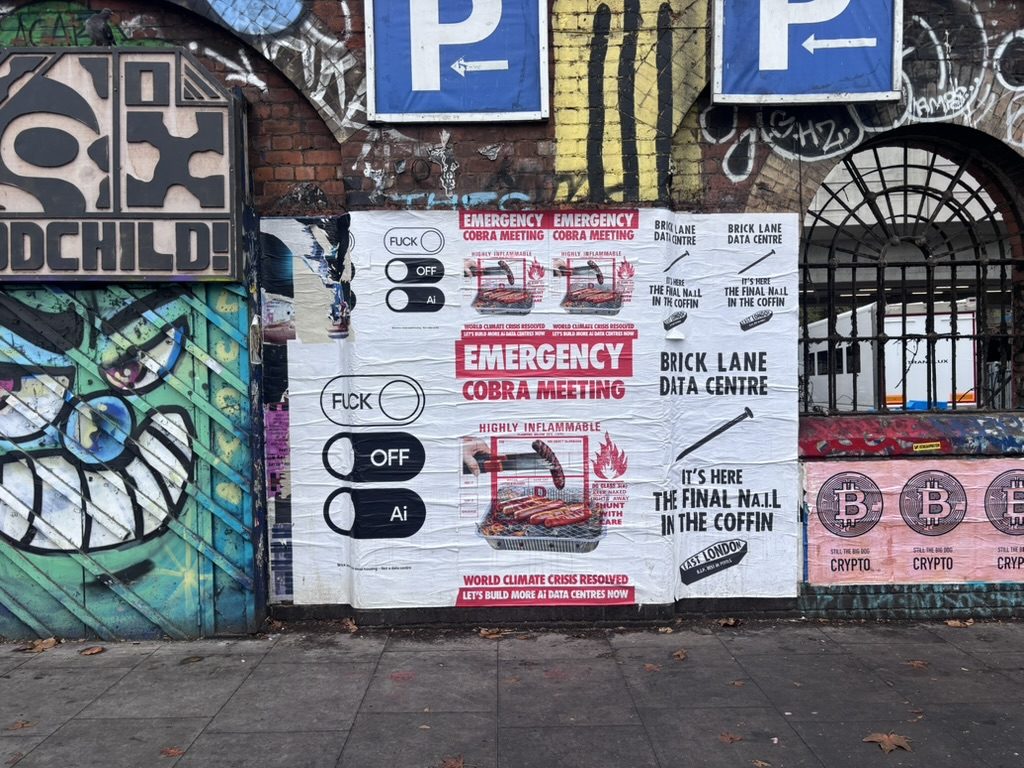
And she is right. I also contacted a spokesperson for Pull the Plug, an organisation that describes itself as a group of “everyday people” concerned about the harms associated with AI. They told me that data centres became a major part of their work after residents from Reading, Leeds, Cornwall, Brick Lane in East London, and Cardiff began contacting them for help.
“Data centres are classified as critical national infrastructure, meaning that they jump ahead of houses and hospitals. So we constantly hear the government talk about the housing crisis, but data centres take priority when it comes to national infrastructure.”
“We’re told over and over again that the UK’s GDP is going to skyrocket if we have all these data centres. We’ve had five years of everyone saying AI is going to lead to the next industrial revolution or it’s going to be as important as electricity and so on and so forth. But where are these benefits? No one has seen them yet, we’ve only seen the direct harms.
“Brick Lane is a really interesting example, because it started as an anti-gentrification group, and it also shows the conflict between local government and central government. So, for example, the Tower Hamlets Council initially rejected planning permission, but the central government, in order to appease or at least attract investment from AI companies, intervened and overruled local government.”
I asked more about Brick Lane, which is near where I live, and the last time I visited I was struck by how many anti-AI posters had appeared. They were plastered over the walls around vintage shops, bakeries, curry houses and railway arches. But what was striking was how little the posters seemed to be about data centres alone.
An anti-data-centre poster would sit beside a climate-change poster. Next to that, something about cryptocurrency. Somewhere else, a photoshopped picture of Elon Musk as Hitler. The causes bled into one another: climate change, anti-gentrification, distrust of Big Tech, and overall a suspicion that this “future” is being designed by people who couldn’t care less whether we want it or not.
The data centre is where all of these grievances coalesce into bricks and mortar.

The spokesperson agreed: “You’re finding not-in-my-backyard sort of conservatives holding hands with radical ecosocialists. You have people across the political spectrum agreeing that they don’t really see why they have to suffer data centres.”
“I think when people are frustrated with tech they often feel like they’re not qualified to level the critiques, which is nonsense. I mean, half the people talking about tech don’t know what they’re talking about. But they are scared, and I think the data centres are this manifestation of that fear.
“People are getting involved in data centre activism because it’s tangible. There’s these CEOs who are building this tech are telling us there’s this 10-20% chance of extinction by AI, and everyone’s going, ‘well, this is absurd’. But one thing they can do, and one thing they can actually get involved in is data centre activism.”
Everywhere you look, AI is being pushed further into ordinary life: search engines now offer AI-generated answers, office software wants to summarise your meetings, and customer service departments increasingly route you through chatbots before allowing you to speak to a person. And people generally seem quite happy to use it for themselves, whether that means laughing at Grok-generated pictures or getting ChatGPT to write their shopping list.
Unfortunately, I don’t think we are on the cusp of a Luddite revolution. AI is here to stay. And if AI is here to stay, so are the data centres that power it.
The political question, then, is who gets to decide what the physical price of this future should be, where that price is paid, and who gets to say no.
This is not simply a story of some distant, poorer community being asked to absorb the consequences (though of course, there is a much bigger global inequality here: poorer countries are already bearing a disproportionate share of the environmental costs of climate change and, increasingly, the demands of our tech industries).
Suggested Reading


What the rich and powerful are really saying about AI
Slough is not a forgotten corner of Britain. Langley is a place where families move because they want their children to go to good schools. Brick Lane is one of the most expensive and hip parts of London. These are not communities without a voice.
And that may be the thing the tech industry and the politicians promoting it have not quite anticipated. People may tolerate an extraordinary amount of technological change when it manifests on their screen. They may be considerably less enthusiastic when it arrives over their garden fence.
How long can the government continue to sell data centres as the infrastructure of Britain’s economic salvation when people of wildly different classes, generations and political persuasions keep arriving at the same conclusion from completely different directions? It won’t be long before “data centre” becomes a political boogeyman bandied around at local and general elections: “Want to stop a data centre on YOUR street? Vote for me!”
Eventually, someone will have to answer the very simple question that people in Slough are asking: if everyone is supposed to benefit from the AI revolution, why does someone else get the benefits while we get the massive, noisy, polluting building?
The machines may be the future. But someone has to live next to them. It turns out that no one particularly wants to.
 Most popular


Sorry Nigel, but the polls show you’ve had it

“We will hope again”: Andy Burnham’s full speech to the 2026 Labour Party Conference


Why is Farage so keen to protect Russia’s right to lie and cheat?

Vigour, passion, purpose: Why Andy Burnham’s bold speech will be talked about for many years to come