

It started in the 2010 Conservative Party manifesto, which promised to “take steps to take net migration back to the levels of the 1990s – tens of thousands a year, not hundreds of thousands”.
Previous Tory manifestos had promised to “control” migration, or to let parliament set an annual target or limit on net migration, but it was David Cameron’s 2010 manifesto that created a national fixation on this specific figure as a target.
Despite coming nowhere close to achieving the target, the 2015 manifesto promised to “keep our ambition of delivering annual net migration in the tens of thousands”. Theresa May’s 2017 manifesto promised “controlled, sustainable migration, with net migration down to the tens of thousands”.
Boris Johnson made no mention of the “tens of thousands” target in his 2019 manifesto, but promised an “Australian-style points-based immigration system”, with “fewer lower-skilled migrants” and the promise that “overall numbers will come down”.
Cameron’s “tens of thousands” target turned every release of migration figures from the Office for National Statistics into a media frenzy, and the obsession has long outlasted the target itself. But in late November, when the ONS releases its statistics for the year ending June 2026, for the first time since the promise was ever made – and the first time since the 1990s (pandemic aside) – that long-defunct target might actually be hit: net migration might drop to the long-promised and never delivered level of below 100,000.
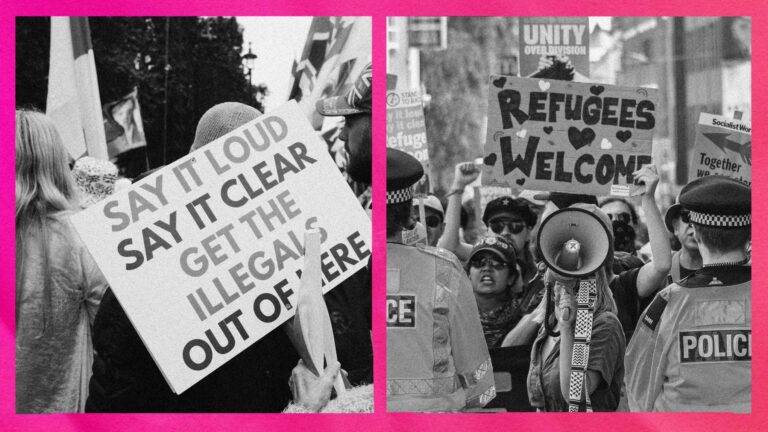
Whether or not the figure crosses that threshold this time, it is virtually certain to do so within a year, and next year the UK might even experience negative net migration for the first time since the “brain drain” of the 1970s. Despite this, furious demands for tougher policies on immigration and statements that the UK is “full” are more widespread than ever. Even the Labour government is cracking down on indefinite leave to remain. What’s really going on with migration, and how has the debate become so detached from reality?
For decades, the UK had relatively low net migration. That was until Tony Blair’s premiership, when the UK was one of a handful of western European countries that did not restrict immigration from new EU members. That led to a surge of hundreds of thousands of people arriving from eastern Europe.
Suggested Reading

Burnham must make the case for fairness
Under EU free movement rules, they could come to the UK if they were seeking a job, but because other large countries had restricted their arrivals, people from Poland, Hungary and the six other 2004 accession nations came to the UK in far greater numbers than was forecast.
This influx benefited the UK economically, but caused tensions as migrants from particular countries understandably concentrated in particular areas – and the influx of workers in certain skilled professions (like, notoriously, plumbing) reduced the rates that incumbents could charge.
In the decades after this, EU free movement and then migration more broadly became an ever-more contentious issue. For a time, the vote to leave the EU took the sting out of the issue, even though migration numbers themselves did not fall. But a series of policy decisions made during Boris Johnson’s government brought things to a head.
After promising to introduce an “Australian-style” points-based immigration system, Johnson’s government relaxed rules on skilled and semi-skilled visas for workers from beyond the EU. That created a surge in immigration, especially in sectors such as care work, where wages are restricted by council budgets, and UK workers were reluctant to take up the roles for the salaries on offer.
This upturn in migration was boosted by two short-term schemes. First, the UK opened its doors to people fleeing Hong Kong, provided they had some historic link to Britain – a group who largely intended to come to the country and stay permanently. Second, it welcomed refugees fleeing Ukraine, a group of people largely here temporarily.
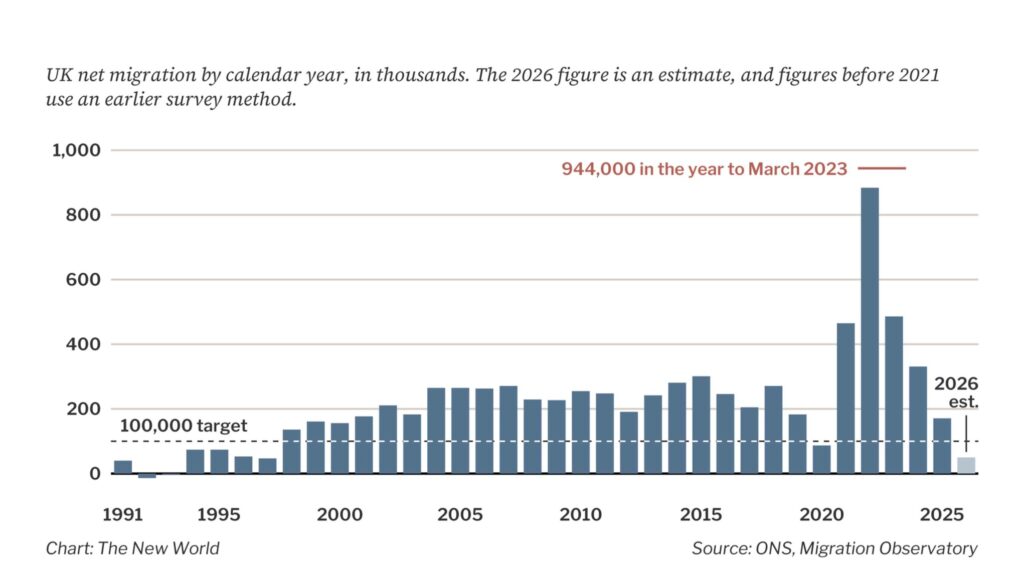
The result of these three policy changes was a surge in migration that was dubbed the “Boriswave” by far right groups, before the term eventually became widely used in mainstream media and political circles. The numbers were, however, genuinely far higher than historic levels, or even the surge in Blair’s time, with net migration peaking at more than 940,000 in the year ending March 2023.
Even without policy changes, net migration would never have remained this high: the people fleeing Ukraine had largely done so within the first few months of the conflict. Similarly, the flow of families departing Hong Kong was not going to last longer than a year or so.
But all the same, successive prime ministers – and then, once Labour came into power, successive governments – repeatedly tightened visa rules for workers and students, as populist and far right figures such as Nigel Farage, Rupert Lowe and Tommy Robinson exploited migration as an issue.
But now, experts know immigration numbers are substantially down and that the statistics will prove it. This is because some of the data that feeds into the calculation is available publicly in advance: the government has published figures on the number of visas it issued for work and study, and these are down 15% year-on-year. Similarly, there is some administrative data available on entries and exits from the UK at airports.
The ONS has additional data available to it, and changes its methodology from time to time, so the exact figure isn’t known – but estimates vary from a little over 100,000 this time around, to potentially around 50,000 or even a little lower, according to calculations by James Bowes at the University of Warwick.
Whatever the actual figure, there is also a widespread consensus that the fall in net migration won’t stop there: it will almost certainly continue to decline all the way through 2027, and possibly even into 2028.
Suggested Reading


When Britain began to empty
The reasons for this are somewhat mechanical, and rely on the way net migration works. As the “net” in the term implies, “net migration” is the simple result of taking the total of everyone who has arrived in the country with the intention of staying here for at least a few years, and then subtracting everyone who has departed.
That means a net migration figure of 100,000 can mean a lot of different things: if 1.9 million people left the country, but 2 million arrived, that would look far more dramatic than if no one left and 100,000 arrived, for example.
Similarly, the total tells us almost nothing about what it means economically for the UK. Asylum seekers, even once recognised as legitimate refugees, often struggle to secure high-paying work in the UK, and are rarely net contributors to public finances. So 100,000 refugees would look dramatically different in policy terms than 100,000 doctors, lawyers and engineers.
Given that the UK has shortages in particular professions such as care – which doesn’t pay very well – that picture gets even more complex: someone moving to the UK to work in the care sector who stays for life will, according to financial projections, eventually cost the government much more than simply increasing pay in the care sector.
But those costs would be borne by a future government, years or decades off, and so it flatters public finances in the short term. Even taking the moral rights and wrongs of migration out of the picture, the policy decisions are complex.
According to Madeleine Sumption, the director of the University of Oxford’s Migration Observatory, most immigrants to the UK either depart within five years or so, or else stay in the UK for life.
That means that where there is a big spike in immigration, a few years later there will be a smaller but still sizeable spike in emigration – which is what the UK is experiencing at the moment. Sometimes it is referred to by politicians or right wing media as a “brain drain”, or a larger than usual exodus of young Brits, but the reality is different – it is just the normal outflow of people who arrived in the last five years.
UK net migration peaked in early 2023, suggesting we have another 18 months to two years of higher-than-normal emigration. When combined with the successive crackdowns on visas, and rules making it increasingly more expensive for people who moved to the UK to continue to live and work here, that means net migration will continue to plummet over that period – very probably going negative next year.
Just try telling the British public that, though: despite the government’s efforts to defuse immigration as an issue by keeping it in the headlines and trying to appear as tough as possible, the narrative on migration has detached entirely from its reality, leaving it as the only issue on which Nigel Farage’s increasingly battered Reform Party consistently beats the government.
Perhaps the government hopes that the shock of net migration actually falling to the tens of thousands – or, next year, turning negative – will finally change the narrative in the UK. The continued dominance of small boats as a political issue, even as crossings fell by almost half, suggests that hope may be a distant one.
Beyond that, the government will have to reckon with how to handle lower migration, when much of the economy and key public services rely upon the hard work – or the cash – of people arriving in the UK. Doctors and nurses take years to train, and can’t be rushed out if not enough want to come here to work.
University finances rely on overseas students, who are finding the UK increasingly harder to travel to, and less appealing as a destination. The National Care Service might one day fix the UK’s chronic shortage of care workers, but something has to keep the system afloat in the meantime.
There is one additional trap waiting for any government that goes too far to celebrate falling net migration: what goes down will also come up. The number of people arriving in the UK has fallen dramatically from its highs of 2023, but it has largely stabilised, and reducing it further would require cutting student and skilled-worker visas even further – which would be economic self-sabotage by any government.
That means it’s unlikely this government would want to cut immigration further. But emigration is, in a year or two, going to fall: people generally leave within five years or so, or never, after all. There is currently a wave of bonus emigration running its way through the system.
When it’s done, emigration numbers will fall, and like a seesaw, net migration will rise once again. As if that weren’t potentially a political headache enough on its own, it is most likely to start showing up in the figures by late 2028 – meaning it would be reported just in time for a general election in 2029, which is the latest date at which Andy Burnham could go to the polls.
Without even trying, Burnham is set to deliver on a promise made by his onetime political adversary David Cameron more than 15 years ago. He might soon find the pledge’s political ramifications and legacy just as complex – and as toxic – as a promise fulfilled, as it was a promise broken.
The UK’s voters are about to get the net migration they say they’ve always wanted. Can we live with the results?