

In the brilliant original opening for this article, I wrote about a comedian making a film in which he interacted with real people and created something that sat queasily between fact and fiction.
My readers would think: “Right, yeah, we get it, it’s Nathan Fielder and his new film about Theranos fraudster Elizabeth Holmes, You Can See Everything” – and then at the last minute I would go, “no, it’s actually Sacha Baron Cohen and Ali G: Who Is I?”
And you’d be “what?” And I’d be like, “Yass! Got you, bitches!” It was going to be a great first paragraph for the article. But the king of being meta has pulled one of the greatest tricks ever, and as I watched events unfold before me over the past few weeks, I realised I had to intervene.
Canadian comedian and po-faced prankster Fielder’s You Can See Everything opens in the UK on November 20, having already earned over $91 million at the US box office, making it second only to Backrooms in A24’s slate of hits. It recently won all the categories in which it was entered in the Critics’ Choice Documentary Awards, despite NOT BEING A DOCUMENTARY.
And to be clear, I’m not pedantically talking about Errol Morris using noirish reenactments on The Thin Blue Line, or Werner Herzog talking about albino crocodiles at the end of Cave of Forgotten Dreams. I’m not naively assuming that documentaries consist of unedited raw footage of THE TRUTH.
But everyone seems to assume that because there are real people in Fielder’s film who seem unaware of how they look, this makes it a documentary. Borat is a documentary by that measure: so are the Jackass films.
Also, I am not saying this is a bad thing. In fact, it leads into the very core of what the film is doing.
The film is a liar’s portrait of a liar. Elizabeth Holmes has been proved guilty of lying – defrauding her investors – and when we meet her in the film, is a little over a month away from beginning an 11-year jail sentence. She invites Fielder and his fellow director Lance Oppenheim, who directed Primetime, to come into her home and document her final days of freedom with her husband Billy Evans and their two young children.
Far from being a fly on the wall, Fielder adopts the Nick Broomfield approach, wearing his headphones throughout as if to keep everyone clear that he’s a documentarian. Except of course he isn’t: he’s a comedian playing a documentarian.
If you haven’t seen his TV shows Nathan For You or The Rehearsal, you might not be aware of this going in. And even The Rehearsal provoked think-pieces about how much of the meta-reality show was real. The answer: none of it.
Fielder’s comedy follows the situationism of Andy Kaufman, a man who took up female wrestling and once came on stage and read the entirety of The Great Gatsby. The act doesn’t have jokes: it is the joke. That the audience sits there and listens, or gets angry and walks out, is all part of the bit.
Fielder doesn’t wear the elaborate disguises of Sacha Baron Cohen’s Ali G, or Borat or Bruno, but ‘Nathan Fielder’ is still a character. His humourlessness is Buster Keaton’s deadpan. His jumpers are costumes: his headphones and strap-on laptop are props. He’s Jackass in a pullover.
In You Can See Everything, he lurks, gauche, inappropriate, annoying to the extent that you begin to feel sorry for Holmes (almost).
A film critic friend of mine had a visceral hatred of the film. “Nathan Fielder is a liar,” he said. To which I could only reply, “Ya think?!”
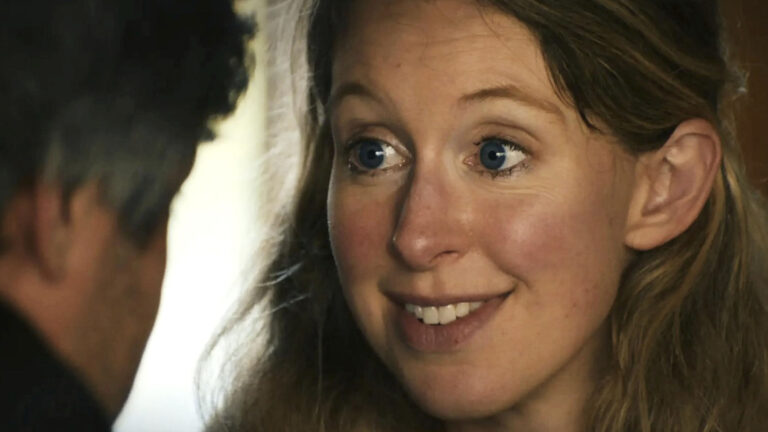

His presence is strangely akin to that of the killer nerd in a horror movie, a fact made obvious by the poster in which he lurks behind a bright-eyed Holmes. This being A24, it is elevated horror.
The biggest lie of the film and perhaps the biggest lie in the universe is that “There is no truth.” This is horseshit that Pontius Pilate tried on after executing THE SON OF GOD. Nice try, Pilate.
The central conceit is that Elizabeth Holmes lives on some level of reality where lying and truth are irrelevant: she just doesn’t get the distinction. This is illustrated in a scene where Holmes doesn’t understand the main joke behind the famous Abbott and Costello routine, “Who’s on first?”
Fielder and Evans both see this as relevant, just the way her mind operates. Neither of them seem to be aware – though this could easily also be part of the lie – that Holmes could just be playing dumb. Is just playing dumb, for fuck’s sake.
The case against Holmes is well documented in the media and was proven in a protracted trial. We’ve had John Carreyrou’s journalism, his book Bad Blood: Secrets and Lies in a Silicon Valley Startup and Alex Gibney documentary and the drama The Dropout, starring Amanda Seyfried as Holmes.
You Can See Everything includes two claims of ignorance: Holmes claims not to know Fielder’s work beyond a glancing knowledge from YouTube; and Fielder claims not to be a “science guy” and so fumbles with the facts of the case. He focuses on a quote Holmes makes about “playing a character”, which she now denies and which is utterly immaterial to her claim of innocence in any case. She’s not a liar because she once claimed to be playing a character: she’s a liar because she lied.
Neither of these claims can be taken seriously.
Holmes orchestrated not only her own massive deception schemes but also put in place vicious attacks on anyone who blew the whistle. There is no way on Earth she is allowing a camera crew into her beach house (it’s a rental, it turns out) without having vetted them completely.
She knows Fielder will make her look vaguely ridiculous, maybe even dumb, but dumb is innocent misspelled. She can be otherworldly. Too good for this world, even as she tries to float another company with Evans.
As for Fielder, there’s no way his team hasn’t researched Holmes thoroughly. In The Rehearsal, they meticulously rebuilt a Boston bar in a warehouse as part of their gag. And the lies behind the Theranos fraud boil down to a very simple proposition. Either Holmes’ Edison, the machine she invented, can test blood for a variety of potential ailments from a tiny drop, or it can’t. It works, or it doesn’t. And it doesn’t.
Fielder continues to film interviews as the clock ticks down to Holmes going to jail. She is calculating that it’s worth rehabilitating her reputation as a doofus rather than evil, even at the cost of spending less time concentrating on her young children and husband.
Suggested Reading


Taika Waititi’s whinge about critics is even worse than his new film
Fielder’s interventions are often gags. He gets her to watch The Dropout – she ends up feeling sick – and turns up on the day she goes to prison with jokeily inappropriate gifts as her parents tearfully wait their turn to say goodbye. LOL.
He then recruits Amanda Seyfried to take on the role of Holmes again, and also to comment on Holmes watching Seyfried playing Holmes. But this b-roll type footage is part of the gag. Holmes is in on it. We’re so happy at getting taken behind the curtain that we don’t notice the other curtain.
It is fitting that in describing the lying of Holmes, Fielder uses performance and comedy, ultimately pointing to his own craft. The Abbot and Costello sketch already mentioned is one instance, and in another anecdote he talks about how David Blaine makes a trick where he pushes a spike through his hand look like it must be a trick, where really the trick is he’s actually doing it.
Fielder is telling the audience that they don’t understand the nature of performance. They don’t know what they are watching.
In the good old days, a criminal’s punishment was often a violent reenactment of the original crime on the criminal’s body. You foment rebellion, we’ll rip your internal organs out, Mr Braveheart. You want to separate the realm with independence, then we’ll stretch you and then quarter you: see how you like it.
Elizabeth Holmes was and is a liar. That’s at the heart of her criminal enterprise. Nathan Fielder’s film punishes her by out-lying her. The film has the cruelty of the genuinely angry; a coldness that’s almost sociopathic.
You Can See Everything? You’ve seen nothing at all.
You Can See Everything is on general release in the UK on November 20
 Most popular


Emily Maitlis’s diary: The con trick that let Russell Brand get away with it for so long

‘I drew Brand’s courtroom sketch – I wish I could forget the faces of the guilty’


The Join campaign starts here. And it’s all about the future


16 things that will definitely now happen on the British right