
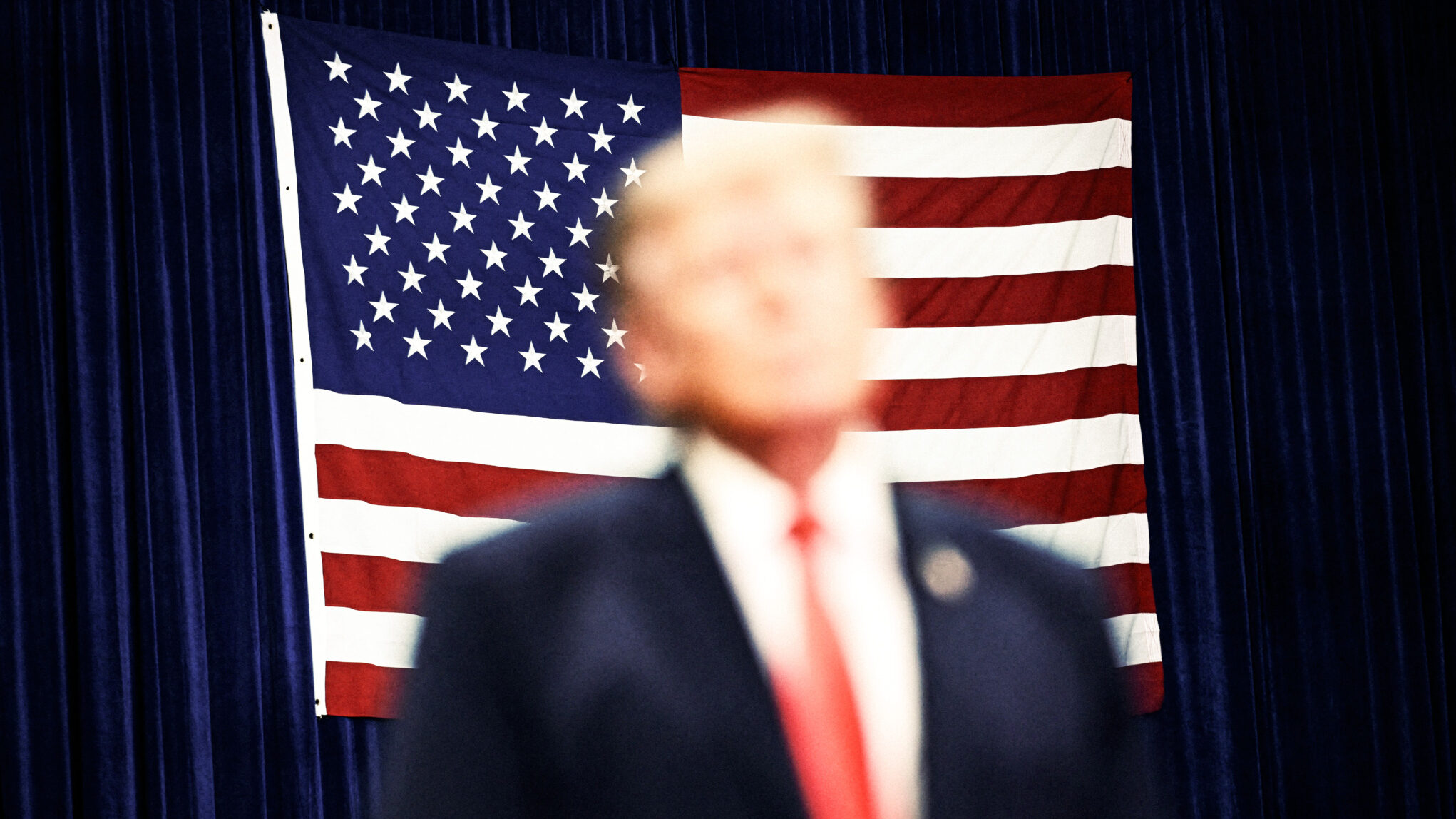
At the New Christian Right (NXR) conference in Irving, Texas on Saturday, the surprise keynote guest was none other than Nick Fuentes. Addressing an overwhelmingly male audience of far right activists, the 28-year-old racist, Holocaust denier and admirer of Hitler insisted that the destruction of the Republicans in the midterms was a moment of great opportunity.
“You’ll find that throughout history,” he said, “it is a small group of highly motivated people that change the world. It’s not the majority, it’s not the crowd, it’s a small group of fanatics, zealots, the martyrs, the people that are willing to die for what they believe in. That’s us. That’s the people in this room.”
Punctuating his call to action with wisecracks, Fuentes brought the crowd to its feet again and again. “Take it back! Take it back!” they chanted.
The king of the “Groypers” (as his extremely online followers style themselves) lapped up the applause, gurning and waving. But waving at what? Surely this gathering of dysfunctional extremists was no more than a carnival of irrelevance?
The theme of the three-day summit, organised by the far right “theobro” pastor Joel Webbon, was: “Christ Is King: America After Trump.”
Also on the bill were the disgraced conspiracist Alex Jones; failed contender for the governorship of Florida, James Fishback; and Buckley Carlson, brother of Tucker (“Donald Trump’s extreme betrayal destroyed it all”).
Suggested Reading

The three Cs that can keep Democrats winning
It is hard to believe that only two years have passed since the 45th US president defied political gravity and assembled an extraordinary electoral coalition to return to power. Today, his movement lies in ruins, an alliance reduced to a chaotic throng of groupuscules.
On Saturday, the New York Times reported the declaration of Joe Rogan that the president had lost the “podcast bros”, so important to his victory in 2024. In truth, as I wrote in April, presenters like Rogan, Theo Von and Andrew Schulz began “drifting away with a collective shrug of bafflement” long before the midterms, vexed by Trump’s war of choice against Iran and a sense that they had been played by the MAGA machine in its quest for young male voters. Two years ago, 56% of men aged 18 to 29 voted for Trump; on November 3, only 37% backed Republican candidates.
No less significant is the erosion of Trump’s Christian base, once the bedrock of his support. In 2024, Evangelicals accounted for 23% of the overall turnout, overwhelmingly to vote Republican; in the midterms that figure had dropped to 17%.
Two years ago, 59% of Catholics supported Trump. In the midterms, the percentage voting Republican had fallen by 11%. Turns out it’s a bad idea for the president and vice-president to wage a war of words with the Pope (“WEAK on Crime, and terrible for Foreign Policy,” according to Trump) if you want those who regard him as Christ’s vicar on earth to stay on your team.
Driving this rapid collapse is an all-important conceptual division. On the one hand, there is MAGA, which is essentially whatever Trump says it is. “MAGA is me,” he told NBC News in January two days after the capture of Nicolás Maduro. “MAGA loves everything I do, and I love everything I do, too.”
On the other, there is the much older tradition of “America First” – popularised by US isolationists in the 1930s – which Trump has greedily appropriated since his 2016 campaign, but, in the eyes of many dismayed right wingers, utterly betrayed since his return to the White House.
First, there is immigration. In his extraordinary interview with Ross Douthat on CBS’s 60 Minutes, which aired on November 8, Trump said that his deportation policy had been “too tough” and that a “deal” with the Democrats was “actually doable”.
No matter that, a few hours after the recording, he announced that his new chief of staff was Stephen Miller – an uncompromising hardliner on immigration. For many of Trump’s former supporters, the Douthat interview was still a moment of desperate appeasement.
“And now amnesty. Seriously?” posted Megyn Kelly on X. Self-styled “theocratic fascist” Matt Walsh of the Daily Wire wrote: “There need to be more deportations, not fewer.” Tucker Carlson scorned Trump’s “deepest desire to be liked by other people” and said he was creeping “as a cold animal does towards the fire.”
And how to square his professed belief in “America First” with the deranged Iranian adventure? For 10 years, Trump has been promising his base an end to forever wars and a relentless focus upon the homeland. Instead, he has given them a conflict that has helped drive the price of gasoline over $6 a gallon in many states.
Suggested Reading
Slavoj Žižek: Beating Trump isn’t the wild triumph you all seem to think
Looming over it all is the role Israel plays in the right’s reconfigured worldview: traditionally regarded by Republicans as an outpost of US values and strategy, the Jewish state is now seen by the “America First” vanguard as little short of a pariah state. From the office of JD Vance to the sweaty bearpit of the NXR conference, the Iran war (and much else) is blamed squarely upon its influence.
Here, there are ugly echoes of Charles Lindbergh and Father Charles Coughlin who insisted that Jews were trying to manipulate America into a ruinous conflict with Hitler. Carlson’s podcasts are now overwhelmingly devoted to conspiracy theories involving demonic forces, Jews and their alleged global reach. One thing is for certain: none of this has anything to do with improving the lot of Palestinians. Once again, an ancient hatred has lodged itself in the soul of the US right.
By any conventional reckoning, what survives of MAGA is unmoored, fractured and struggling for relevance. On which basis, the midterms are indeed cause for celebration.
But it is quite consistent with this spirit of hope to remain sharply vigilant. Why? Because, as Professor Robert Pape of the University of Chicago writes in his latest book, Our Own Worst Enemies: America in the Age of Violent Populism, there are also new dangers to monitor.
Specifically, Pape identifies the risk that significant groups of voters become increasingly convinced that they face systemic demographic replacement; or that the economic insecurity they and their children confront is structural rather than temporary.
At such moments, he argues, “Electoral outcomes do not resolve conflict; they intensify it. Defeat is no longer a setback. It is interpreted as the beginning of permanent exclusion.”
In this context, it is surely significant that – patchily but undeniably – the US militia movement is stirring back into life. Between August and October, the non-profit research organisation the Global Project Against Hate and Extremism recorded renewed activity, including paramilitary training, in Georgia, California, Virginia, Ohio and Idaho.
The groups springing up take many names: Minutemen, Pine Tree Rangers, “irregulars”, “civil training groups” and “The Cull”, a new network that describes itself as the “decentralized militia of sovereign warriors who accept the price of freedom and carry the weight of the war we must wage to keep it.”
These units lack the strength in numbers and the kinetic force of the movement at its peak on January 6. But it is no accident that, as Trump’s unifying power fades, so the paramilitaries are resuming their local activities.
In volatile times, such stirrings matter very much. They matter because the immediate future is so precarious. As psychologists would say: nothing is safe and everything is possible.
In the third quarter of 2026, nearly 40% of US growth was accounted for by tech investment. That could signal a great boom in the 2030s and the potential for a new progressive age. But, to date, much of the AI-related profits recorded by companies reflect drastic payroll reductions rather than the addition of real value. After the exit of Nvidia boss Jensen Huang, the global Microsoft outage last Friday, and the wobble in tech markets, it is no longer alarmist to suggest that the bubble could burst.
Suggested Reading
The Two Matts Q&A: Tech tightropes and locking up Donald Trump
The US working class remembers bitterly all the promises that were made in the early years of globalisation: that manufacturing jobs were indeed being exported to countries with cheaper labour costs, but would be replaced by new, better-paid forms of employment.
What blue-collar Americans actually got was the gig economy, depressed wages and deaths of despair. Look at the protests at data centres all over the US as ordinary voters sense a fresh round of elite betrayal. What they are trying to say – to bellow – is: we won’t get fooled again.
Another convulsive socio-economic shock like the 2008 financial crash is far from inevitable. But it is a real possibility. And it is such a moment that the new right – the renegade children of MAGA – is counting on.
Their rhetoric is extreme, often preposterously so. When Webbon boasts that “I’ll take fascism over democracy,” he sounds more like a shock jock than a leader of consequence. But they have time on their side, and they know it.
Webbon is 40; Fishback is 31; Fuentes, who has been campaigning for a decade, is not yet 30. On election night, his livestream coverage was beaten only by the far left activist Hasan Piker, and outstripped most mainstream news networks. Like Piker, he understands that in an age of permacrisis and instability, it is all to play for.
For a generation like mine, raised to believe that institutions were secure, that the spectrum of acceptable political ideas was fairly stable and that elections were settled on the “centre ground”, it may be difficult to accept that those assumptions are completely obsolete. But accept it we must.
A small but unsettling case study is a book that is currently causing a stir on the American right, entitled American History Z, by Joey Oliver, a 28-year-old follower of Fuentes. A tract as troubling as it is odious, it combines a compendium of unexamined bigotries with a certainty that change is at hand.
“We have become the first group of men to develop total immunity to the liberal order’s magic,” Oliver writes. “This newfound invincibility has sent them into a panic. We understand why they’re scared – and they should be.” He adds: “But now the absurdity will end. As the young men of Gen Z rise up, we will terminate the liberal world once and for all.”
On Saturday, I watched the livestream of Webbon and Fuentes at their hateful little gathering and thought: what do they really think they can accomplish? Do they know how marginal they are?
But then I listened to Fuentes and heard the gravelly confidence already baked into his young voice. “If we can get that small group of people, if we can get the one per cent of Americans, the ones that have ideas, the smartest and the best, the strongest, those with the most faith and fortitude, if we can get them on our side, organise them, point them in the right direction, nobody can stop us.”
They wait for a moment that may never come, but they do so with patience. And patient people are dangerous.
They are ludicrous. They are terrifying.