
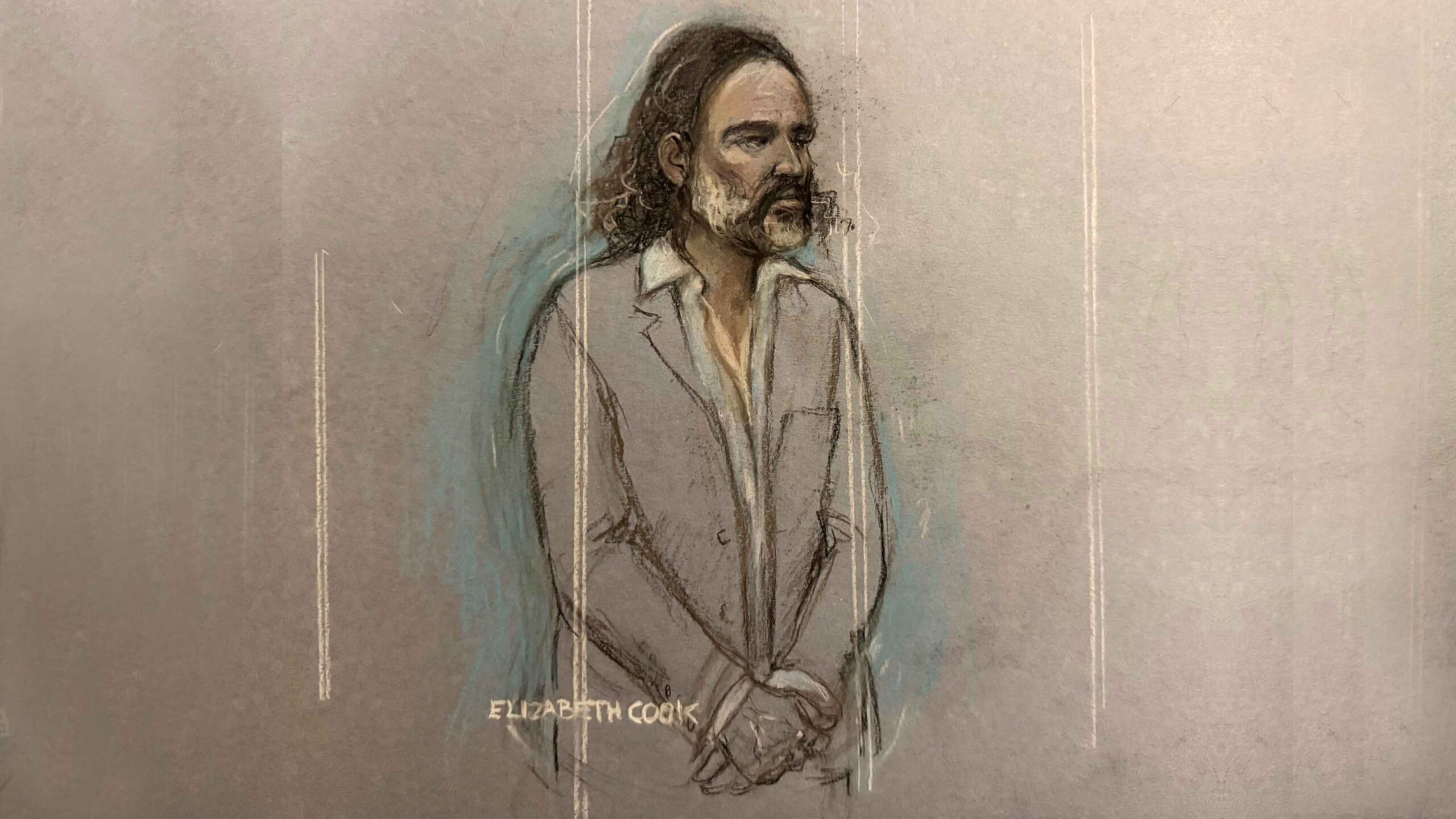
At Southwark Crown Court over the past month, most of the reporters allowed into the room had a good view of the back of the dock. This was of limited use to Elizabeth Cook. The dock, in the middle of the courtroom, was enclosed by tall glass panels, with seats for the press, family and public behind it and to one side.
The judge’s clerk and the usher had reserved her a seat from which Cook could see Russell Brand’s face. The reason is that she is a court artist. She is not allowed to sketch when she is in the room itself. Instead, she goes by memory, which means she has to decide which moment of his trial to take out of the room with her.
Brand might be easy to remember, but there were changes as the days and weeks went on. She tells me, “I look for his demeanour – his posture, how he arranged his arms and hands as he stood and as he sat. But mostly I am concentrating on facial expression and reaction. After a while I note all expressions.”
She is permitted to take notes, and jots down aides-memoire, such as, “eyes closed, a small frown, a drop of the head, a hand wiping a tear.”
“If it’s an obvious gesture, the reporter I work with might lean forward and raise an eyebrow in my direction which I take to mean, ‘That’s the moment’…”
Suggested Reading
The reckoning I thought Russell Brand would never face
She leaves as quietly as she can, heads to the press room or finds a nook with better light, and gets out her paper and pastel pencils. A single face will take her 20 to 30 minutes. If depicting the court’s furniture is going to cost her too much time, it can wait.
She then photographs the drawing and sends it to PA Media, then goes back in. There will be more pictures, and she can take a little longer over those.
“My first pic is always quick and not completely finished. The later ones will be more carefully drawn,” she says. “I’m conscious of rolling news and the need to get pictures out to accompany the live reporting.”
The Brand trial put this decidedly analogue part of rolling news on display. The Times ran live coverage of the verdicts on November 5, when Brand was found guilty of one count of rape and three counts of sexual assault and acquitted of three other counts.
On November 9 he was sentenced to ten years and six months in prison. On that day you could watch footage of the judge, Mr Justice Bennathan, explaining the sentence. But for a view of Brand, there was only Cook’s drawing.
“When I look at a defendant, the whole face remains in my visual memory,” Cook says. While she gets out her paper and pencils, it stays there, “and then runs out of the end of the pencil”. She has been doing this since 1993.
Famous faces bring their own difficulties, she says. Readers sometimes tell Cook that a celebrity she has drawn doesn’t look quite right, and ask why she didn’t copy a photograph. The photograph they have in mind is likely to show someone who knows what to do when a camera is pointed at them. As Cook puts it, “that public face rarely makes it to the dock”. A likeness can look strange precisely because the expression is unfamiliar. The reader and the artist are comparing two different sightings of the same person.
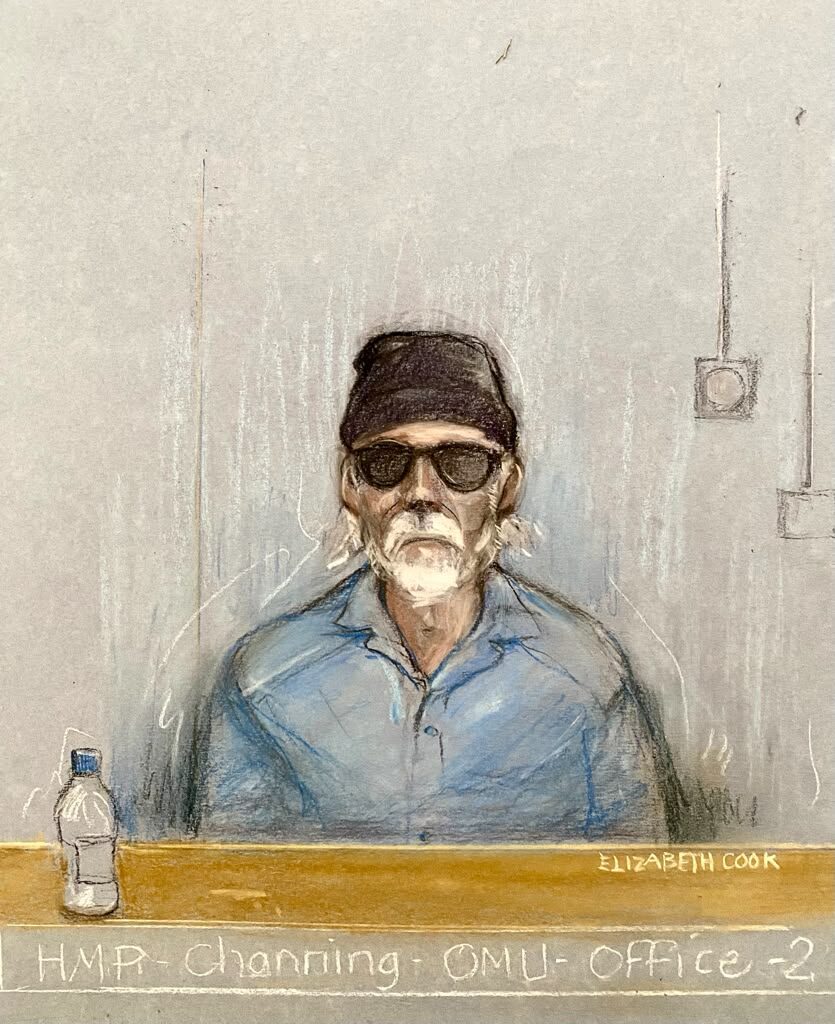
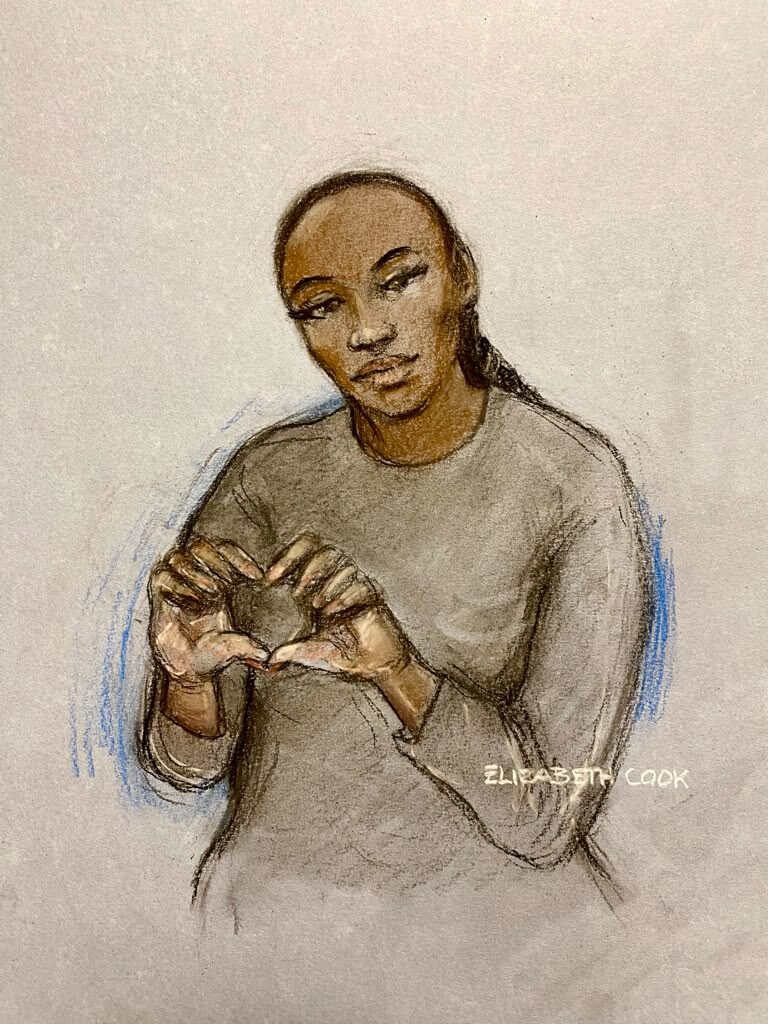
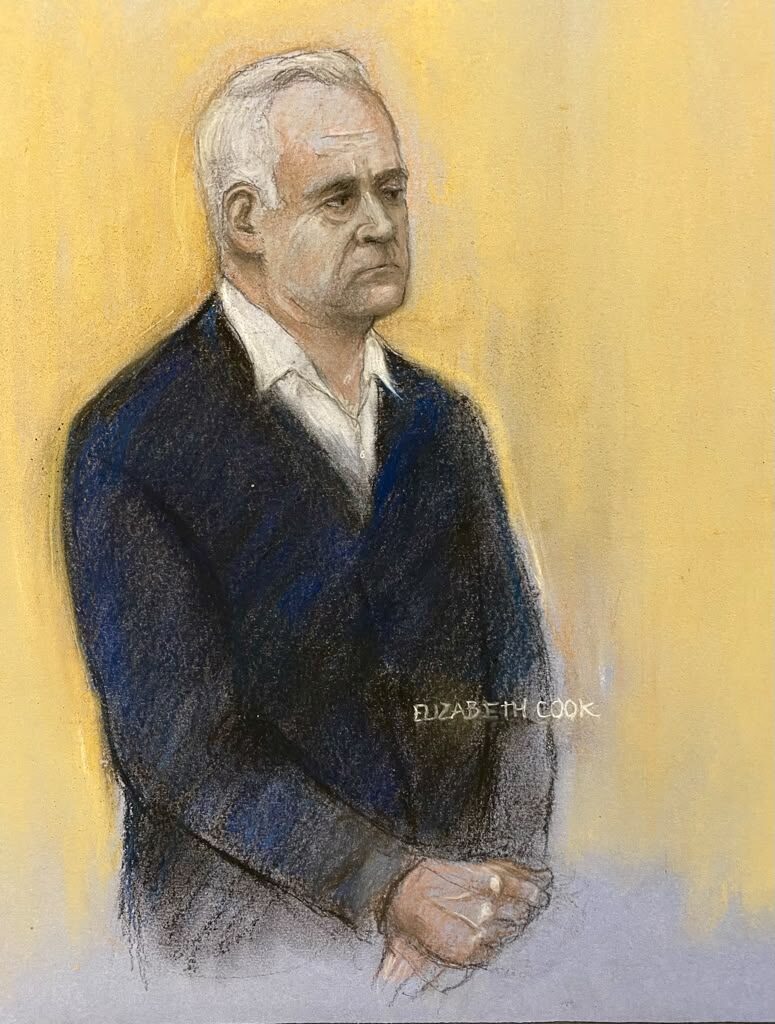
A sketch filed in a hurry might give most of its space to a single face. With time, Cook can add in the bench, the people seated nearby and the space between them.
These additions can lend her images even more emotional force. In a sketch from the 2011 trial of Gary Dobson and David Norris for the murder of Stephen Lawrence, Cook drew both men alongside Lawrence’s parents, Doreen and Neville. She told The Guardian in 2014 that she had been sitting about 12 feet from the parents and had brought them closer in her composition. Neville had closed his eyes as the evidence unfolded. Cook had drawn the defendants years earlier at the Macpherson inquiry. Here, the expressions of Stephen’s parents carried the burden of those intervening years.
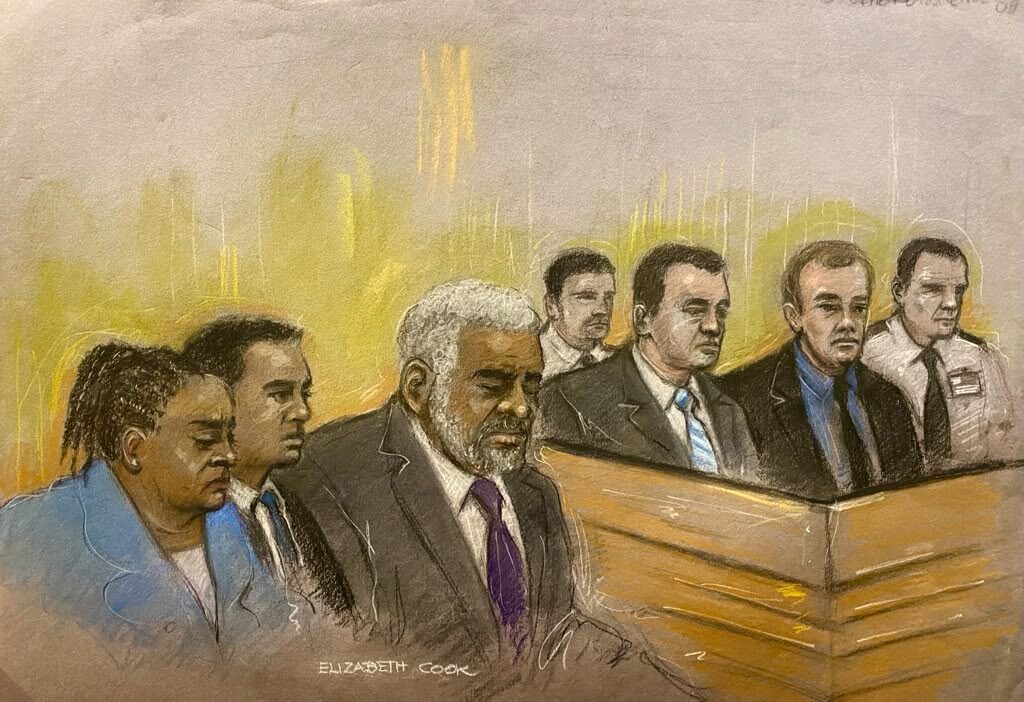
There is a judgment in deciding how much of the room to put on the page, and another in deciding where the reader’s eye will go first. “My stare is objective,” she says. “There is a weight of responsibility – my subject must be presented accurately”. She calls it “visual journalism”. A face can show somebody’s reaction, but a photograph leaves the viewer free to misread it. A sketch is much less likely to be misinterpreted.
The Victorians would have recognised the appetite for a picture from the Brand trial. In the 1870s the Tichborne case, involving a man who claimed to be the missing heir to a fortune, made celebrities of its participants. The illustrated weekly The Graphic published a courtroom scene by its staff artist Godefroy Durand.
A painting in the Government Art Collection largely follows Durand’s illustration, but changes some of the figures to include the claimant’s supporters. It is a reminder of how much an illustrator could tell a reader simply by showing who was in the room and where they stood.
Portable cameras brought a different kind of scrutiny and in the early twentieth century, photographers could take pictures in and around court. One case cited in accounts of the backlash is the 1922 trial of Edith Thompson and Frederick Bywaters for the murder of Thompson’s husband, Percy. The trial attracted fashionable spectators and extensive coverage. A murder case had become an occasion on which the crowd itself was news.
Section 41 of the Criminal Justice Act 1925 addressed both the camera and the pencil. In England and Wales it was forbidden to take photographs in court of judges, jurors, witnesses and parties to proceedings. Making portraits or sketches of those people in court with a view to publication was also banned. It also prohibits publishing any such image. But the demand from newspapers remained – and so the courtroom sketch was born.
Cook works among a handful of artists. They spread out their large sheets of paper wherever there is room, sometimes in a press room, or perhaps an interview room. Someone, she says, came up with the collective noun “a scribble of court artists”. Their work is shaped by the same news cycle as the reporters’.
In 2014, the artist Priscilla Coleman told The Independent how demand had fallen away during the Gulf War, when trials she thought worth covering struggled for space on the newspaper’s pages. And demand fluctuates. Some days, a live news desk needs a picture within minutes of a verdict. On another day the same desk can give an entire hearing a few lines – no image needed.
By 2020, when the government made provision for filming Crown Court sentencing, the obituary of the profession was being written again. The first broadcast followed in July 2022. The new rules permitted authorised media, with the judge’s permission, to film the judge delivering the sentence, so a viewer can hear it explained in the judge’s own voice. The guilty party remains off-camera.
America offers a test of what happens when television gets a wider view. In 1981, the US Supreme Court held in Chandler v Florida that the Constitution did not impose a blanket ban on states allowing cameras into criminal trials. States can set their own rules. In federal criminal courts, a separate rule generally bars courtroom photography and broadcasting during proceedings. How much an American audience gets to see can therefore depend on the court, as well as the case.
The most famous example of cameras and artists working on the same trial was OJ Simpson’s televised murder trial in California. In April 1995 the Los Angeles Times reported that Judge Lance Ito had ordered sketches depicting the jurors to be submitted for approval before broadcast. Bill Robles, the artist whose work prompted the order, had left their faces blank, but the judge was concerned that other details, including distinctive hair and body shapes, might still make jurors recognisable. One of the drawings that troubled him had already appeared on television.
Robles also drew Simpson in the civil trial that followed, which did not have the televised coverage of the criminal case. One of his watercolour and ink drawings from that trial is now in the Library of Congress.
“Live televised sentencing hasn’t changed my modus operandi,” Cook told me, adding that she would welcome the televising of trials as a step towards more open reporting. The public could then see for themselves the expressions, reactions and visual evidence that those in the courtroom can also see. It is a position that invites the question: how much can the public be shown while protecting the people whose anonymity the court is bound to preserve?
At Brand’s sentencing, Bennathan began by reminding anyone listening or reading that the complainants could be identified by a combination of details as well as by name. The judge used numbers to refer to the victims. A published drawing has to reckon with the same problem as a written account or a broadcast. Details that seem incidental to the person producing it can tell somebody who knows the people involved a great deal.
The cases that bring Cook into court have changed. She says she more often covers terrorism and child abuse trials, and cases in which children have been murdered by other children, than when she started. A celebrity case may put her work in front of a much larger audience, but the routine includes hours spent looking closely at people in circumstances few would choose to witness.
I ask if she can still picture some of the faces she had drawn decades ago. She can, she says – “unfortunately. Rather than remembering faces from past trials, I try to forget them.”
See more of Elizabeth Cook’s work at www.elizabethcookcourtartist.com with originals available for purchase
 Most popular

16 things that will definitely now happen on the British right
Johnny Depp’s Ebenezer uncancellation is the worst kind of Christmas present
The dangerous myth of ‘neutral’ technology
Why does everyone hate Laura Kuenssberg?