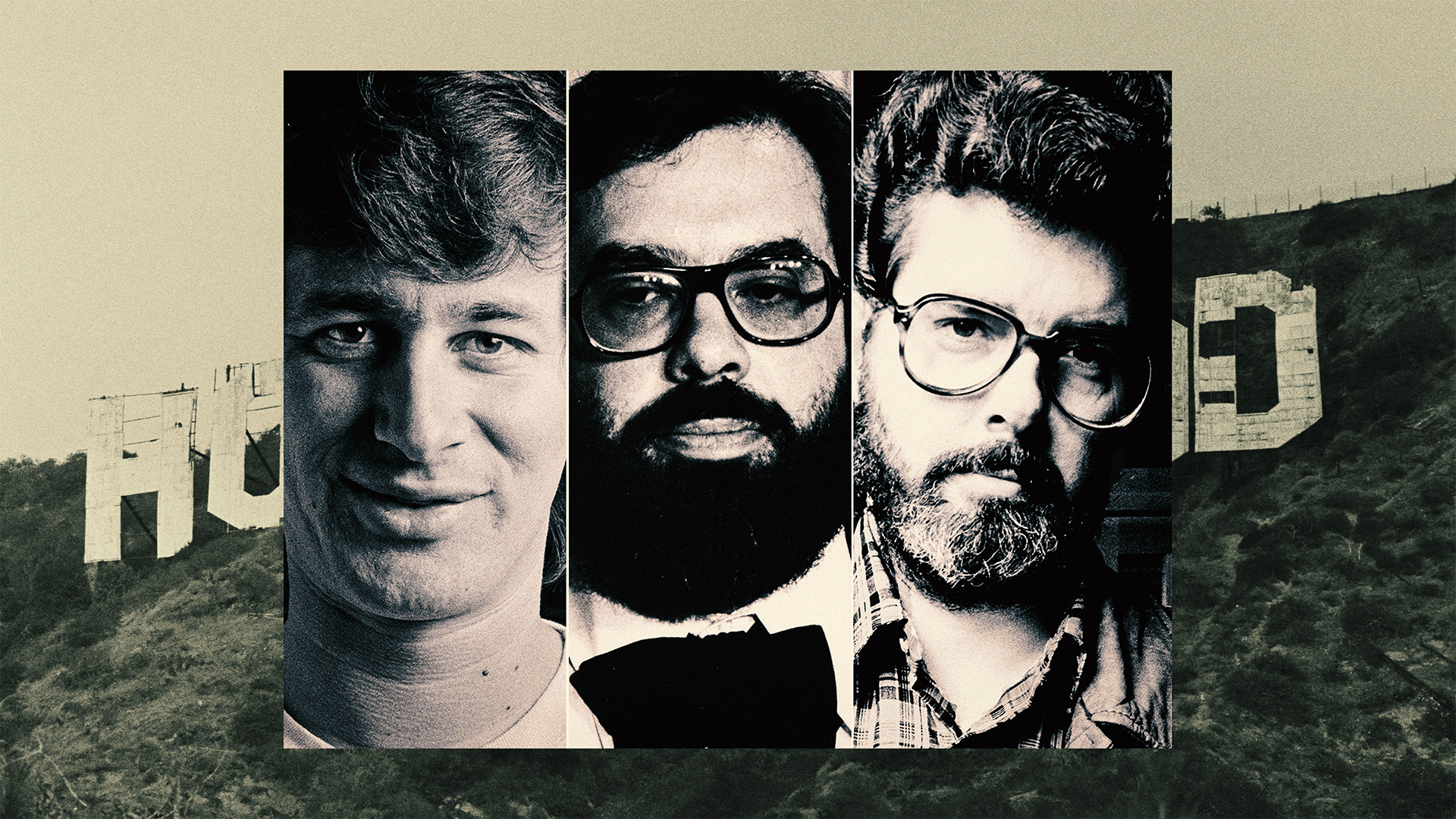
George Lucas and Marcia, his editor and wife, were in New York to see David Picker of United Artists and pitch him a movie about a night in small-town California, young people driving around on the eve of Vietnam, their car radios tuned to a rock’n’roll station. Picker was interested, and they agreed to meet in Cannes, where the Lucases were premiering his debut film THX 1138.
That night, they were sleeping on the couch of Francis Ford Coppola, who had just started filming The Godfather, but was petrified the studio was going to have Elia Kazan take over as director – after all, Kazan knew Marlon Brando from On the Waterfront. In the middle of the night, the Lucases were woken up as Coppola and Eleanor, his wife, crashed through the room. Eleanor had gone into labour, and the Lucases had a plane to catch.
From the airport in London, George phoned Francis. Eleanor had given birth to a little girl. They named her Sofia. It was George’s birthday as well. He was 27.
Suggested Reading
The new Michael Jackson biopic is worse than bad – it’s dangerous
Raymond Chandler once dismissed biographies, saying: “Who cares when a writer bought his first bicycle?” My reply would be: “Me, and what colour was it?” The Last Kings of Hollywood: Coppola, Lucas and Spielberg and the Battle for the Soul of American Cinema by Paul Fischer is just the kind of biography I love. It is packed with rich novelistic detail and evokes the immediacy of being there before everything happened; before everything was inevitable; before everything went wrong.
Every Hollywood career is bookended by two essential myths, one summed up by 42nd Street – “Sawyer, you’re going out there a youngster, but you’ve got to come back a star!” – the other by Billy Wilder’s Sunset Boulevard – “I am big. It’s the pictures that got small.”
Coppola, Lucas and Steven Spielberg were the three Hollywood directors who changed the public image of the director from the horsewhip-wielding European barker with a monocle to the American wunderkind, what became known as the brat pack, raised on TV reruns and trained on cheap home movie cameras. You can get a taste of the excitement in Spielberg’s otherwise fairly dull The Fabelmans, every time young Fabelberg gets his camera out.
Coppola was the big brother of the bunch. He was the precocious Orson Welles figure. A jack-of-all-trades, he left Queens for California and started his career writing scripts, directing B-movies, sitting on boards, fixing expensive editing equipment with a hammer and a screwdriver, envisioning himself as a tycoon, a studio head.
Lucas was the shy kid from north California who became a demon behind the wheel of a car and almost killed himself driving too fast. He was the savant, the R2-D2 to Coppola’s Chewbacca.
Having ditched film school, Spielberg snuck into the Universal lot and became a whizzkid, fast, cheap and exciting. His TV movies looked like big-budget movies; his movies invented blockbusters.
Suggested Reading
A writer’s obsession with the Alain Delon murder mystery
It’s funny how Spielberg was always the junior in all this: the least secure. When he saw Lucas’s student feature, he was depressed. It was so far ahead of anything he had achieved or even conceived.
Walking out of The Godfather, he was crushed. It made his own film Duel, and the scripts he was being offered, look like journeyman fare.
Coppola and Lucas, who would have a huge commercial and critical hit with his second feature, American Graffiti, making $200m from a budget of $70,000, were the adults who genuinely believed they could make it outside of the studio system, obstinately shunning LA for San Francisco. Young David Fincher lived on the same street as George Lucas, delivering the newspaper to his address.
There were other influences. Martin Scorsese, Paul Schrader and Brian De Palma were all hanging out and projects would go from one to another. It’s hard to credit what an outsized influence John Milius, director of Conan the Barbarian, had on the group. Everyone screened each other’s rough cuts; read each other’s scripts; cast each other’s actors.
Harrison Ford appeared in Coppola movies before becoming Han Solo and Indiana Jones. Richard Dreyfuss had his breakout in American Graffiti before becoming the Spielberg everyman in Jaws and Close Encounters.
Things were not always plain sailing. Milius wrote Apocalypse Now for Lucas with Coppola producing, but Coppola killed a deal with Columbia because he wanted his independent studio Zoetrope to produce the film. Lucas dropped out, and his friendship with Coppola suffered. As far as he could see, the important thing was to get the film made; not to use films as assets to build your studio.
Other directors similarly didn’t share Coppola’s vision. Spielberg was so loyal to Universal that his agent Mike Medavoy ditched him, because he could never leverage him a better deal. Scorsese and De Palma just wanted enough cash to make a film.
Scorsese made Boxcar Bertha for Roger Corman’s low-budget exploitation studio, which led to the withering summation from his mentor John Cassavetes: “Marty, you’ve just spent a whole year of your life making a piece of shit!” Scorsese took note.
Suggested Reading
The mystery of the missing JFK witness
We’ve heard many of these stories before on DVD extras and in innumerable articles. The making of The Godfather was recently retold in a book, Mark Seal’s Leave the Gun, Take the Cannoli, that became a TV drama, The Offer. The making of Jaws inspired a stage play, The Shark Is Broken, starring Ian Shaw as his father Robert, playing Quint. Before all that, Apocalypse Now spawned its own award-winning documentary Hearts of Darkness (1991), based on the footage Eleanor Coppola had shot on set.
You might also be aware of the what-might-have-beens of the merry-go-round of projects and casting calls, though I didn’t know Al Pacino could’ve been Han Solo had he wanted it. He turned it down because he didn’t like playing winners.
But what Fischer gives is far beyond “what if?” It is the story of a small circle of friends and colleagues, their fallouts and affairs, and the way they shaped global culture. Take Melissa Mathison, who started off bringing Al Pacino doughnuts on The Godfather before becoming Coppola’s PA, and then his lover, for over seven years. She was a mistress who was less critical of his work than Eleanor, according to Coppola.
Exasperated by Coppola’s refusal to divorce Eleanor, Missy (as she was known) started seeing Harrison Ford, who did leave his wife and mother of his two sons to marry her. She then wrote E.T. for Steven Spielberg and Kundun for Martin Scorsese before losing Harrison Ford to Calista Flockhart.
The peak was 50 years ago, 1976. Everyone had their hit; even De Palma achieved box office success with Carrie. After that, things began to crack.
Lucas went interstellar with Star Wars; Milius’s dream project Big Wednesday flopped. Apocalypse Now was Coppola’s apotheosis and the beginning of the end.
Hubris took its toll. Everyone began making sequels, even Coppola with The Godfather Part III. Lucas went from experimental film-maker to the producer of Indiana Jones and Star Wars, and wouldn’t direct another picture until 1998.
No one slept on anyone’s couch any more. The kings were dead.
The Last Kings of Hollywood: The Battle for the Soul of American Cinema by Paul Fischer is published by Faber
John Bleasdale’s novel Connery is published by Plumeria