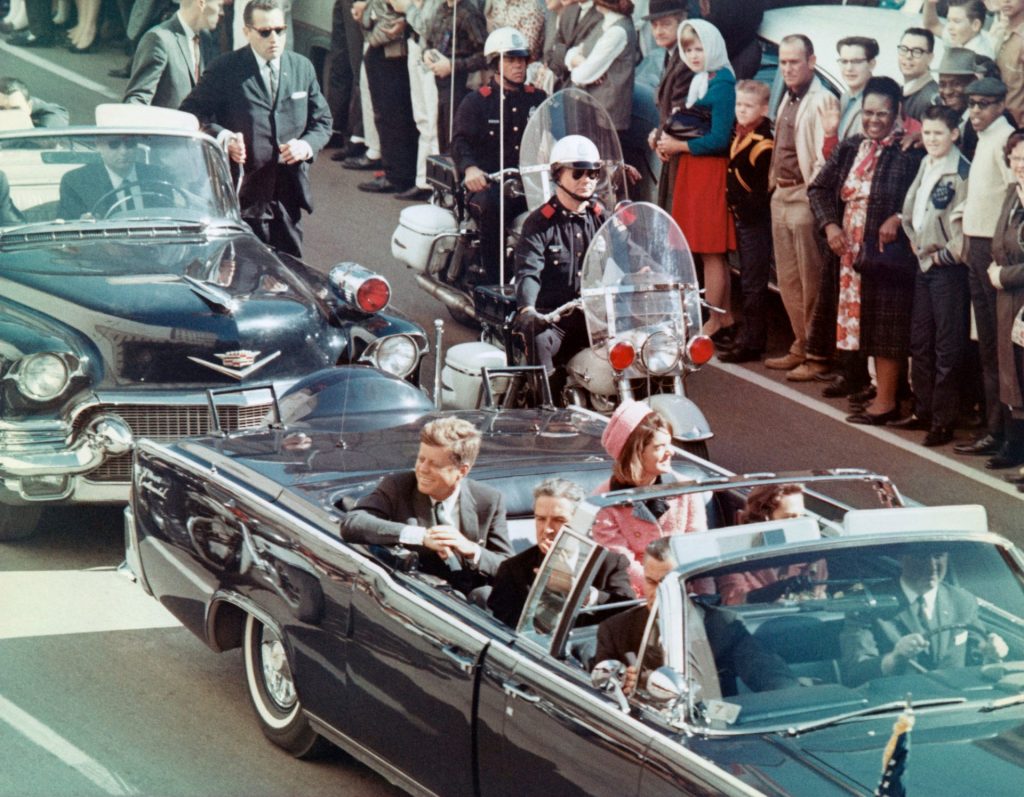
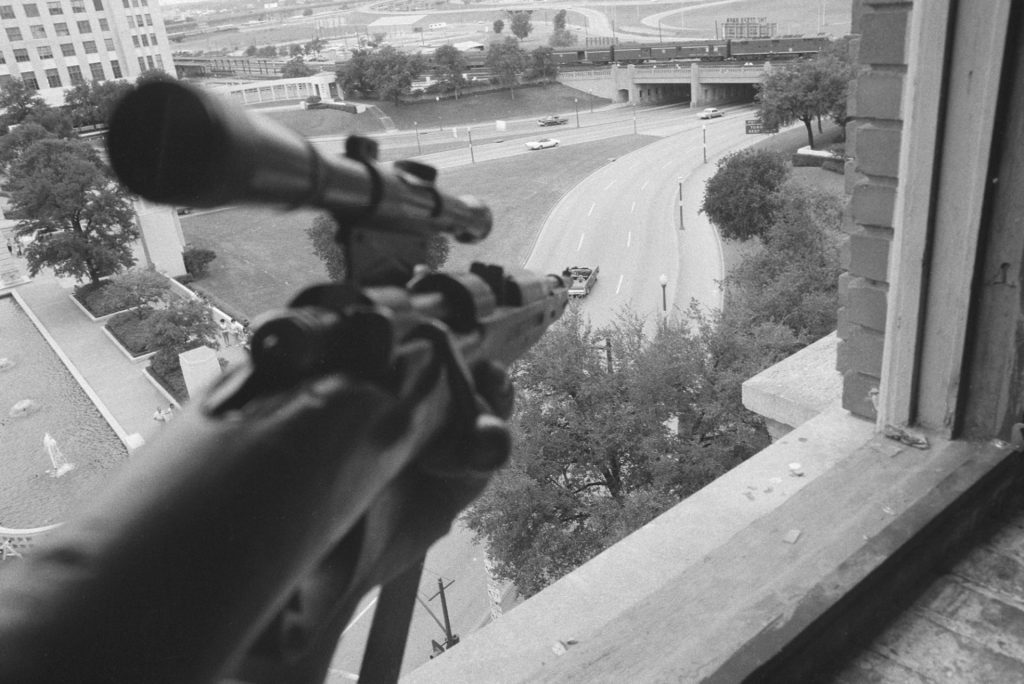
It’s Friday, November 22, 1963. The time is 12.30pm. We’re in downtown Dallas. President Kennedy’s limousine has just passed the Texas School Book Depository and crawls along Elm Street.
A man approaches the kerb and opens a large black umbrella. Just a few feet away, in a moment that would later seem almost choreographed, another man, wearing a black cap, raises his right arm in the air. Completing the impression of synchronicity, it’s at this precise moment that the assassin’s first bullet strikes the president.
Kennedy’s limousine speeds towards Parkland Hospital, and the bystanders have, all of a sudden, become witnesses. Many run towards what becomes known as the Grassy Knoll, convinced the shots came from behind a picket fence there. Others race towards the Book Depository itself.
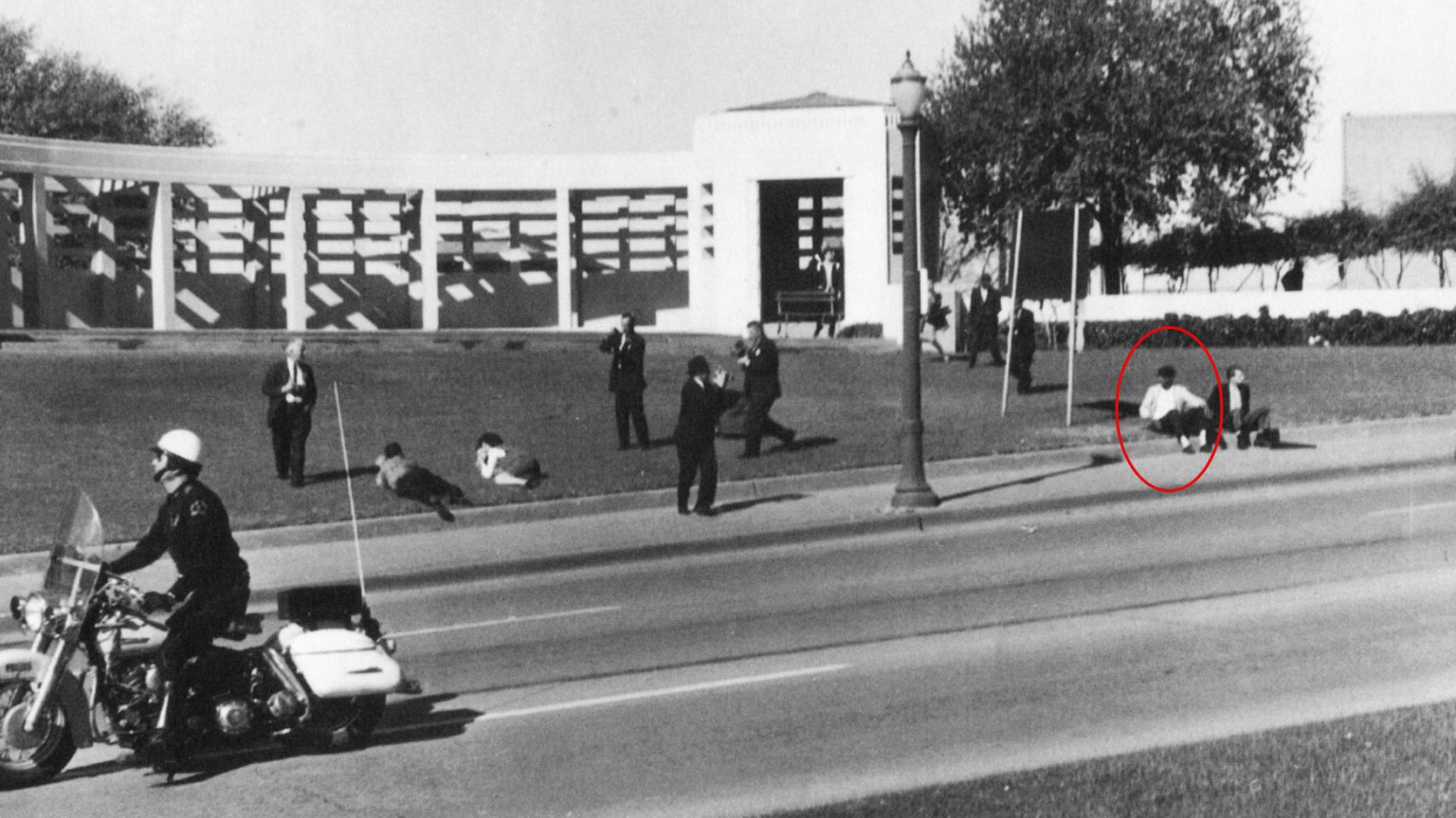
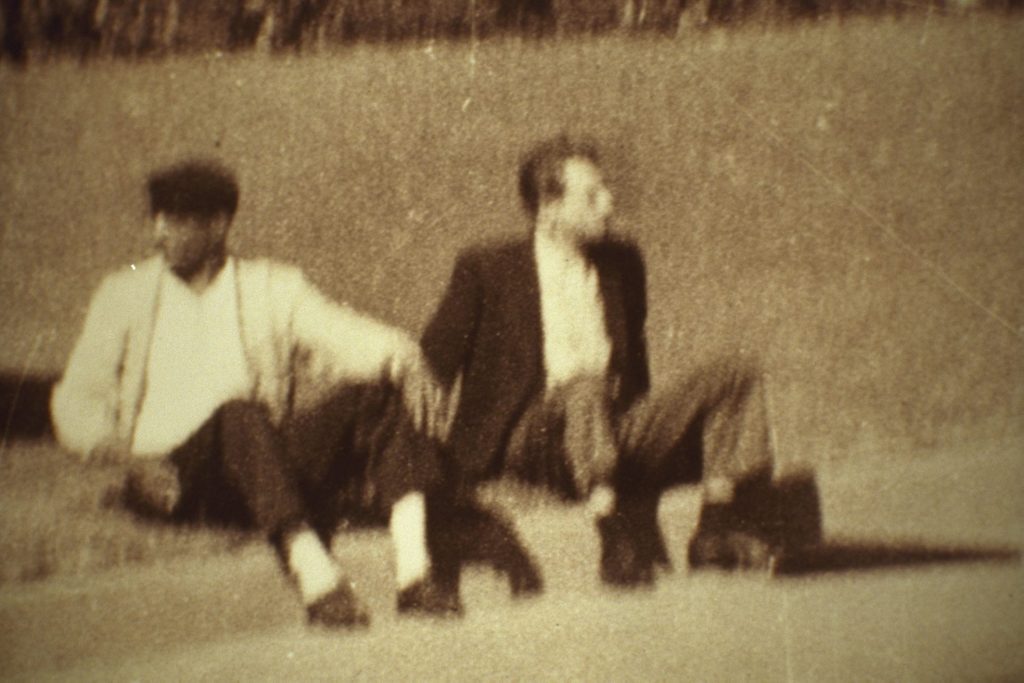
In among the shock and pandemonium, the Umbrella Man, as he’ll soon become known, sits on the kerb of Elm Street, his accessory now closed. Joining him is the man in the black cap. The two men sit side by side and quietly observe hell breaking loose around them, seemingly in no rush to join the hunt for the assassin.
A few minutes later, they stand and depart separately. The Umbrella Man walks back towards his office and slots back into his normal life, where he’ll remain blissfully anonymous for the next 15 years.
Black Cap Man walks toward the Grassy Knoll and is never seen again. He’s never interviewed by the police or any government agency. To this day, his identity remains a mystery. Everything we know of him is contained in just a few grainy photographs, taken during the most studied six seconds of the 20th century.
In the years following the assassination, researchers zoomed in on these snapshots and concluded that Black Cap Man was a person of colour, wearing a white cardigan and glasses. After some lateral thinking and considerable guesswork, they decided his skin colour meant he was probably a Cuban exile, and his cap was less a fashion choice and more a revolutionary beret in the style of Che Guevara. A freeze-frame had been conjured into a three-dimensional suspect.
The researchers zoomed in further, and what they saw this time would seal this man’s fate. In one photograph, they believed they could see Black Cap Man speaking into a walkie-talkie. In subsequent images, he appeared to tuck the device into the back of his trousers, before disappearing for ever. The images were hazy and unclear, but the lack of definition, ironically, defined him.
The researchers concluded that the two men were part of a ground team in Dealey Plaza – Umbrella Man providing the visual signal, Black Cap Man relaying the results via radio. As a plan, it made perfect sense: risk-averse, with built-in redundancy. And once it had been executed, it was little wonder that both men disappeared from the scene.
In the court of assassination literature, their silence was used to convict them. If they were innocent bystanders, the argument went, they would surely have come forward. So why hadn’t they?
In 1978, the Umbrella Man’s long-held anonymity finally came to an end when he was identified as Louie Steven Witt, a Dallas resident who worked in insurance. Witt was hauled before the House Select Committee on Assassinations, where he gave his own remarkable explanation about his actions in Dealey Plaza.
However, it was what he said about Black Cap Man that proved most revealing to this story. “Sometime later, after the cars moved out, I recall a man sitting down to my right and he said something like – ‘they done shot them folks’. He repeated it two or three times.”
When asked to describe the man, Witt said he remembered him as Black – but that he didn’t recall looking at him for any length of time. Asked directly whether the man had been carrying a walkie-talkie or radio, Witt said he didn’t recall seeing one, though he allowed that it could have been there without him registering it.
The committee pressed harder, telling Witt that the man beside him was alleged to be Cuban, and that photographs suggested he’d been talking on a two-way radio. Could Witt remember anything that might help identify him?
“I wish I could give you more information, but I am sorry I can’t. Those walkie-talkie things are fairly large. I feel like I would have remembered that. I can’t say with 100% certainty, but somehow I just feel like I would.”
And with that, the official investigation into Black Cap Man was over. All that remained was a phrase – “they done shot them folks” – repeated to a man who wasn’t even looking at him.
For those already suspicious of Witt, his comments regarding Black Cap Man were seen as more misdirection and obfuscation. For them, the debate rages on, and you can now submerge yourself in an abundance of theories on your app of choice.
On YouTube, for example, the most popular video on the topic has a total of 393,000 views and 1,643 comments, many of which support the idea that these two men were part of the plot to kill Kennedy.
On Reddit, a 2025 thread titled “The Signalman in Dealey Plaza” features a trail of comments ending in detective emojis. The latest theory on Black Cap Man identifies him as Felipe Vidal Santiago, a former Cuban naval officer who fled the country when Fidel Castro came to power.
Do people see what they want to see when they look at these photographs? I think, in some cases, the answer is undoubtedly yes. The theories generated from these images were so well developed, so entrenched in the psyches of the theorists, that they became immune to the slightest doubt.
In the absence of answers, we’re left with a vacuum that can be filled with all sorts of theories and projections. So, while we’re speculating, let me add my own theory to the pile and provide another reason as to why Black Cap Man may have wanted to remain anonymous. This one is far removed from signals and walkie-talkies – it’s about being a Black man in 1963, in a city like Dallas.
At the time of the assassination, Dallas was still operating under a Jim Crow system of racial segregation and discrimination toward its Black citizens and, as a result, their daily reality was one of systemic hostility and injustice. Black residents were denied mortgages in white neighbourhoods, their children were educated in segregated and underfunded schools, and their communities were over-policed and under-protected.
They were quick to face arrest, but slow to receive protection or service. If a Black person should end up in court, they would almost certainly be tried by an all-white jury, and a 1963 memo from the office of the District Attorney explicitly advised against “Jews, Negroes, Dagos, Mexicans or a member of any minority race” from taking part in the judicial process.
These attitudes were so prevalent in Dallas that they permeated the investigation itself. If you look carefully at the witness testimonies, you can see it time and again.
For example, when the Black witnesses on the fifth floor of the Texas School Book Depository were questioned, they were all asked if they had been in trouble with the law before – a question not known to be directed to any of the white witnesses. And when the Warren Commission’s star witness, Howard Brennan, was asked about those same men, he admitted, “through my entire life, I could never remember what a coloured person looked like if he got out of my sight. And I always thought that if I had to identify a coloured person I could not.”
Now, I should make a confession. The man I’ve been calling Black Cap Man isn’t actually known by that name among assassination researchers. He wasn’t called Cardigan Man or Radio Man either – names that would have followed the Umbrella Man precedent. Instead, the people responsible for assassination nomenclature went in a different direction. They focused on the colour of his skin. For the last 63 years, he has been known as the Dark Complected Man.
Whenever I see that name, it makes me pause. It isn’t just the outdated terminology – it’s the fact that his skin colour was chosen as his defining feature, during a time when Black people in America faced legally mandated discrimination.
In a case obsessed with forensic precision, his label was vague, lazy, and loaded with bias. Given all of that, is it not understandable that a Black witness might choose not to come forward – particularly when he had already been reduced to a racial descriptor?
There is one more piece of evidence that supports this reading. Just prior to the assassination, a young Black couple were sitting on a bench near the grassy knoll, having their lunch. A nearby witness, Marilyn Sitzman, described them as being between 18 and 21 years old.
After the shots were fired, Sitzman saw them throw down their Coke bottles and run. A Secret Service agent corroborated the account, reporting a Black male running across the grass towards some concrete steps.
Photos taken 30 seconds after the assassination show no sign of the couple. The remains of their lunch were found an hour later – two small bags and a pool of spilled soda – but the couple themselves were gone.
Just like Black Cap Man, they chose anonymity over testimony. We should ask ourselves why. Is there a pattern here that tells us more about the Black experience in Dallas in 1963 than who shot the president – and why?
Looking at these witnesses through a racial lens, rather than a conspiratorial one, may help us understand their behaviour. Perhaps not everyone’s reaction to those six seconds WAS a sign of guilt or innocence. Perhaps they’re reflective of the reality of their lives, not the fictions we’ve created for them.
Whenever I look at the photographs of Black Cap Man, I see the weight of everything we’ve piled on top of him since 1963. He has been buried under theories, accusations, and misidentifications.
Suggested Reading
MAGA’s magic bullet
A hand raised in the air becomes a signal to assassins. An unclear shape in a grainy photograph becomes a walkie-talkie. Silence becomes proof of complicity.
But if Louie Steven Witt was telling the truth, we’re looking at a man in shock, repeating the same stunned words over and over again – not in Cuban Spanish, but in the voice of a Black Texan who had just watched something terrible happen in front of him: “They done shot them folks.” And then he disappeared, for ever.
The investigation, as it so often does, reveals more about us than it does about him. A hand could just be waving. A radio could just be a radio. And silence – in 1963, in Dallas – could simply be self-preservation.
Everything is possible in Dealey Plaza. Even the things we haven’t thought of.
Adapted from The Umbrella Man and Other Stories by Martin Fitzgerald, published by Biteback on April 28. A one-man show based on the book is running at the Spire @ Surgeon’s Hall during the Edinburgh Fringe, August 7-29. Follow Martin on BlueSky or Instagram