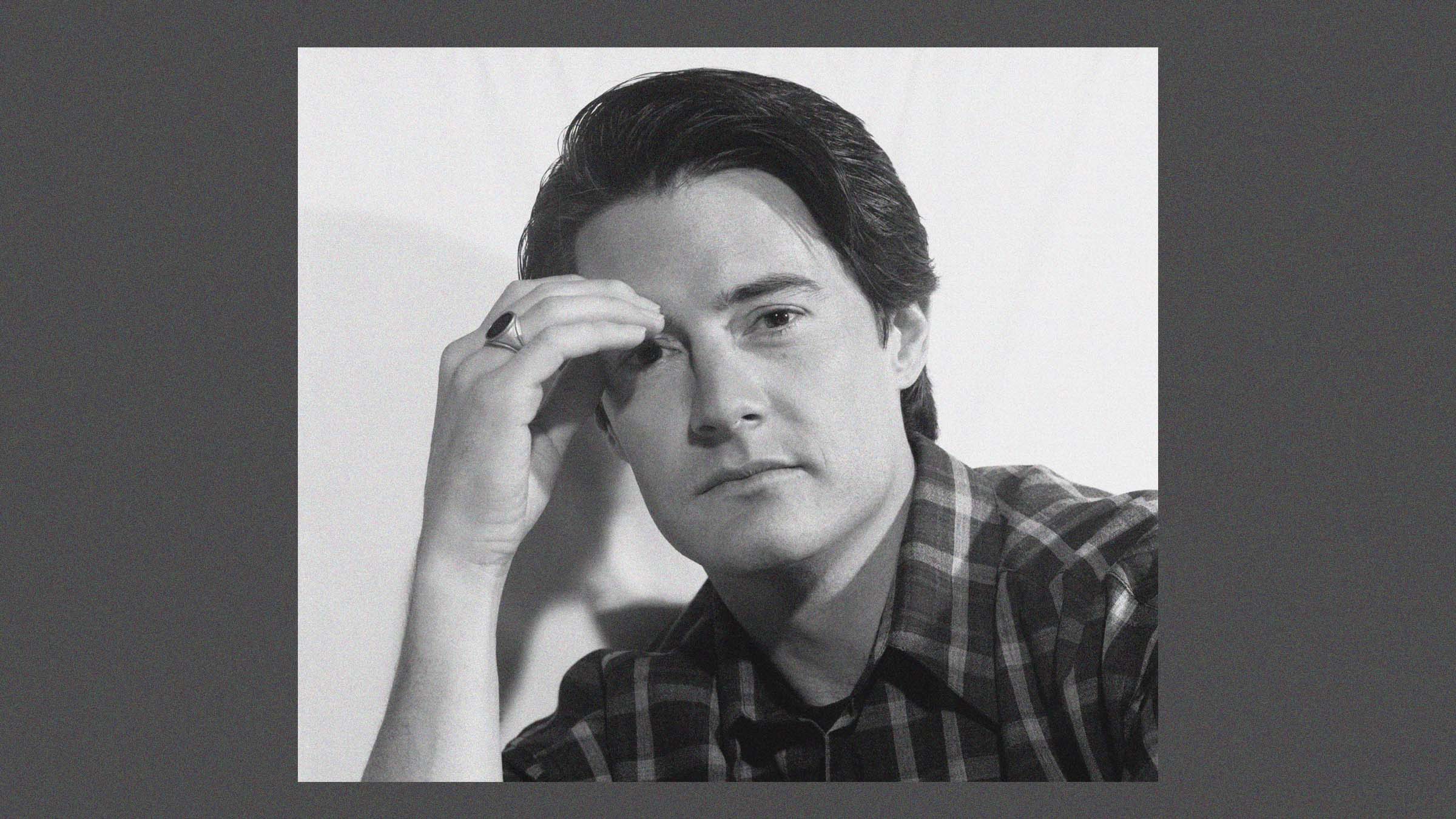
There’s a scene in Blue Velvet when Jeffrey and Sandy are walking down the street late one evening in the small, quiet town of Lumberton. “Do you want to see the chicken walk?” Jeffrey asks Sandy. “Sure,” she says. And her date walks Groucho Marx-low, his thin neck pistoning and his arms in tight, flightless wings at his side.
“That’s … interesting,” she duly says.
The moment was unscripted, the result of David Lynch seeing Kyle MacLachlan goofing around for the crew’s amusement. Laura Dern’s reaction was genuine befuddlement as she wasn’t in on the gag. And the moment captures the essence of actor MacLachlan’s almost heroic uncool.
Born in Washington State, MacLachlan’s story – as recounted in his new memoir Fictional Selves – is one of an ordinary kid who is plucked from obscurity into a strange realm of hesitant, stuttering stardom.
The son of a 1950s-style conservative dad and a more artsy school counselor mom (soon to be divorced), we first find him in the Mexican desert where he is starring in Lynch’s new film Dune. Nearly four decades before Denis Villeneuve’s adaptations, it is the first cinematic incarnation of Frank Herbert’s science fiction epic, a book to SF fans what Lord of the Rings is to fans of fantasy. Already, Alejandro Jodorowsky had tried and failed to bring the monster volume to life, with Salvador Dali set to play the villain.
Then Dune fell to Lynch. It would be his third film, after Eraserhead and The Elephant Man. Unlike Lynch, who didn’t care for the book, MacLachlan was a huge fan but only stumbled into the role when spotted by a casting director while performing Tartuffe by Moliere in Seattle. He didn’t achieve fame so much as have fame fall on him, he writes.
The production was epic, noxious and uncomfortable, but he had beaten out more experienced and sexy young actors – Tom Cruise and Val Kilmer were both in the running – to get the role of Paul Atreides, the boy who would become a Messiah to the Fremen; revenge his family and become Emperor of the Galaxy. Now, surely, global fame was assured.

Except the stars did not align. The film was taken away from Lynch and chopped down from its original four-hour length to a more bum-friendly 135 minutes. But what the buttocks gained, the brain lost.
The Spice refuses to flow for the first two-thirds of the movie and then, just as everything begins to make sense, the third act has a skip-to-the-end rush that loses the audience. Billed as Star Wars for grown-ups, Lynch’s Dune fundamentally misunderstood the appeal of Star Wars. It was like Jaws without the shark, just Amity and safe beaches. I mean, okay, I guess.
Following Dune, there’s a slump in MacLachlan’s career during which he makes some truly bad decisions, like not starring in Platoon. Tony Scott auditions him for Top Gun and instantly knows he’s not right, which, as anecdotes go, isn’t the best.
Even when discussing failures like these, MacLachlan is cheerful enough; a personality he’s further developed on his podcast and through a series of embarrassing or unembarrassed (depending on your cringeometer) posts on his Instagram account. He entertains a conceit whereby there’s another Kyle internally monologuing negatively with himself as if to add a further dimension, but I don’t really buy it.
Then Lynch returns to save Paul Atreides. He makes the neo-noir Blue Velvet, using MacLachlan as a kind of avatar for his own brand of midwestern weird. He and Lynch team up again for Twin Peaks, and Dale Cooper, the FBI agent with a taste for damned fine coffee, gives MacLachlan genuine fame as a household name and puts his face on magazine covers.
As well as directing its best episodes, the director appears as hard-of-hearing FBI man Gordon Cole, always at a higher volume than the rest of the town’s inhabitants. His habit seems rooted in the truth, and Lynch’s honking voice rendered in all CAPS makes for the funniest parts of the book: “WELL DARN IT, KALE!”
But soon MacLachlan could feel a decline in quality as the network took over, and Lynch’s perspective was squandered by executives who wanted to run with the zeitgeist and turn Peaks into Dallas. The film which succeeded it, Fire Walk With Me, is characterised by MacLachlan as Lynch’s revenge on the show and the network.
His own role is halved in the script, and some of his part given to Keifer Sutherland and Chris Isaak. He would be halved again in The Return but this time, he’d get to play both parts.
Stars’ biographies are always negotiations between drawing back the curtain but not too far. MacLachlan pulls many of his punches; a co-star is berated for being obnoxious but not named (it is almost certainly Bill Murray, with whom he appeared in a 2000 version of Hamlet).
The reticence is especially obvious when it comes to his own romantic behaviour. The attentive reader might note that he has a way of skipping from co-star to co-star, usually with the excuse that the previous relationship was “treading water”. Don’t be so hard on yourself, buddy.
Suggested Reading

Bonnie Garmus: ‘Donald Trump would not understand my book’
As he goes from his old girlfriend to Laura Dern to Twin Peaks’ Lara Flynn Boyle and then to supermodel Linda Evangelista and then to his now-wife Desiree Gruber, a producer and entrepreneur, I have to say, I’m beginning to reappraise the potential effects of that chicken walk.
Beyond his other roles – I forgot he was Ray Manzarek in The Doors – the most infamous was Showgirls, the Paul Verhoeven fleshfest that is part way between Debbie Does Dallas and The Room. In one particularly notorious scene, he is almost orgasmatronned to death in a swimming pool by Elizabeth Berkley. Once he saw the finished picture, he developed a strategic cold and was unable to attend the press junket.
MacLachlan emerges from the pages as a smart, charming, self-deprecating actor with an oddball CV, if a bit squeaky-clean. Perhaps too clean.
Aside from the hits and misses already mentioned, he has had crowd-pleasing stints in big franchises – Sex and the City, Desperate Housewives and How I Met Your Mother, as well as pairing up with Halle Berry on The Flintstones live-action movie. He is certainly more cunning Agent Cooper than naive Dougie Jones.
Yet he’s convincing. His newly realised internet persona as a good sport and honorary babygirl of the Brat era has managed to prove that you can’t be cringe if you don’t know what cringe is. Just ask the chicken.
Fictional Selves: A Memoir by Kyle MacLachlan is published by Century. Kyle MacLachlan is on a book tour of Britain from October 18-21
 Most popular
My truly deranged encounter with Trump apologist Kellyanne Conway

Is this the real reason Trump keeps falling asleep in public?

Why are all AI posters so bad?

23 stupid reasons why Britain should never rejoin the European Union