
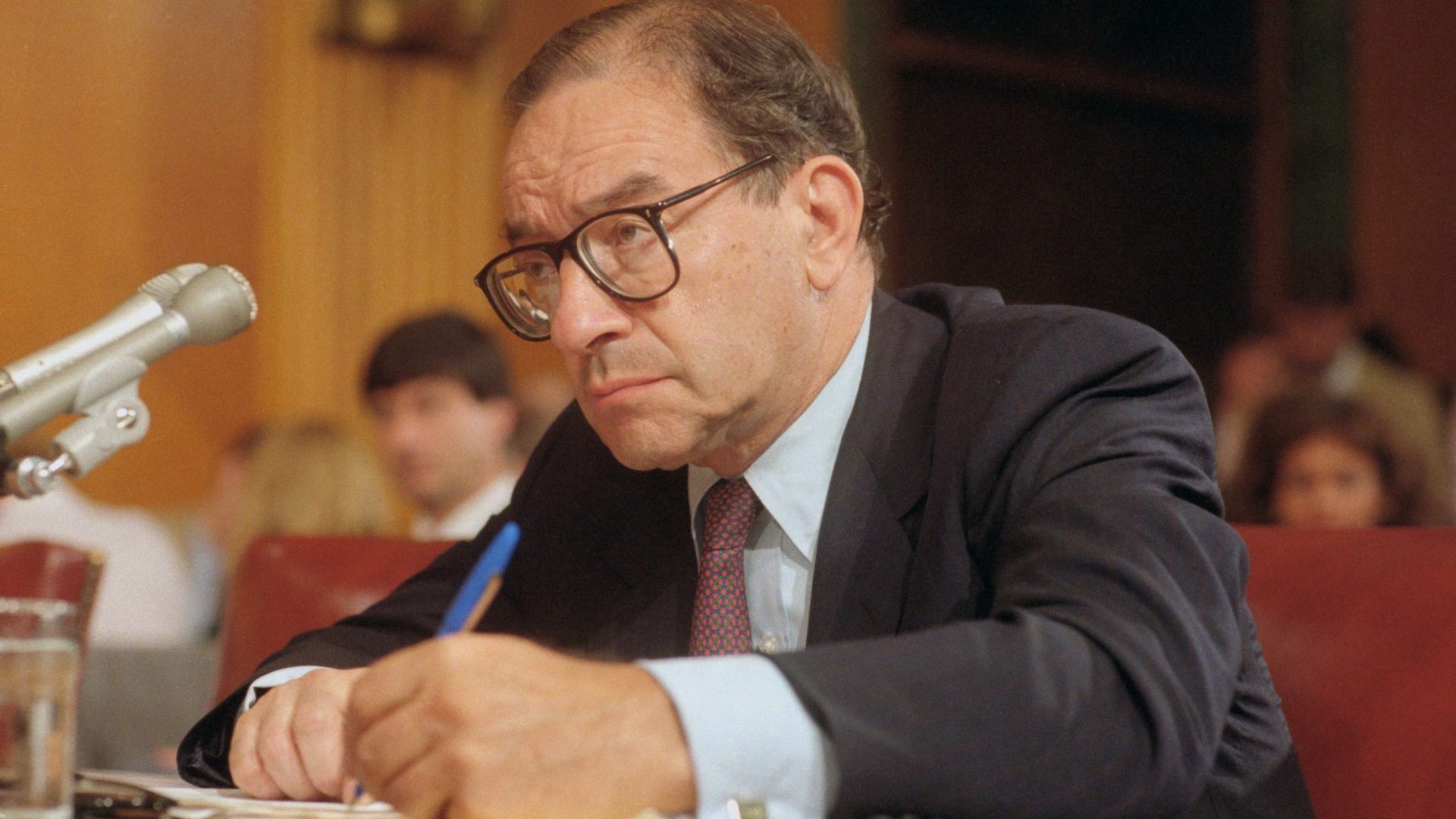
Alan Greenspan, who recently died aged 100, became chair of the US Federal Reserve Bank in 1987 just over a fortnight after Guns ‘N’ Roses released their seminal album Appetite for Destruction, which, it turned out, was a fitting coincidence. Greenspan, despite his intellectual swagger, his charm and his immense self-assurance would turn out to be perhaps the most destructive bureaucrat in US history.
And he was a bureaucrat. Despite his schooling at the feet of the philosopher Ayn Rand, who taught the chilly, Objectivist gospel of letting the rich dominate, and sod everyone else, Greenspan’s reputation was forged during his career overseeing a public sector body. It was an irony that seemed to escape both him and the scores of libertarian finance bros who adored him.
He was chair of the Federal Reserve from 1987-2006, serving a sequence of four year terms, and for much of that time he was one of the most influential figures – if not the most influential – in the global economy. It was Reagan who appointed him, describing Greenspan as an “economist’s economist”. At his swearing in ceremony, Greenspan thanked Reagan, and then, in a remarkable turn of self-confidence, told the crowd:
“I should also thank in advance the creators of all those events that will make the next four years easygoing: inflation which always stays put, the stock market which is always a bull, a dollar which is always stable, interest rates which stay low, and employment which stays high. But most assuredly, I would be thankful to those who have the capability of repealing the laws of arithmetic, which would make all of the foregoing possible.”
Suggested Reading
Economic growth? So what?
It’s an economist’s idea of a joke – but Greenspan kind of got his wish. Sure, there were big economic problems along the way. In October 1987 he had to deal with Black Monday, when he cut interest rates to stave off the market panic. He had to deal with the 1990-91 recession, the Asian financial crisis of 1997 and the near-catastrophic collapse of Long Term Capital Management in 1998.
But on the broader level he was presented with global economic conditions that offered him the chance to put his Randian worldview into practice. The first thing in his favour was the new financial de-regulatory mood that had taken hold on both sides of the Atlantic.
Greenspan was all in favour of this. He wanted to tear down the old rules that he saw as holding back Wall Street, and by association America. Addressing congress in 1987, he railed against, “Perhaps the single most important anomaly that now plagues our financial system – the artificial separation of commercial and investment banking.”
That separation, between high street and investment banks had been put in place after the crash of 1929 by Franklin Roosvelt to protect ordinary Americans from the financial shenanigans of Wall Street. But that sort of caution is the very opposite of the Randian world view.
Greenspan called for “a full repeal” of that separation, arguing that it would loosen “restrictions on underwriting and dealing in specific types of securities such as revenue bonds or commercial paper.” Eventually, in the Financial Services Modernisation act of 1999, Bill Clinton signed the law that took down this piece of post-depression era regulation.
But perhaps an even more important factor was the emerging relationship between the US and China. America was importing huge amounts of cheap Chinese goods, and this had two effects. First, it meant that US shoppers could buy cheap stuff in the shops, which kept inflation down. Second, it meant the Chinese banks ended up holding huge amounts of dollars and they used these dollars to buy US government bonds.
From Greenspan’s perspective at the Fed, this created an extremely juicy economic situation – consumers kept spending, inflation was low, huge amounts of dollars were coming back into the American economy from China, and he was able to keep interest rates low. Wall Street loved him for it.
Greenspan, the central banker, became something of a star. I spent about a decade as a financial journalist, passing through CNBC followed by London’s finance think tank land where I edited an economic journal. At that time Greenspan was regarded with awe.
Sure, no one could really understand what he said, but the moment anyone announced that they had met Greenspan, or they’d been “talking to Alan”, everyone paid attention. Paul Volcker, Greenspan’s predecessor at the Fed, was still around at the time, but no one had ever been so excited about him. (But then Volcker’s time at the Fed coincided with much nastier economic circumstances.)
There was an almost priestly quality to Greenspan. Something about his low, croaky voice and the relentlessness of his speeches made them seem almost oracular. Take these remarks, for example, made to congress in February 2004:
“Looking forward, the prospects are good for sustained expansion of the US economy. The household sector’s financial condition is stronger, and the business sector has made substantial strides in bolstering balance sheets.”
“Narrowing credit risk spreads and a considerable rally in equity prices have reduced financing costs and increased household wealth, which should provide substantial support for spending by businesses and households. With short-term real interest rates close to zero, monetary policy remains highly accommodative.”
It is hard to imagine a bolder statement from the head of a central bank, not least the Fed. But it’s already possible to glimpse, among all the jargon and the self-satisfaction, the seeds of what was to come. For anyone who went through the financial crisis of 2007-9, references to “narrowing credit risk spreads” “increased household wealth” and “short-term real interest rates close to zero”, are enough to make the hairs stand up on the back of your neck. There was a disaster brewing, and he couldn’t see it.
Suggested Reading
Will Trump’s Iran War cause a global economic crash?
The charge will always be that Greenspan was culpable for the financial crisis. He wasn’t entirely to blame – no individual could have single-handedly summoned up an economic disaster so colossal. But of all the people who could have done something about it, Greenspan was right up there.
He, more than anyone, would have seen the bubble that was inflating in the US housing market, pumped up by his policy of low interest rates and bank deregulation. A hike in rates would have cooled things down, but for Greenspan, being able to tell congress that rates were “close to zero” was his real goal.
It was what came to be known as “the Greenspan Put” – sure, he would cut rates to stop asset prices falling, but he’d never increase rates to stop an upward spike in asset prices. And so the housing bubble grew and grew as people happily borrowed all that cheap money at low rates and spent it on yet more houses, and Greenspan did nothing about it, because to act would have been against his principles.
The bankers then took all of these mortgages and packaged them up into financial products with absurd names like “Collateralised Debt Obligations”. These turned out to be so complex that almost no one took the time to understand them, or work out what would happen to them if the house prices on which their value depended suddenly dropped.
By 2005, there were clouds on the horizon. In July that year, Greenspan told congress: “We certainly cannot rule out declines in home prices, especially in some local markets. If declines were to occur, they likely would be accompanied by some economic stress.” But, Greenspan assured the congressional committee, the “macroeconomic implications need not be substantial.”
His conclusion was that “nationwide banking and widespread securitization of mortgages make financial intermediation less likely to be impaired than it was in some previous episodes of regional house-price correction.”
He really did speak like this – and not just in his public appearances. According to Bob Woodward’s biography of Greenspan, when he proposed to his second wife, he phrased it in such a complex way that she had to ask him to repeat it. The jargon was part of the Greenspan mystique. A clever, wrinkly old man using clever-sounding words, like a Yoda of the central banking world – surely he knew what he was talking about. And what he was telling congress in 2005 was that everything was just fine.
But it turned out that Alan Greenspan was wrong. Things were not fine. The “macroeconomic implications” of falling house prices were very serious indeed. The “widespread securitization of mortgages” (those CDOs) did not make “financial intermediation less likely to be impaired.” Mortgage-backed securities were about to choke the global financial system, almost to death.
Greenspan stepped down in January 2006 and when his successor, Ben Bernanke, gave a statement to congress in July 2007, his analysis seemed to come from a parallel economic reality. “Conditions in the subprime mortgage sector have deteriorated significantly, reflecting mounting delinquency rates on adjustable-rate loans,” said Bernanke. Translation: Americans can’t pay their mortgages.
Suggested Reading
Coretta Scott King, the architect of a legacy
“In recent weeks, we have also seen increased concerns among investors about credit risk on some other types of financial instruments.” Bernanke was describing the start of the global financial crisis.
Having left office, Greenspan set up a consulting firm, Greenspan Associates, and one of its first forecasts predicted that the US was heading for recession, which was – all things considered – brutally ironic. He also took on roles with PIMCO, the colossal west coast bond fund, with Deutsche Bank, and also with a hedge fund in Palm Beach which had foreseen the collapse of the sub-prime mortgage market. Greenspan’s policies at the Federal Reserve had played a substantial role in that collapse.
Greenspan returned to congress in 2008 for hearings on the crisis, and this time the committee’s questions were far more combative. The chair read one of Greenspan’s own statements back to him: “Free, competitive markets are by far the unrivaled way to organize economies. We have tried regulation, none meaningfully worked.” As the global economy was crashing all around them, the committee chair asked, did Greenspan still cling to this ideology?
“Well, remember, though, whether or not ideology is, is a conceptual framework with the way people deal with reality. Everyone has one. You have to,” said Greenspan, in a rare loss of fluency. But then he regained himself: “To exist, you need an ideology. The question is, whether it exists is accurate or not. What I am saying to you is, yes, I found a flaw, I don’t know how significant or permanent it is, but I have been very distressed by that fact.”
At least he had the intellectual honesty to admit his own shortcomings. But by then it was too late. The financial crisis destroyed an almost unimaginable amount of wealth. People lost their homes, huge Wall Street global institutions simply vanished overnight. Governments around the world spent billions bailing out banks and taxpayers picked up the bill.
The longer-term result was austerity, the euro crisis and punishing levels of unemployment across the world. The UK economy still hasn’t really recovered from the effects of the financial crisis. The damage looks permanent, particularly in terms of productivity. It also triggered the beginnings of the global anti-elite political wave that is washing across us now (and which I have written about here.)
Alan Greenspan was one of the most consequential figures of our time, but not in the way he would have hoped. Yes, he was brilliant, captivating, and a highly gifted musician who studied at the Julliard. But he was also someone who got hold of an idea in the 1950s and didn’t change his mind for six decades.
What he demonstrated more than anything was the danger of being a political system-builder. For that, really, is what he was. He used his formidable influence to drag the global economic system towards a free market, financial-libertarian ideal of his own imagining.
The problem was that, in the end, it didn’t work. The result was destruction.
 Most popular
My truly deranged encounter with Trump apologist Kellyanne Conway
The moral depravity of Robert Jenrick

Is this the real reason Trump keeps falling asleep in public?
Suella Braverman’s book has sold only 106 copies. This is why