Ever since Donald Trump romped to victory in the 2024 presidential election, Democrats have been looking for a left-wing answer to Joe Rogan, host of the world’s most popular podcast and a secret weapon in Trump’s arsenal – a man credited with winning over young men to the Maga cause.
Rogan has, to his millions of fans, the air of being an ordinary guy, a broadcaster and comedian who never used to wear his politics on his sleeve. In the years since the Covid pandemic, Rogan’s outlook has been increasingly conspiratorial and credulous – and his approach to Trump and Maga ever friendlier.
Joe Rogan still styles himself as an independent and an everyman, but he sat for hours giving friendly interviews to Trump and JD Vance in 2024, while never managing to set anything up with Kamala Harris.
As a result, Rogan brought Trump the kinds of voters traditional campaigns simply couldn’t reach. Democrats either needed a politician who could sit down and get along with Joe Rogan, or they needed their own answer to him. In Graham Platner, the party thought it might have found both.
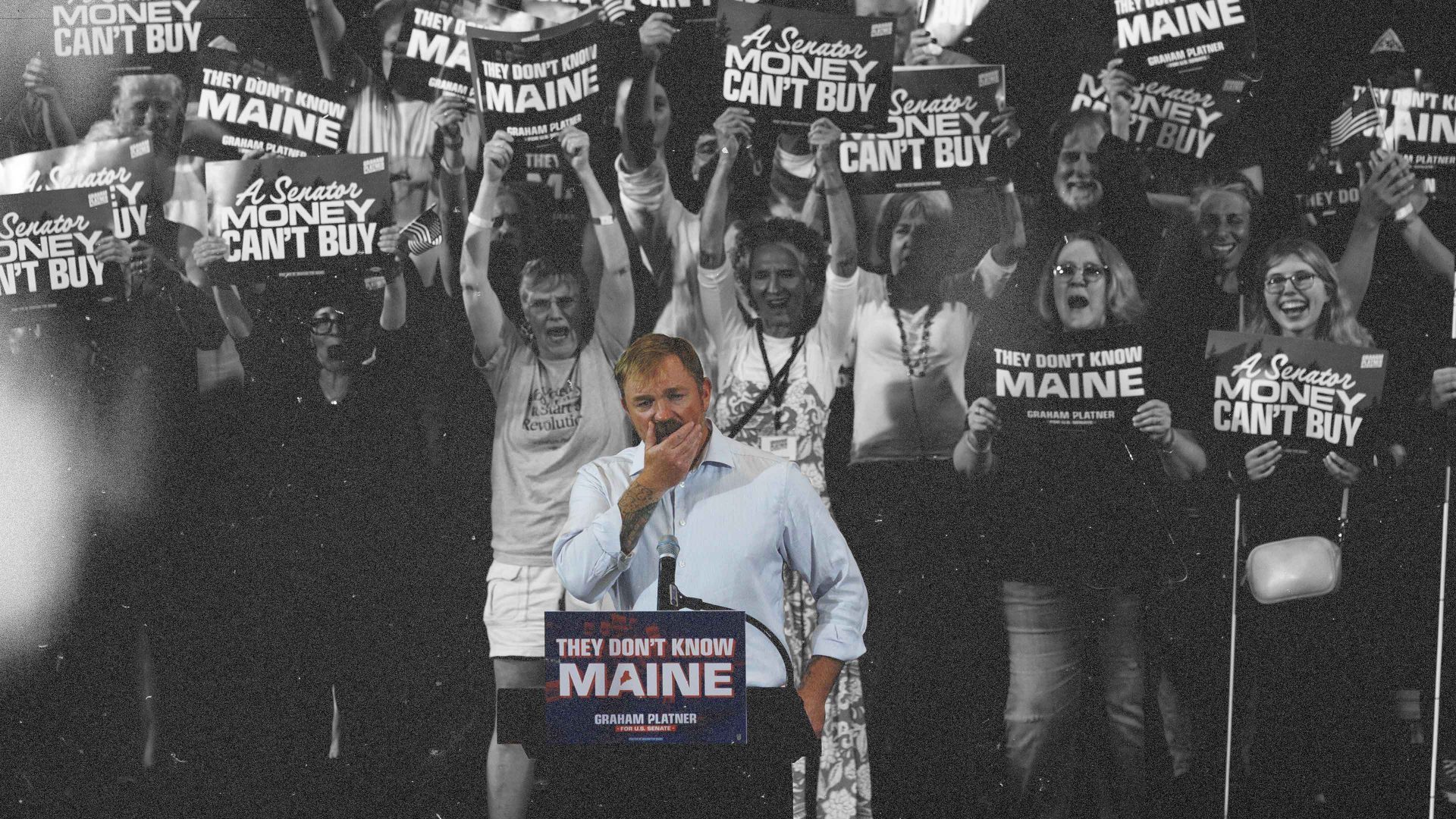
Platner emerged as if from nowhere in the summer of 2025 as a prospective challenger for one of Maine’s two Senate seats in November 2026 – an absolute must-win if the Democrats are to have any hope of reclaiming the Senate, and with it the power to block Trump’s cabinet appointments and judicial nominees.
Suggested Reading


Happy birthday, America. It’s a shame about your king
To get that Maine seat, though, the Democrats have to unseat Susan Collins, a veteran Republican who managed to hold it even when her state turned decisively against Trump. When it was last contested in 2020, Maine voted for Joe Biden over Trump by a margin of eight points. Collins, though, kept her Senate seat by a seven-point margin – a huge personal vote of confidence.
Defeating her, Maine Democrats reasoned, would take a deeply unconventional candidate. That the party establishment was trying to position the state’s unpopular 78-year-old incumbent governor as their contender made the need for a challenger even more obvious. That’s when talent scouts turned up on the doorstep of Graham Platner.
On paper, Platner ticked every box someone looking for a Rogan-like figure of the left could dream of. A Maine native and Marine veteran in his early 40s, Platner was working as an oyster farmer – with no history of involvement in politics. His messaging was unabashedly populist: anti-oligarch, anti-foreign wars, and convincingly in favour of tackling the affordability crisis.
Here was a Democratic candidate who looked and sounded like a “real” American man – whatever that means – and who couldn’t be dismissed as a big city coastal liberal. As if to emphasise that point, his launch video showed him diving for oysters, and chopping wood. He laughs as he remarks on how his hobbies include shooting pistols.
The party finally had a convincing working-class avatar, even if this required a little fudging of the details: Platner’s family background was wealthy, oyster farming was a relatively new business for him, and his main customer was his mother’s restaurants. But details matter much less than aesthetics, and the supportive headlines rolled in. “This Maine oysterman thinks Democrats are doing ‘jack’ about fascism,” said the Guardian. “Maine’s Populist Senate Candidate Thinks We Are in a New Gilded Age,” agreed American Prospect. The Nation went a step further: “Graham Platner Is the Real Deal,” it promised.
Here was a candidate to get excited about, even when some of the gloss inevitably took a few knocks. When Platner’s history of dubious Reddit posts was unearthed, it was easily shrugged off – his unpolished language and outdated opinions were a sign of his authenticity, just part and parcel of a candidate from outside the political elite.
But as early as October 2025, something came along that was much harder to ignore: footage of Platner showed that he had a very distinct tattoo of a skull and crossbones across his chest. Specifically, it was the Totenkopf, or “death’s head”, a symbol indelibly associated with the Nazi Party in general, and the SS in particular.
Suggested Reading


The American right’s war on Britain
This one was harder to explain away. But Platner had by now built huge momentum behind him, alongside an enthusiastic base, major endorsements, including senators Bernie Sanders and Elizabeth Warren, and friendly relations with influencers ranging from the leftist YouTuber Hasan Piker to the former Obama staffers behind Pod Save America. So explain it they did.
Platner, so the story went, had got the tattoo while he was in the military almost 20 years earlier, with no idea of its history. He had supposedly gone through the intervening decades never learning he had a large Nazi symbol on his body. Soon after its discovery, he had it covered up.
Some otherwise natural supporters of a campaign like Platner’s remained unconvinced, but generally his campaign continued largely unscathed. By late spring 2026, it was clear Platner would win the Democratic primary, and would become the party’s candidate against Collins this November.
There were other shoes to drop. In June, reporting from several women Platner had dated suggested he had engaged in erratic or coercive behaviour – and contradicted his claim he had been unaware his tattoo was a Totenkopf.
These were once again largely dismissed, especially because one of the women interviewed was a known Republican political operative. A further story alleging Platner had been sexting women even after his marriage was similarly shrugged off.
Some Democrats tried to question why so many possible red flags had been ignored in the enthusiasm for a candidate like Platner – why had the party needed to force someone into a particular mould, even if he didn’t fit there? But more just wanted the conversation to end, for the critics to shut up. Platner would be the candidate, and everyone just needed to get behind him, like him or not.
That all changed in early July, when a former girlfriend of Platner’s went on the record to accuse him of a serious sexual assault. Almost everyone who had endorsed Platner withdrew their support. The Maine Democratic Party said they would no longer fund his campaign. Eventually, though still denying all wrongdoing, Platner announced he would suspend his campaign.
Maine’s Democrats are now left in a similar position to that of the national party in 2024 – scrabbling to find a replacement candidate in just days or weeks, and hoping that there is still time to salvage the bigger contest. They are forced to do that even as they are locked in recriminations: perhaps they couldn’t have known about the most serious charge against Platner, but why were so many warning signs ignored? Why did their guy have to look and sound like Joe Rogan?
The reality is that any search for a left-wing answer to Joe Rogan is doomed from the start, because it’s looking for the wrong thing. Joe Rogan emerged as a phenomenon, a product of his time and his fanbase. Trying to focus group the traits that make him appeal to his fans and find a similar, marketable product is to miss the point entirely.
The trick is not to try to create a new Joe Rogan, but to harness the authentic energy of left-wing figures who emerge and speak to people Democrats otherwise can’t reach. That’s something congresswoman Alexandria Ocasio-Cortez has managed consistently since her emergence in 2018, when she won a New York primary while working as a bartender.
It is something New York Mayor Zohran Mamdani has in spades – getting elected as a left-wing firebrand, and a Muslim to boot, and yet still able to charm even Donald Trump into going easy on him.
Suggested Reading

Burnham is already winning the new Brexit wars
Joe Rogan is a powerful – and these days, malign – force in American politics. But the political space for a Joe Rogan-type figure is already filled… by Joe Rogan. Trying to get a mini-me lookalike is doomed to failure, especially when the brand relies so heavily on free-wheeling authenticity.
Democrats pursued this dead-end for nearly two years, and Graham Platner was the best they found. It has ended in disaster, and may even have already cost them their best chance of taking back the Senate.
Platner’s failure doesn’t mean that left-wing candidates can’t win. It certainly doesn’t mean left-wing voters should trust the Democratic establishment, or leave it to the centrists seemingly determined to make sure Americans are only represented in Congress by the over-70s.
Platner is the result of a failure of imagination, a belief that only a certain type of white man can appeal to young male voters. He is, ultimately, what happens when you try to fake authenticity. The last thing Democrats need is their own Joe Rogan. They need to be far more imaginative than tha