Driving into the main square of Montreuil-sur-Mer, a pretty little town in northern France, I caught sight of British and French flags fluttering a few yards apart. This is world war one territory, home to many military cemeteries, so Anglo-French flag-flying is not unusual.
This was especially attractive though, as the two flags flanked a beautiful tree. Always on the lookout for my “Tree of the Day” for social media, I parked up, and walked over to capture this splendid scene.
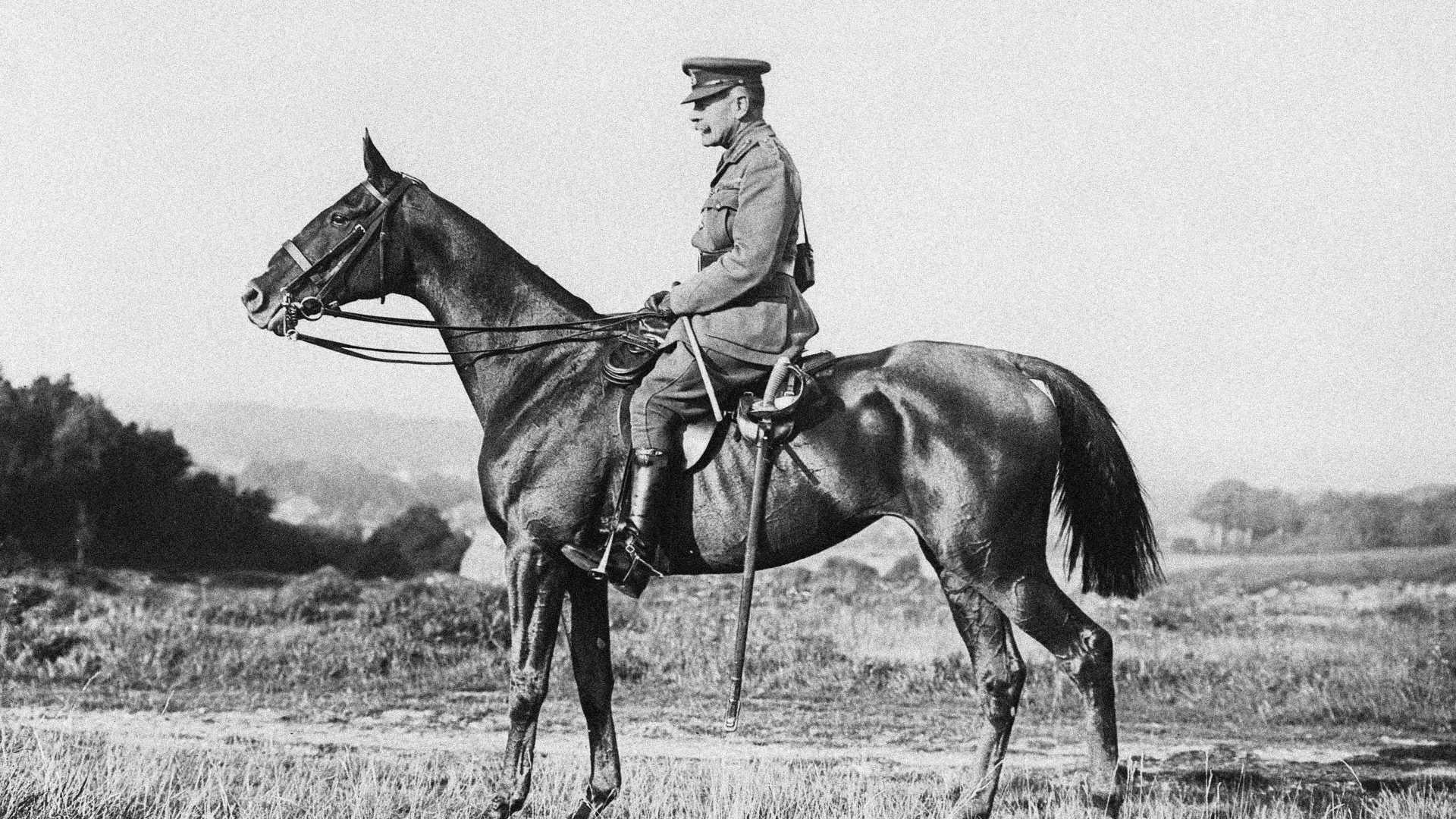
I noticed another element, a dark statue of a horseback soldier. It explained the Union flag. For this was field marshal Douglas Haig, commander of the British Expeditionary Force on the western front from 1915 to 1918. Indeed, his role in the hundred days offensive played a big part in delivering the armistice of November 11, 1918.
Not only was he eventually deemed worthy of the Montreuil statue – crafted by Paul Landowski, whose work includes Christ the Redeemer in Rio de Janeiro – but when Haig died in 1928, a day of national mourning was declared in Britain. His funeral was a major state event, his coffin followed by royals and carried by French Marshals Foch and Pétain. There is an even grander statue of Haig in Whitehall, another at Edinburgh Castle.
Suggested Reading
We are living in the age of climate unreality
The Montreuil statue, unveiled in 1931, was funded by local public subscription, but removed by the Germans during the second world war, at the end of which the locals recovered the cast of the original from Landowski, and recast a new one. So he clearly had many admirers on both sides of the Channel.
Like many military leaders, however, he was deeply controversial, and the controversy grew with time. As the full stories of the battles of the Somme and Passchendaele in particular became known, and the casualty rate under his command was calculated at around two million, “Butcher Haig” became one of his many unflattering nicknames.
A high-ranking freemason, an international polo player, and a 19th-century predecessor of David Cameron and Boris Johnson when a member of the Bullingdon Club whilst at Oxford University, he was wide open to portrayal as a member of the officer class gilded elite sending thousands of young working-class men to their deaths. On just the first day of the Battle of the Somme, 57,000 British and Empire troops were killed. Roughly the entire current population of Keighley, my birthplace.
Back at the hotel, I read a report by historian Peter Frankopan in Foreign Policy magazine, which cited Russian military bloggers suggesting that on parts of the Ukraine war frontline, Russian troops can expect to live for between 20 and 35 minutes.
Drones, and Ukraine’s current superiority on that front, have changed the nature of warfare. Britain’s intelligence agencies believe half a million Russian soldiers have been killed since Vladimir Putin’s full-scale invasion in 2022. Frankopan’s report suggested the average life expectancy of a new recruit – from training ground arrival to combat zone death – is between ten days and three weeks. It is hard to imagine a democracy withstanding these kinds of stats.
As things stand, there are no official statues of Vladimir Putin in Russia. Several, raised mainly in a spirit of satire, have been removed by the authorities. So Haig is well ahead on that front, even if most days, drivers speeding down Whitehall are unaware of who that is atop the horse in the middle of the road.
But it is hard to see world war one as “the war to end all wars,” when Putin’s meat-grinder approach, throwing more and more young Russians to their certain death, seems to be modelled more on Haig’s “over the top” strategy of the last century, than the hi-tech tactics being used by Ukraine, who by some estimates are losing just one soldier for every eight Russians.
Suggested Reading

Who’ll chip in to send Laurence Fox to Russia?
Putin, who sees himself as part of a lineage of Greats – from Peter the Great to Catherine the Great to Vladimir the Great – will surely be expecting posthumous statue construction on the scale of Stalin and Lenin, who had thousands of the damned things, though many of Stalin’s were later removed. As Haig discovered, however, that depends on winning.
Right now, even with Donald Trump being more on Putin’s side than Ukraine’s, that seems a lot less likely than when the Russian leader believed his war would be won within a week. The first world war lasted 1,568 days. Putin’s war passed that grisly milestone last month, and the meat grinder just grinds on.
The latest book on Trump, Regime Change, by New York Times journalists Maggie Haberman and Jonathan Swan, sold more than 300,000 copies in the US in the first week after publication. That is huge, certainly the fastest-selling non-fiction book so far this year, figures certain to make it an international bestseller. Trump may be terrible for the world, but is still good business for the media.
Fiona and I downloaded the book and listened to it over a few long drives in France. We have not quite finished it, but thus far, many hours in, we have reached the conclusion that there is not one single nice or attractive personality in or even close to the Trump circle. None.
The events Haberman and Swan describe are awful; the characters even worse. God help America as it looks to its next 250 years.
I do, however, owe Trump an apology. I had said before the World Cup that one of the reasons I was dreading it was that the Narcissist-in-Chief would use it in much the same way Hitler had used the 1936 Olympics in Berlin.
Now there is still time, but even with his intervention to get FIFA to reverse a red card decision against one of the US players, [[CUT -and his FIFA buddy Gianni Infantino has said they will jointly present the trophy to the eventual winners. But thus far,] Trump has barely featured in, nor hardly mentioned, the festival of football being followed by billions all over the planet.
Given how much he had sought to attach himself to the project in the run-up, why has he not even attended a game? I find it genuinely puzzling
My speculation? 1, He worries about getting booed if he attends matches. 2, The crowds would be less interested in him than in the games they are there to watch. And 3, perhaps more than 1 and 2 combined, he has realised he cannot influence what happens. Even he, consummate liar that he may be, knows that if the score at the end says, for example, France 4 USA 0, there is absolutely nothing he can do to change it.
Trump was to some extent upstaged on Independence Day both by Taylor Swift (she got married, don’t you know) and New York mayor Zohran Mamdani. If you haven’t seen Mamdani’s speech, made from behind a desk with newly naturalised Americans alongside him, do check it out; the politics of hope and joy at a time when Trump’s dominant politics are so, so different. It is beautifully written, masterfully delivered, and genuinely inspiring. It is remarkable to think he is only 34, and tragic that his birth outside the US means he can never run for the presidency.
Then again, Thomas Jefferson was 33 when he drafted the Declaration of Independence. Alexander Hamilton was 32 at the time of the Constitutional Convention in Philadelphia. Gouverneur Morris, known as “penman of the Constitution” was 35, and James Madison, so-called “father of the Constitution”, 36.
Time, surely, to get the 30-somethings back in charge? Donald Trump is 80, and offends the principles of the founding fathers every day, every hour, every minute of his second term.