On a balmy autumn afternoon in Serbia’s second city, Novi Sad, your correspondent’s head is swimming. Only soft drinks are being consumed around the table outside this pub on the edge of a small park – but as far as political thinking is concerned, my drinking companions are serving up the hard stuff.
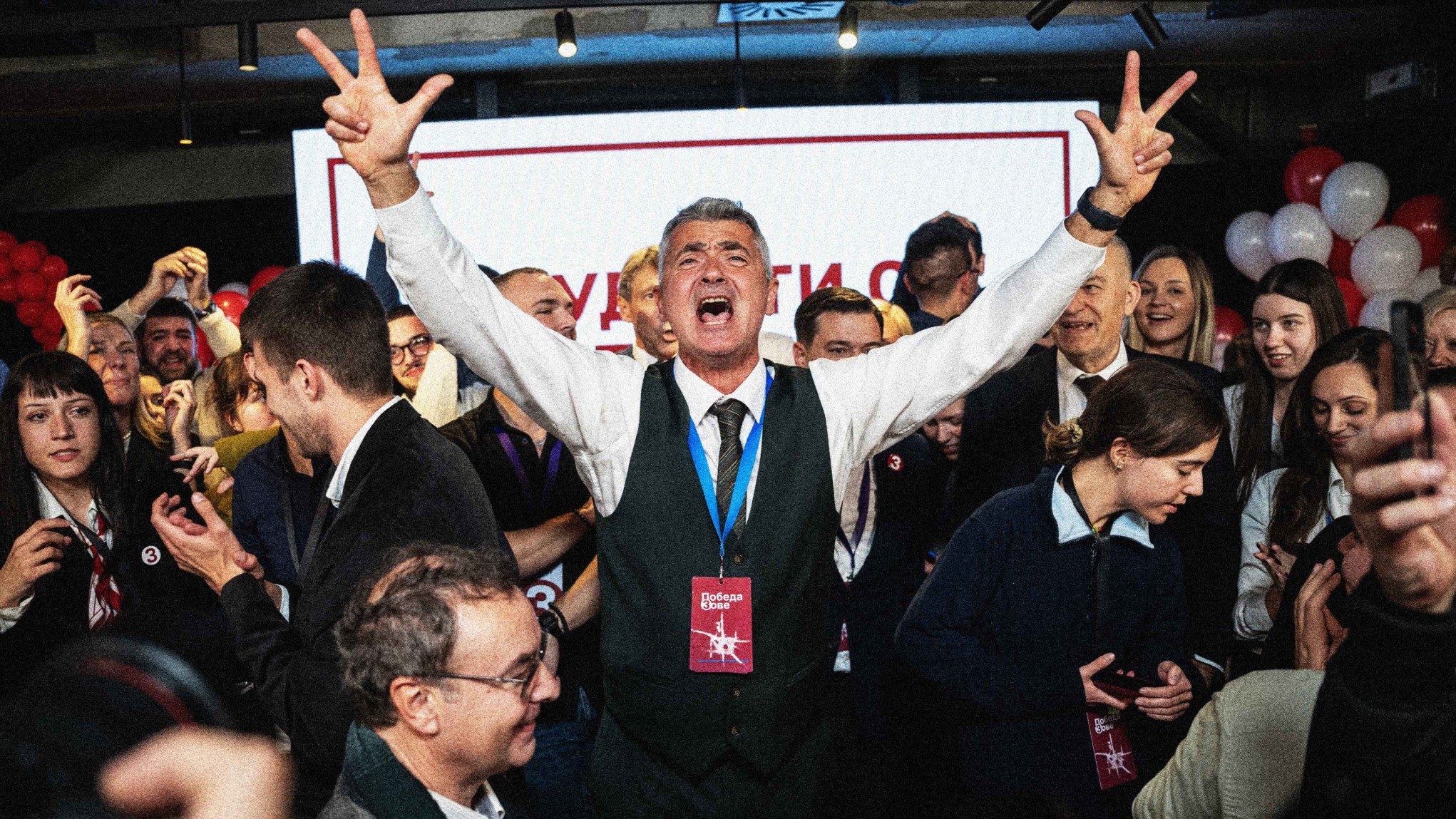
Three of them are barely in their twenties. The fourth is grey-haired, and exudes fatherly pride, although one gets the sense that the young people are very much in charge. All of them are leading lights in the Student List – the movement which has just won Serbia’s parliamentary elections, ending 14 years of government by the long-serving populist leader, Aleksandar Vučić.
Our meeting is taking place four days ahead of the vote – and my drinking companions are patiently explaining to me how their movement works. This is where my discombobulation begins. Because to anyone raised in a political system where there are parties with defined leaders, cabinets and shadow cabinets, the Student List is a radical departure from the norm.
“Let me get this straight,” I ask, painfully aware that I am about to state the obvious. “The Student List doesn’t have any defined leader, there is no hierarchy – and you haven’t even named a candidate for prime minister?”
“You must know a very important fact,” begins the grey-haired man opposite. This is Ilija Srdanovic, a professor of cardiology at Novi Sad University who is clearly accustomed to teaching students who are slow on the uptake. “The student movement is a fully democratic movement. We have numerous candidates who can take the prime minister position or any other position in any ministry.”
In a conventional political party setup, the professor would be the prime minister candidate. He was placed in the top slot of the Student List’s 250 candidates, which is where other parties put their potential heads of government.
In Serbia’s variant of proportional representation, that ranking meant he was all but guaranteed to be elected to parliament. But the Student List has eschewed conventions from the start – including the old-fashioned concept of letting the electorate know in advance who might end up in the prime minister’s office.
Ilija Sredanovic tells me this is the way to avoid a “cult of personality” forming around a leader, as it did around Vučić. The latter was mockingly nicknamed “Superman” by his detractors, for his habit of inserting himself into every situation in Serbia, no matter how small. But Vučić-friendly media embraced the label, portraying him as the tireless, sleepless protector of the Serbian people.
“That’s all very well,” I say, “but how are you getting this proposition across to the Serbian people, that they won’t know who’s going to be prime minister until there’s another process after the election?”
“It is really not a weakness; it is an opportunity,” Prof. Srdanovic replies. “We are not a one-man-show party in which one man decides everything on a daily basis, including my speciality. Everybody has to see that as a strength.”
The young people at the table – Aleksandra, Vuk and Aleksandar – nod in agreement. All of them have been involved in the student-led protest movement which gave rise to Student List since its early days. And they know that the leaderless structure is a key feature, not a glitch.
It all started in Novi Sad in November 2024, when a concrete canopy collapsed at the city’s recently renovated railway station. 16 people died, triggering an outpouring of grief and anger that has barely subsided since. Vučić had boasted that the railway station was a key part of his signature infrastructure project, the high-speed line from Belgrade to Budapest.
In March 2022, I stood on top of the canopy to take photos of Vučić and Hungary’s then-prime minister Viktor Orbán at a re-opening ceremony for the station in the square below. Then, on a swish new train back to Belgrade, Vučić plied me with Serbian wine and told me how the railway project was just one of the ways that he and his Progressive Party were driving the country forward.
That personal association with Novi Sad Station has proven to be Vučić’s downfall. The student-led protesters held him personally responsible for presiding over the corruption they blamed for the disaster. When he failed to respond to their demands for full accountability, they pivoted to demanding elections – and started their own political movement.
Wisely, the students decided not to put themselves forward, but selected their candidates through a process involving a series of interviews and assemblies. The Student List includes athletes, engineers and economists as well as academics – but the one key qualification was that none of the candidates should have a background in politics.
“People in this country are tired of the current system, of the current political parties,” says Vuk, a thoughtful and eloquent law student. “We are offering something new, something different. A team of people, a team of experts with integrity, with good intentions.”
And behind them, students from across Serbia’s university faculties, who plan to continue with their assemblies to choose the cabinet and the new government’s policies.
Suggested Reading

Serbia: a land of protests, paranoia.. and Del-Boy Trotter
“We have been transparent from the beginning,” says Aleksandra, who started as an electrical engineering student but is now considering her options. “We are a direct democratic movement, and that’s how we make decisions. As the whole core of our movement, every single student has the option to decide on every single thing. And people do understand that.”
I wonder if they do. When the streets of Belgrade erupted in celebration on Sunday evening after Aleksandar Vučić’s early concession of defeat, the main focus was the electoral downfall of a man that many of Serbia’s people have never forgiven for his role as a minister under Slobodan Milosevic in the 1990s. As champagne corks popped and fireworks crackled, conversations about “horizontal democracy” were not on the agenda.
But with people across Europe demonstrating disdain for established political parties, perhaps the Student List will offer inspiration. It is certainly a bold experiment – and we are about to find out whether it will work beyond the boundaries of a university campus.
 Most popular

His dad tried to overthrow Putin – now Pavel Prigozhin runs an African country
Liz Truss’s new mini-book is every bit as bad as her mini-budget
I was at Eton with Charles Spencer – this is how it explains his battle with the royals

18 things that will absolutely, definitely happen if Trump gets whopped in the midterms