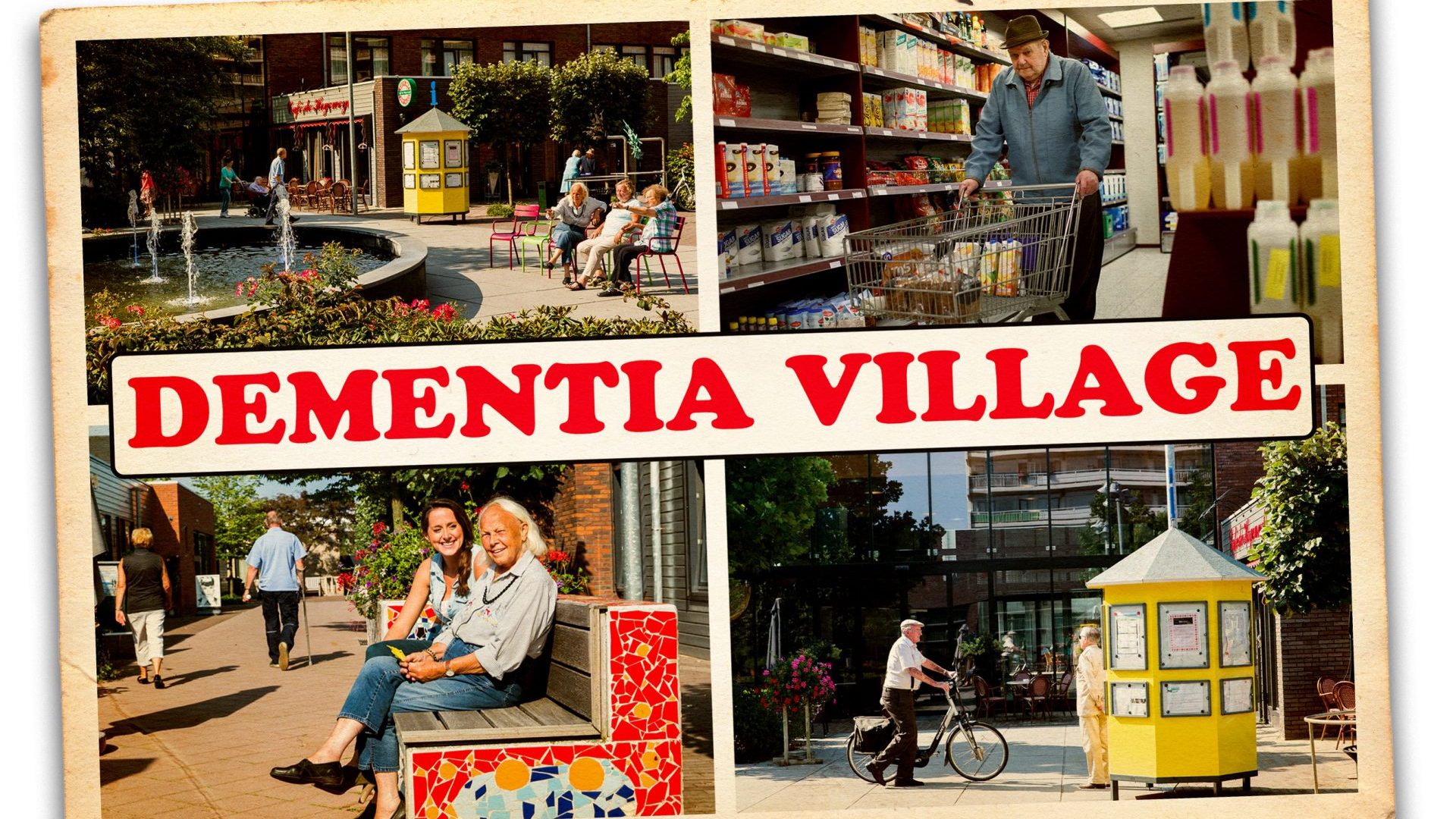
Geert has had a good morning. He has had a hearty breakfast of hagelslag – buttered bread with chocolate sprinkles – a soft-boiled egg, coffee and orange juice. The radio is playing Dutch folk music. Some of his flatmates have settled in the lounge to watch Goedemorgen Nederland on NPO 1, but Geert wants to take advantage of the beautiful spring morning and go for a walk.
He steps out of the front door and strolls past the fountain to the village square. Through the window of the salon, the hairdresser gives him a cheery wave. He goes every two weeks for a trim and will see her soon. At the Mozart concert hall, he hears classical music and glimpses couples dancing through the windows. A few villagers in wheelchairs are swaying along to the music. He smiles.
Near the supermarket, an old man is playing chess on an oversized board with a young woman. Geert watches as the man thinks, reaches across and moves his knight. From inside the shop comes the clink of trolleys and the familiar bustle of people buying groceries. Geert will pop in later for chocolates; he has a sweet tooth.
Then he makes his way to the pub, where he is meeting his friend Stamm. They like to sit and read newspapers together. The sun is shining, and life is pretty good in his village in the municipality of Amsterdam.
Geert is in the advanced stages of dementia, as are all the residents of De Hogeweyk, a pioneering managed-living village in the Netherlands that has become one of the most admired – and most misunderstood – dementia care facilities in the world.
To admirers, it is a humane alternative to the locked ward, where residents live in small households, shop for groceries, go to concerts, visit the hairdresser and participate in something resembling ordinary life. To sceptics, or at least headline writers, it can sound like a benevolent version of the 1998 movie The Truman Show: an elaborate stage set in which vulnerable people are kept inside an illusion.
Eloy van Hal, one of De Hogeweyk’s founders, has little patience with that description. It is, he says, a journalist’s fantasy – irresistible perhaps, but wrong.
Suggested Reading
Why philosophers can’t explain the power of music
“Nobody who really visits De Hogeweyk talks about The Truman Show,” he tells me. The hairdresser is a hairdresser. The waiter is a waiter. The shopkeeper is a shopkeeper. They are not actors pretending to provide services; they are professionals doing real jobs in a place where many of their customers have dementia.
The ethical concern is not entirely fanciful. Julian Hughes, former deputy chair of the Nuffield Council on Bioethics, has warned that dementia care can cross a line when it becomes deliberately deceitful. Some care homes, for example, have installed fake bus stops outside their buildings. When residents say they want to go home, staff take them to the “bus stop”, wait until they forget why they are there, then guide them back inside.
For critics, this kind of deception risks undermining what grip a person with dementia still has on reality. If the person realises something is wrong, it may increase distress rather than relieve it.
Van Hal says that misunderstands De Hogeweyk. The village is not a stage set and the staff are not actors. Residents are not being tricked into a false past; they are being supported to live as normally as possible in the present.
Van Hal has worked at De Hogeweyk for 24 years, beginning when it was still a more traditional nursing home. The transformation began with a deceptively simple question: why should people with dementia be forced to live in places nobody else would choose?
“When I was appointed, I wanted to work there because of the vision: a normal life for people living with dementia,” he says. The team began to imagine “not an institutional building, but a neighbourhood” where people needing complex dementia care could live in a much more normal community.
Today, van Hal works through Be Advice, De Hogeweyk’s consultancy arm, helping organisations around the world rethink dementia care. The model has inspired projects in Norway, France, Italy, Australia, New Zealand, Canada and the United States. But he is careful about the word “model”. De Hogeweyk is not a Dutch kit home for dementia care, to be airlifted into another country and assembled with tasteful brickwork and a supermarket. It is a philosophy.
That philosophy begins with language. Van Hal dislikes the word “patients”. People do not live in De Hogeweyk as patients in a unit, he says, but as residents in a home. A patient is defined by illness. A resident is still a person with habits, preferences, history, irritations, tastes and rights.
De Hogeweyk is owned by Vivium, a private foundation that works within the Dutch long-term care system. Residents need an official care profile showing they require complex dementia care and can no longer live safely at home. Once someone qualifies, the Dutch state covers daily costs including housing, care, food, medication, doctors and staff, with the resident contributing according to income and assets. To anyone used to the British horror show of people selling homes to fund care, it sounds startlingly civilised.
Suggested Reading
A shot of hope
When I ask about design features often cited in dementia care – avoiding patterned floors, for example, because residents might perceive them as holes – van Hal pushes back. Those things matter, but they are not the essence.
He asks me whether, when the time comes, I would want to move into an institutional nursing home in Spain. No, I say. Why not? Because nobody would willingly choose long corridors, communal rooms, compulsory television, mealtimes dictated by the organisation and the slow crushing of individual choice.
That, says van Hal, is exactly the point. People with dementia are no different in wanting freedom, comfort and recognition. Yet for decades, care systems created “awful institutions” because it seemed efficient to place many people together, feed them and care for them. But human beings need more than feeding and care.
If a person becomes aggressive or depressed in such a place, the institution may say: that is the dementia. Van Hal says the more honest answer may be: it is the place. It is the way the person is treated. It is the way life has been taken away.
That is also why he is wary of medication being treated as the first answer. In some American memory units, he says, residents may be on between 15 and 25 different medications. In the Netherlands, the average is closer to eight. Medication, he argues, is often used to manage problems caused not by dementia alone, but by the conditions in which people are forced to live.
Even the way residents are grouped is part of the philosophy. Older articles have described De Hogeweyk as having seven lifestyle categories. Van Hal stops me. Since 2015, he says, De Hogeweyk has worked with four broad lifestyles, not seven.
Each resident lives in a small group home with six others. Meals are cooked in the house. Laundry is done there, too. There is no central dining hall, no vast ward, no institutional schedule imposed from above. The home has a front door and operates, as far as possible, like an ordinary household.
The matching process begins with the person’s previous life. What music did they like? What television programmes did they watch? What food did they enjoy? Were they formal or outgoing, traditional or cosmopolitan, quiet or sociable?
The four broad lifestyles range from traditional Dutch households, with local news, folk music and familiar food, to more urban, formal or cosmopolitan households. It is not rigid, van Hal stresses. Nobody is reduced to a type. But if people with broadly similar rhythms and expectations live together, there is less friction. A Spaniard forced to eat only Dutch food and live to Dutch rhythms would soon be unhappy, he points out. Why would dementia erase that?
The household is where life feels familiar. The wider village is where people follow interests and meet others. A traditional resident who also likes classical music can still attend a classical music club. Someone who enjoys painting, baking, the gym or jazz can go to the appropriate space.
That movement matters. Activities are not simply wheeled into a day room. Residents leave their homes and go to them. A concert takes place in the theatre because a concert should feel like a concert. Folk music or jazz belong in the pub. Painting and baking take place in creative rooms. Exercise takes place in the gym.
The environment itself tells residents what is happening. It helps them orientate themselves. It also means they go outdoors, walk or are wheeled through the village, encounter neighbours and participate in the ordinary choreography of a community. Life is not brought to them on a tray.
Suggested Reading

Germany tried to introduce a sick note revolution – it failed
Nor is De Hogeweyk designed to shut the outside world out. Outside groups use the theatre. Local people can visit the restaurant. Companies hold events there. There are markets and seasonal gatherings. During elections, the polling station is in De Hogeweyk. Neighbours can come for lunch or dinner and meet residents naturally, in the square or restaurant.
This, too, is deliberate. The more ordinary contact, the less people with dementia are hidden away as frightening or pitiable. Van Hal says if De Hogeweyk were being designed from scratch today, he would go further still. He would make it even more open, less enclosed, more embedded in everyday society.
“People with dementia, you cannot lock them in,” he says – not even in a kindly designed village.
The supermarket is often where the Truman Show myth attaches itself, perhaps because journalists enjoy the thought of staff secretly restocking shelves behind the scenes. Van Hal insists it is not fake. Residents who buy things pay for them. If they do not have cash, there is a back-up system so relatives can settle up later.
Households also shop there. A care worker from each home buys groceries, sometimes with residents helping. Then the food is cooked in the house. Across De Hogeweyk, van Hal says, 27 different meals are prepared every day.
Again, the goal is not abstract nutritional perfection imposed from above. It is food people actually want to eat in the last phase of life. In a traditional household, that may mean potatoes, vegetables and meat. In a cosmopolitan household, it may mean pasta, Chinese food or sushi, alongside Dutch food.
Residents do not have unlimited individual choice at every meal. They live in a group of seven, so the household usually eats one meal. But because people are matched with others who share broadly similar tastes, there is a better chance they will enjoy it. Care workers know residents well enough to adjust where possible.
This is what agency looks like when dementia is advanced. It is not the fantasy that everyone can make every decision all the time. It is the hard, patient work of preserving as much preference and dignity as possible.
Demand is unsurprisingly high. De Hogeweyk has been full since opening. There is always a waiting list, usually between six months and a year and a half. Around 70 to 75 residents die each year, out of 188. The average stay is about two years, though it can range from a few weeks to several years.
And this brings van Hal to the subject many care models prefer to avoid: death. De Hogeweyk, he says, is not only about a good life with dementia. It is also about a good death.
The Dutch approach to end-of-life care can differ sharply from that in countries such as the UK, Spain, Italy or the US. The goal is not to extend life for as long as possible with every available intervention. The question is whether an intervention will actually help the person have a better day.
A hospital admission, for example, may treat one problem while causing another. A resident with advanced dementia may be frightened, disorientated and agitated in hospital, then return weaker, more confused or unable to enjoy the life they had left.
So the medical team and family discuss choices carefully. Should a lung infection be treated? Will antibiotics help? What happens if they do not? Is hospital really in the person’s best interests? Or is it better to provide comfort and allow the body to take its natural course?
Van Hal is clear that this is not assisted dying or euthanasia. It is palliative care. In fact, he says, palliative care begins when someone moves in. It means thinking from the start about comfort, dignity, quality of life and the likely consequences of medical intervention.
Suggested Reading

What if we’ve got ultra-processed foods wrong?
If a resident reaches the end of life and refuses food and fluids, De Hogeweyk does not use feeding tubes. If the body is shutting down, the focus becomes comfort care and a pain-free death. Residents usually die in their own beds, in their own homes, with professional support around them.
This is not neglect, he insists. It is the opposite. It requires difficult conversations with families who may believe that doing more is always kinder. Sometimes, the kindest thing is not to intervene.
The result, van Hal argues, is that residents remain part of household and community life for longer. They may be in wheelchairs. They may no longer speak. They may need to be pushed by staff, relatives, volunteers or other residents. But they can still smell food cooking in the kitchen, hear music, sit outside, attend a club, or simply be among other people.
When I suggest that the typical De Hogeweyk resident must therefore be someone still reasonably active and able to walk around, van Hal corrects me immediately. No, he says. Around 40% of residents use wheelchairs. Some move themselves; others need help. The point is not that everyone is physically active. The point is that dependency does not mean exclusion.
A wheelchair does not stop someone from enjoying music in the theatre. It does not stop them from smelling dinner being prepared. It does not stop them being part of a home.
For van Hal, this is the heart of the matter. De Hogeweyk is not about architectural cleverness or a charming village aesthetic. It is about refusing to build places nobody would choose for themselves.
“We should stop building and managing institutions where nobody wants to go,” he says. The task now is to transform them: to normalise, deinstitutionalise, and get rid of institutional thinking, not only in buildings but in minds.
That is the mission he now takes around the world. Not to export a Dutch theme park for dementia, but to persuade care systems to ask one brutally simple question: would you want to live there yourself?
More on De Hogeweyk at www.bethecareconcept.com and www.vivium.nl