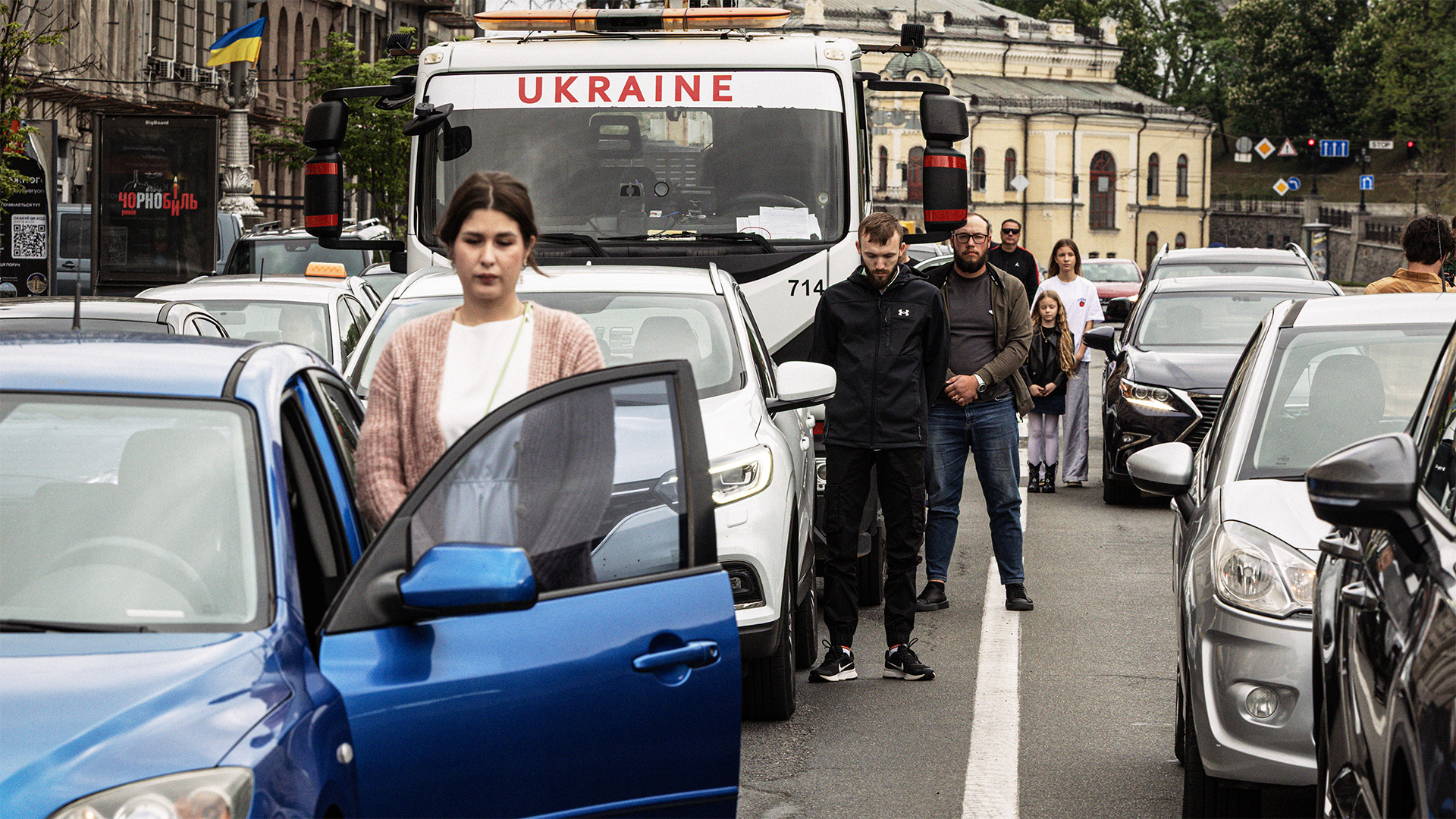
I arrived shortly after one of the largest Russian missile and drone attacks on Kyiv in recent months.
Upon arrival, I downloaded an app. Millions of Ukrainians use it every day. It alerts you when an attack is incoming. It directs you to the nearest shelter. And it tells you when it is safe to come out.
Every morning at nine o’clock, the country pauses for a minute of silence to remember those who have died. And there are many to remember.
Walking through Maidan Square, I passed photographs, flowers, flags, and teddy bears left in memory of the fallen. It is estimated that 140,000 Ukrainians have been killed in this war – from a population of 30 million.
And yet what struck me most was not grief. It was resilience.
I kept returning to one question throughout my visit: why has Ukraine survived?
History offers many examples of countries that collapsed under invasion – populations that collaborated, resistance movements that fragmented and faded. Ukraine has been different, and I think the reason matters for all of us.
Would Ukraine have fought as effectively without President Volodymyr Zelenskyy’s leadership? It is difficult to know.
Leadership matters, especially in moments of national crisis. But the determination I encountered felt deeper than any one individual. It reflected a society that had already decided what it was fighting for: a society that totally rejects Russian imperialism, with a memory of a time before the Soviets, of age-old trading links, of a world where Kyiv preceded Moscow.
Ukrainians told me, repeatedly, that theirs is a political community — not one defined by blood and soil — forged through shared civic commitment and the belief that citizens should determine their own future. That spirit is visible now not just in the trenches, but in the laboratories, the ministries, and the start-ups.

Because Ukraine is not only defending itself. It is reinventing itself.
I visited defence technology companies developing the next generation of drone and autonomous systems. I saw battle management software fusing intelligence from multiple sensors in real time, enabling responses measured in minutes rather than hours.
I also spent a day looking at GovTech. Through a single app, Diia, Ukrainians can get married, pay taxes, or claim compensation for a home destroyed by bombing. The friction between citizens and government has been removed through digital design. It is remarkable that a country fighting for its survival is simultaneously building one of the most advanced digital governments in the world.
The companies emerging from wartime necessity will not disappear when the war ends. Some will scale internationally. Some will become major defence and technology firms.
And the soldiers who held the line must share in that success — through equity, investment funds, training programs that connect wartime service to long-term prosperity. Those who built Ukraine’s defence must help build its future.
But Ukraine also teaches us something more uncomfortable. Ukrainians fight for Ukraine. Would the British – or French or Germans – fight for Europe? What is missing is a sense that “Europe” itself is worth defending.
That sense of place and belonging cannot be manufactured by the top-down technocratic managerialism of the European Commission. Part of the reason that there is such a powerful populist insurgency across the continent is that people feel managed, not represented.
The European project must be something more than an economic arrangement. It must be a political project, one built on identity, not only on interest. That, too, is a lesson Ukraine is teaching us.
Jean Monnet, the so-called father of Europe, understood that European integration advances furthest not through idealism, but through crisis. Today Europe faces Russian aggression, uncertain American commitment, and instability from the Middle East. The peace dividend is over.
Europe’s leaders must now make a case to their publics that they must cut back on social welfare and spend more on defence. And they must work together as a genuine continental enterprise.
That means a European Security Council bringing together EU members, the UK and Ukraine; a shared defence industrial base with coordinated procurement; European Defence Bonds financing large-scale investment; and a collective deterrent posture built around British and French nuclear capabilities.
The technology, the capital, and the industrial capacity exist. What is required is the political will.
Si vis pacem, para bellum. If you want peace, prepare for war.
Which brings me back to Ukraine. It is showing Europe what it needs to become. The country that many expected to fall within weeks has become a laboratory for the future of defence, digital government, and national resilience. Its extraordinary wartime advances can become the seedbed of a European defence renaissance — and the renewal of the social contract between citizens and government.
The future of Europe is being forged right now in Ukraine.
Emma Sky is the founding director of Yale’s International Leadership Center and is a lecturer on great power competition and cooperation, grand strategy and Middle East politics.
The train from Warsaw to Kyiv took 21 hours – four longer than scheduled, owing to delays at the border and with connecting services. It is a slow way to cross into Ukraine, but airports are still not open.
I arrived shortly after one of the largest Russian missile and drone attacks on Kyiv in recent months.
Upon arrival, I downloaded an app. Millions of Ukrainians use it every day. It alerts you when an attack is incoming. It directs you to the nearest shelter. And it tells you when it is safe to come out.
Every morning at nine o’clock, the country pauses for a minute of silence to remember those who have died. And there are many to remember.
Walking through Maidan Square, I passed photographs, flowers, flags, and teddy bears left in memory of the fallen. It is estimated that 140,000 Ukrainians have been killed in this war – from a population of 30 million.
And yet what struck me most was not grief. It was resilience.
I kept returning to one question throughout my visit: why has Ukraine survived?
Suggested Reading

Why have we let Putin get away with it for so long?
History offers many examples of countries that collapsed under invasion – populations that collaborated, resistance movements that fragmented and faded. Ukraine has been different, and I think the reason matters for all of us.
Would Ukraine have fought as effectively without President Volodymyr Zelenskyy’s leadership? It is difficult to know.
Leadership matters, especially in moments of national crisis. But the determination I encountered felt deeper than any one individual. It reflected a society that had already decided what it was fighting for: a society that totally rejects Russian imperialism, with a memory of a time before the Soviets, of age-old trading links, of a world where Kyiv preceded Moscow.
Ukrainians told me, repeatedly, that theirs is a political community — not one defined by blood and soil — forged through shared civic commitment and the belief that citizens should determine their own future. That spirit is visible now not just in the trenches, but in the laboratories, the ministries, and the start-ups.
Because Ukraine is not only defending itself. It is reinventing itself.
I visited defence technology companies developing the next generation of drone and autonomous systems. I saw battle management software fusing intelligence from multiple sensors in real time, enabling responses measured in minutes rather than hours.
I also spent a day looking at GovTech. Through a single app, Diia, Ukrainians can get married, pay taxes, or claim compensation for a home destroyed by bombing. The friction between citizens and government has been removed through digital design. It is remarkable that a country fighting for its survival is simultaneously building one of the most advanced digital governments in the world.
The companies emerging from wartime necessity will not disappear when the war ends. Some will scale internationally. Some will become major defence and technology firms.
And the soldiers who held the line must share in that success — through equity, investment funds, training programs that connect wartime service to long-term prosperity. Those who built Ukraine’s defence must help build its future.
But Ukraine also teaches us something more uncomfortable. Ukrainians fight for Ukraine. Would the British – or French or Germans – fight for Europe? What is missing is a sense that “Europe” itself is worth defending.
That sense of place and belonging cannot be manufactured by the top-down technocratic managerialism of the European Commission. Part of the reason that there is such a powerful populist insurgency across the continent is that people feel managed, not represented.
Suggested Reading
I’m in Ukraine, a nation let down by America
The European project must be something more than an economic arrangement. It must be a political project, one built on identity, not only on interest. That, too, is a lesson Ukraine is teaching us.
Jean Monnet, the so-called father of Europe, understood that European integration advances furthest not through idealism, but through crisis. Today Europe faces Russian aggression, uncertain American commitment, and instability from the Middle East. The peace dividend is over.
Europe’s leaders must now make a case to their publics that they must cut back on social welfare and spend more on defence. And they must work together as a genuine continental enterprise.
That means a European Security Council bringing together EU members, the UK and Ukraine; a shared defence industrial base with coordinated procurement; European Defence Bonds financing large-scale investment; and a collective deterrent posture built around British and French nuclear capabilities.
The technology, the capital, and the industrial capacity exist. What is required is the political will.
Si vis pacem, para bellum. If you want peace, prepare for war.
Which brings me back to Ukraine. It is showing Europe what it needs to become. The country that many expected to fall within weeks has become a laboratory for the future of defence, digital government, and national resilience. Its extraordinary wartime advances can become the seedbed of a European defence renaissance — and the renewal of the social contract between citizens and government.
The future of Europe is being forged right now in Ukraine.
Emma Sky is the founding director of Yale’s International Leadership Center and is a lecturer on great power competition and cooperation, grand strategy and Middle East politics.
 Most popular


Emily Maitlis’s diary: As I was saying to George Clooney just the other day…

A new film about Elon Musk reveals him as so awful it’s almost tragic. Almost
Never again? Think again. The far right’s resurgence in Germany should terrify all Europeans

There’s only one reason Trump went to Ireland – it wasn’t to meet the Taoiseach