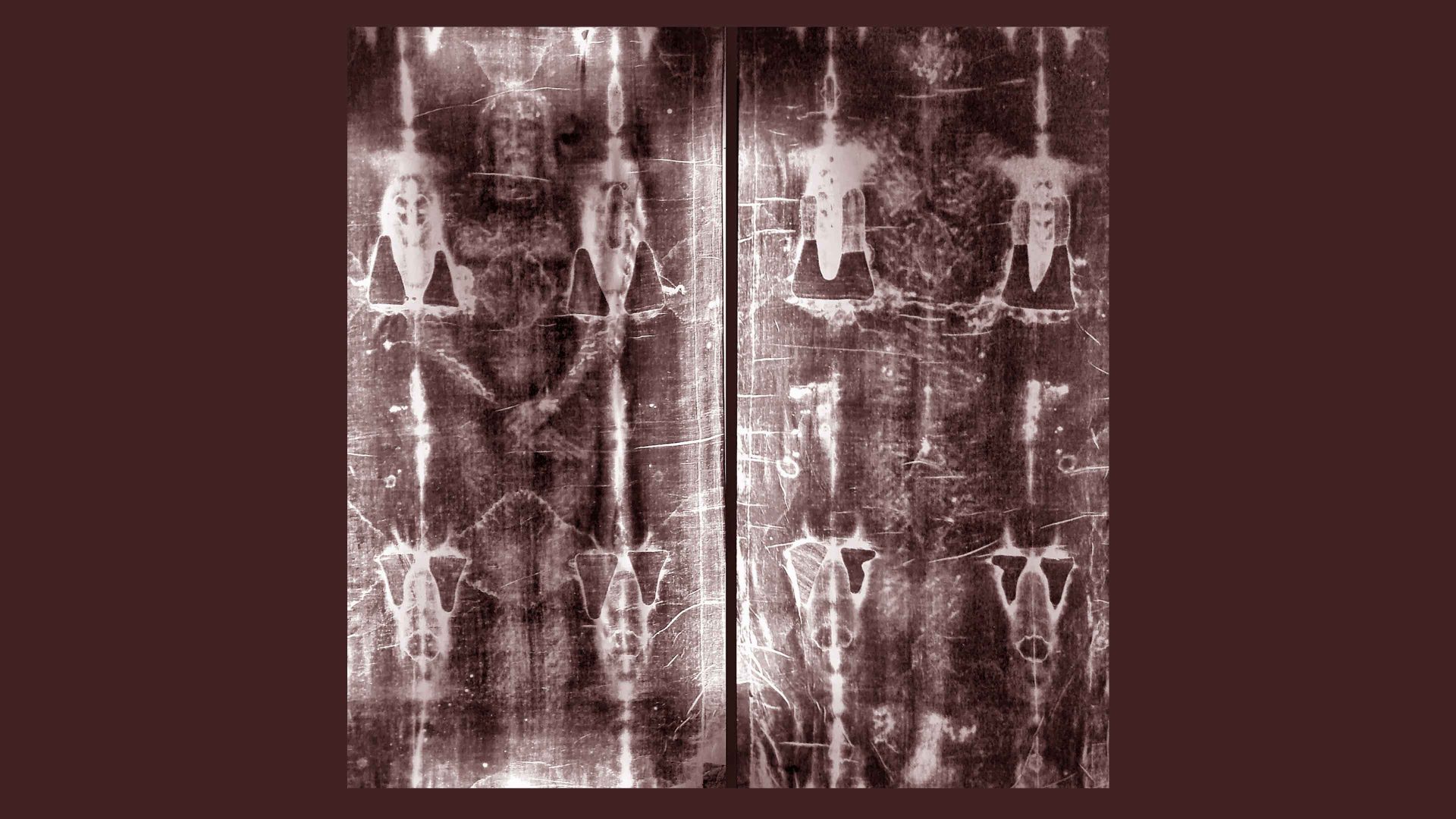
I’m guessing that most readers of The New World will be sceptical of the idea that the image of a man marked by the wounds of crucifixion on the Shroud of Turin is that of Jesus Christ, somehow (supernaturally?) imprinted when the cloth was used as his burial shroud. Well, me too. But I have what some might see as an unbecoming fascination with this holy relic. It’s still not known how the image is formed – it is not painted in pigments, but seems to be caused by darkening of the threads themselves.
My own belief is that the object is one of the many ersatz relics forged in the Middle Ages, which is consistent with its first documented appearance in the 1360s in the household of a French nobleman (who, in true Dan Brown fashion, had links with the Knights Templar, disbanded and outlawed around 1312). Perhaps more persuasively, that view is consistent too with radiocarbon dating of the cloth in 1988 by three separate labs in Oxford, Zurich and Arizona, which indicated a likely origin between 1260 and 1390.
Yet that study, which asserted that the evidence was “conclusive”, has not settled the matter to everyone’s satisfaction. For one thing, an analysis of the raw radiocarbon-dating data in 2015 pointed to inconsistencies among the different labs. Some argue that well-documented fire damage to the Shroud in the 16th century could have skewed the results to a later age. And an Italian attorney who examined all the available archaeological evidence argued in 2001 that it is consistent with a more exotic story.
In this view, the cloth could indeed have been created around the time of Christ, brought to the region of modern-day Turkey centuries later, and ended up in Constantinople where the Crusaders snatched it when they sacked and looted the city, the seat of the Byzantine emperors, in the rapacious and wayward Fourth Crusade in 1204.
Anticlimactically, a new study of threads taken from the Shroud in 1978, some of which were used in the 1988 radiocarbon work, doesn’t rule out either scenario. Instead, it adds intriguingly and somewhat bizarrely to the mystery. The work, by a team in Italy, reports analyses of DNA traces in the scraps of fabric. Modern techniques can identify which organisms such traces came from, even if the DNA is many centuries old.
Suggested Reading


Bees are smarter than we ever imagined
As well as finding genetic remnants from the Italian researcher who took the samples in 1978 (he is a co-author of the new paper, but died last year), the team identifies DNA from carrots, bananas, oranges and peanuts and other plant species of the Mediterranean and the Americas, and from livestock including pigs, cattle, chicken and dogs.
This doesn’t mean the Shroud was used as a tablecloth for a Renaissance farmyard banquet, but simply testifies to a long and varied history. But it’s the human DNA that intrigues most: as well as some from western European ethnic groups, over half of it is from ethnic lineages of the Near and Middle East, and 39% is from people of Indian heritage. It’s possible then that the cloth, whatever its age, was woven in the Indian subcontinent.
What should we make of this? First, that the debate about the Shroud’s provenance will surely continue. But also that this deeply puzzling object encodes a complicated story of some kind, whether it is a medieval fake (made by God knows what means) or something more venerable.