The looks of awe, love and anxiety that pass between mother and newborn son are powerful, but not a word is spoken. The baby does not cry, the woman’s lips are pursed for a kiss, not speech. An unspoken sense of wonder is tangible, and within the reverential spaces of a place of worship or studious calm of an art gallery, it feels natural to lower the voice when confronted with a serene Mother and Child. But such works of religious art are not necessarily created in silence.
When the artist Giotto di Bondone was at work in the Scrovegni Chapel in Padua from 1303, he would have had dozens of assistants around him. Some would have been crushing pigments, others manhandling the mobile scaffolding. Trusted fellow painters established in their own right would have been working alongside the master, all of them calling down for materials.
For more than two years, the chatter would have clattered on. Giotto, who had designed the building which was to house one of the greatest picture cycles in the world, created in effect a shoebox theatre where voices would have amplified effortlessly.

The timeless images that his project alchemised from a combination of artistic genius and technical knowhow, began life with a violent chemical reaction. Fresco, the art of sealing images directly into a plastered wall, is a tortuously complicated process. The jewel-like colours of Giotto’s Paduan masterpiece owe their vibrancy to the application of pigment into a final skim, over several preparatory layers, of slaked lime.
As the contemporary Scottish artist and writer Lachlan Goudie explains and demonstrates in his revelatory book The Secrets of Painting, it is dangerous work. First you need to crush a tough block of lime, then pour water into the powder so that it spits and froths corrosively until it settles into a workable white goo.
More chemistry dictates which pigments can be applied without loss of colour. Some would have to wait until the lime plaster had dried, including the expanses of sky rendered in azurite, which glows across the whole unfolding storyboard. Goudie gamely gives it a go, this fresco lark, and pronounces himself “petrified”.
Giotto had to both work at speed and trust patiently in the skills of others in the stop-go business of creating the three registers of the chapel, while occasionally nipping out to negotiate further contracts. For the man whose phenomenal drawing skills were spotted early in his career kept several irons in the fire, setting up further commissions while working on another, racking up debts for materials, that needed paying off, and all the while sensitively imbuing his biblical subjects with such tenderness, complexity and movement that from the turn of the 14th century, art would, quite simply, never be the same again.
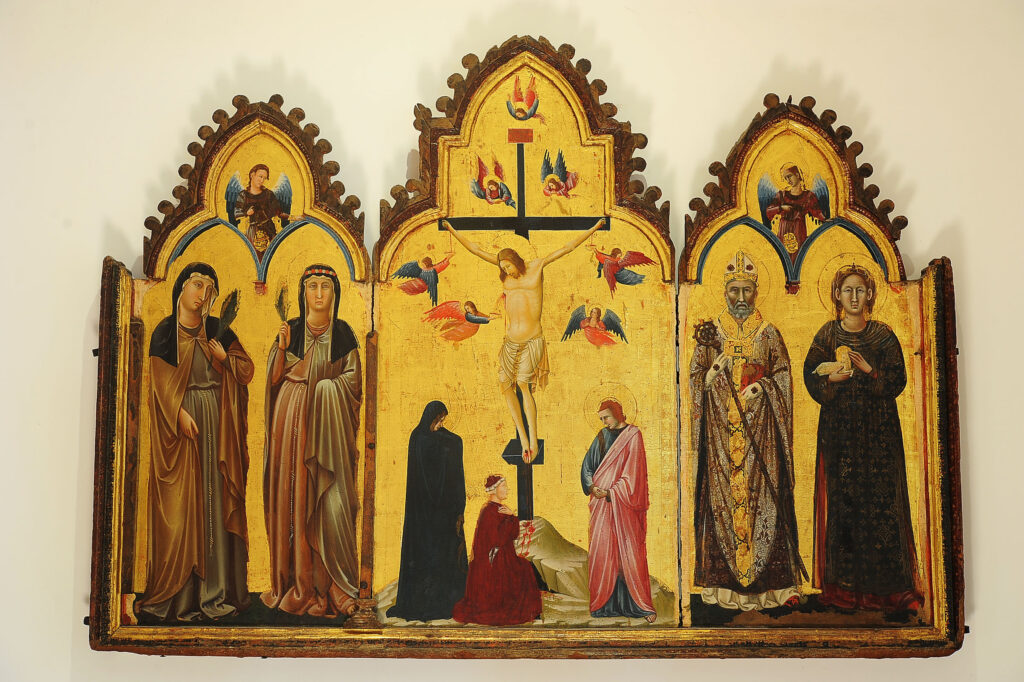
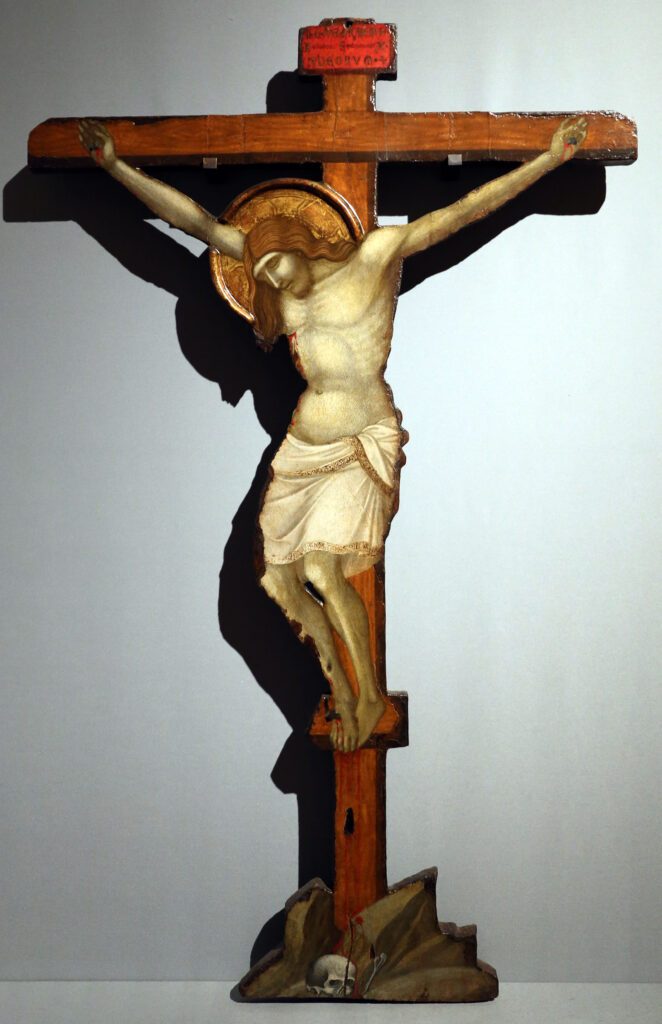
A Giotto-themed exhibition at the Galleria Nazionale dell’ Umbria in Perugia takes its inspiration from the 800th anniversary of the death of Saint Francis of Assisi, and also from the collaboration between artists at a time when the busy workshop, and not the solitary studio, was the norm. While Giotto is the star of the show, none of his frescos can be moved from the churches for which they were created. And so, alongside portable works, such as votive pieces on panel, are masterpieces of the same era by artists of whom so little is known that they are simply named after their town or artwork – the Maestro of Cesi, the Maestro of Paciano, the Maestro della Croce di Gubbio.
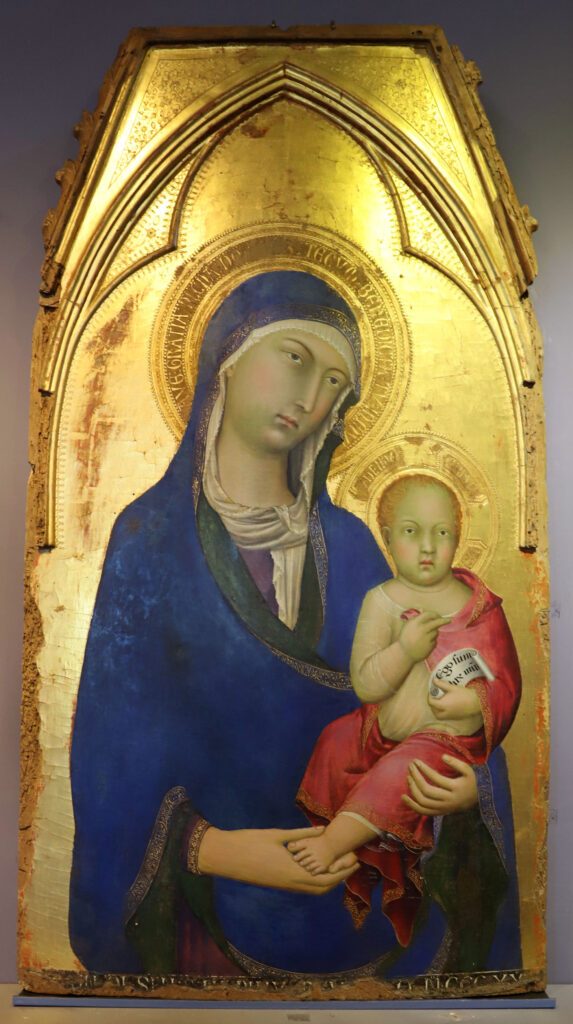
The outstanding difference between Giotto and his contemporaries was summed up by the Cennino Cennini, who could claim a direct link to the master: his own tutor Agnolo Gaddi was the son of one of Giotto’s pupils, Tadeo Gaddi. In Cennini’s important book about the philosophy and practice of art during the Renaissance, Il Libro dell’Arte, he declares: “Giotto changed the art of painting from Greek into Latin, and made it modern, and had the art more complete than anyone since.”
What Cennini was observing was that until Giotto, the formal, Byzantine style was dominant: expressionless figures were fixed firmly and flatly into standard compositions with little or no architectural or background context. Giotto revived not only the lime-based fresco technique of the Romans, but also a style of figure painting that had volume and personality.
Creating volume was, in the case of the halos that abound in the Scrovegni Chapel, a three-dimensional business, with an extra raised ring of plaster applied to bear the gilded corona. But when it came to bulking out figures to make them real flesh and blood, Giotto explored the possibilities of arranging cloth so that it suggested shape, weight and movement. He may, believes Gordie, have draped assistants in lengths of fabric in order to see how cloth would fall over limbs and torso.
But the credible animation of Giotto’s figures is also born out of human emotion and experience. In an early polyptych, on loan to Perugia from the Florence’s Uffizi galleries, rather than staring solemnly at us in the Byzantine style, the infant Jesus, supported by his mother, squirms in her grasp to clutch at her neckline, twisting his roseate gown as he turns. Her shift does not fall in a waterfall of colour, but curves over discernible breasts.
Giotto’s people are real. This contact between the child with his natural curiosity and his patient, capable, breast-feeding mother, is a recurring motif that other artists would copy.
Suggested Reading
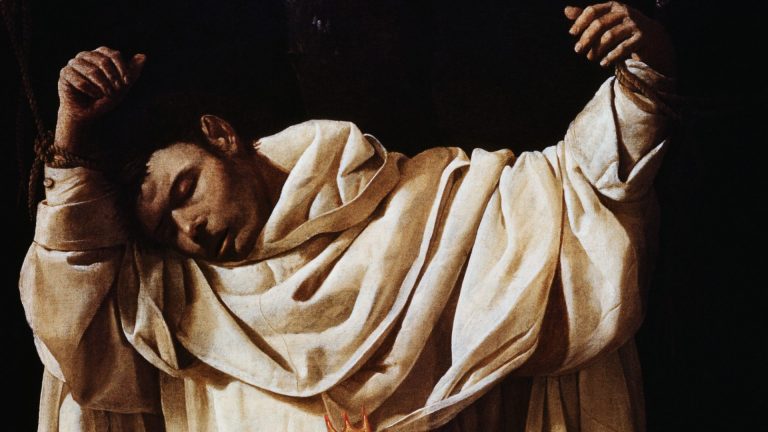
The secrets of the painter who made cloth come alive
An artist follower of whom we know more than of the many mysterious Maestri, Pietro Lorenzetti, was hugely influenced by Giotto, whose work he travelled from his native Siena to observe. The tactility of Giotto’s figures was assumed by Lorenzetti too, and would emerge in his own works alongside those of Giotto in the lower basilica at Assisi.
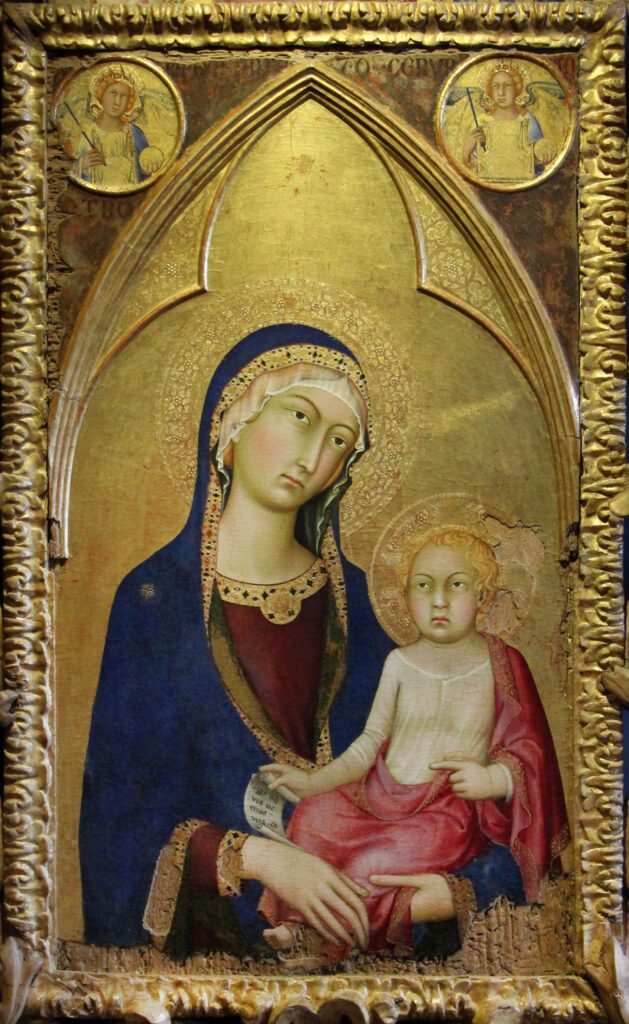
In a Maestà of around 1312, his Christ child lolls against his mother, one small arm hooked over her shoulder. In a slightly later Madonna and Child, again with contact at the shoulder, Mary clasps both her baby’s ankles and her strong right hand envelopes his left arm. Much is made of the ability to draw hands, which are complex, but more important than their anatomy in these 14th-century depictions is their expressive gestures.
Giotto was born in or near Florence in 1267, the son of a blacksmith, but like so many personal details, the facts are disputed. Later in life, and with considerable wealth he certainly bought property of his own there.
He probably trained with Cimabue and may have spent some formative time in Rome. But he worked far and wide, certainly as an established artist in Rome, where he designed a mosaic for the old St Peter’s Basilica, and appearing in Naples between 1328 and 1333. He returned to his native city only three years before his death in 1337, appointed the city’s chief architect and surveyor, and designed the Campanile next to the Duomo.
His breakthrough years appear to have been in Assisi, where a papal bull, on display in the exhibition, decrees that the basilica rapidly erected to house the remains of St Francis be augmented and further decorated. The project was to be funded by alms left by pilgrims, for Assisi adroitly and rapidly became a place of pilgrimage upon Francis’s death and almost instant canonisation.
Suggested Reading
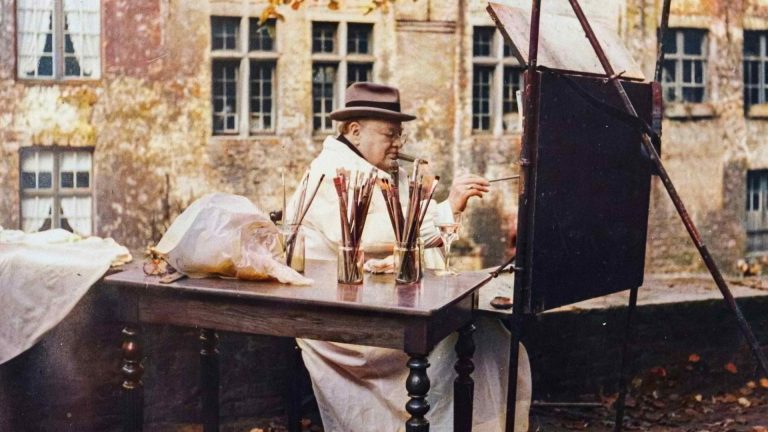
Was Churchill any good at painting?
In the Upper Basilica, Giotto is pretty much certain to have been among artists, some from Rome, who illustrated in 28 images the life story of the saint who espoused poverty and self-denial. Among those images attributed to Giotto there is realistic detail and awareness that is without precedent.
Take, for example, the moment when Francis, born into a wealthy family, gives away his clothing: the bishop scoops up the hem of his cloak and wraps it around the idealistic young man to hide his nudity. This well-understood gesture smacks of a mind that understands the human talent for improvisation.
The relatively recent life and legacy of St Francis resonated throughout Giotto’s career. He was undoubtedly responsible for paintings in the vault of the lower Basilica in around 1320, and his assistants and successors went to work on the many churches dedicated to the saint.
In around 1325 he created frescos on, among other subjects, the life of St Francis, in the Bardi Chapel for Santa Croce in Florence. Here he did not use the demanding technique he employed in the Scrovegni Chapel, but painted a secco, on to dry plaster. Unlike the Scrovegni frescoes, whose bright colours are locked in, these have worn badly, but their humanity is indestructible.
One small and early but partly damaged tempera panel on loan to Perugia from Borgo San Lorenzo illustrates Giotto’s particular genius for capturing tenderness. Not yet a father himself – 10 years later he would marry Ciuta, who gave him four sons and four daughters – he already observes touch with special insight.
While the Virgin looks at us, only the hands of her child are still visible. One is wrapped round his mother’s index finger, the other reaches up to her chin, little fingers splayed. It’s an embrace as passionate as any words of love.
Giotto and Saint Francis: A Revolution in 14th-Century Umbria is at the Galleria Nazionale dell’Umbria, Perugia until June 14. The Secrets of Painting: The Hidden Art of the Masterpiece from Prehistory to Today by Lachlan Goudie is published by Thames and Hudson at £38
 Most popular

My truly deranged encounter with Trump apologist Kellyanne Conway


Suella Braverman’s book has sold only 106 copies. This is why

The moral depravity of Robert Jenrick
Hungary’s lesson to the world: Populism isn’t permanent