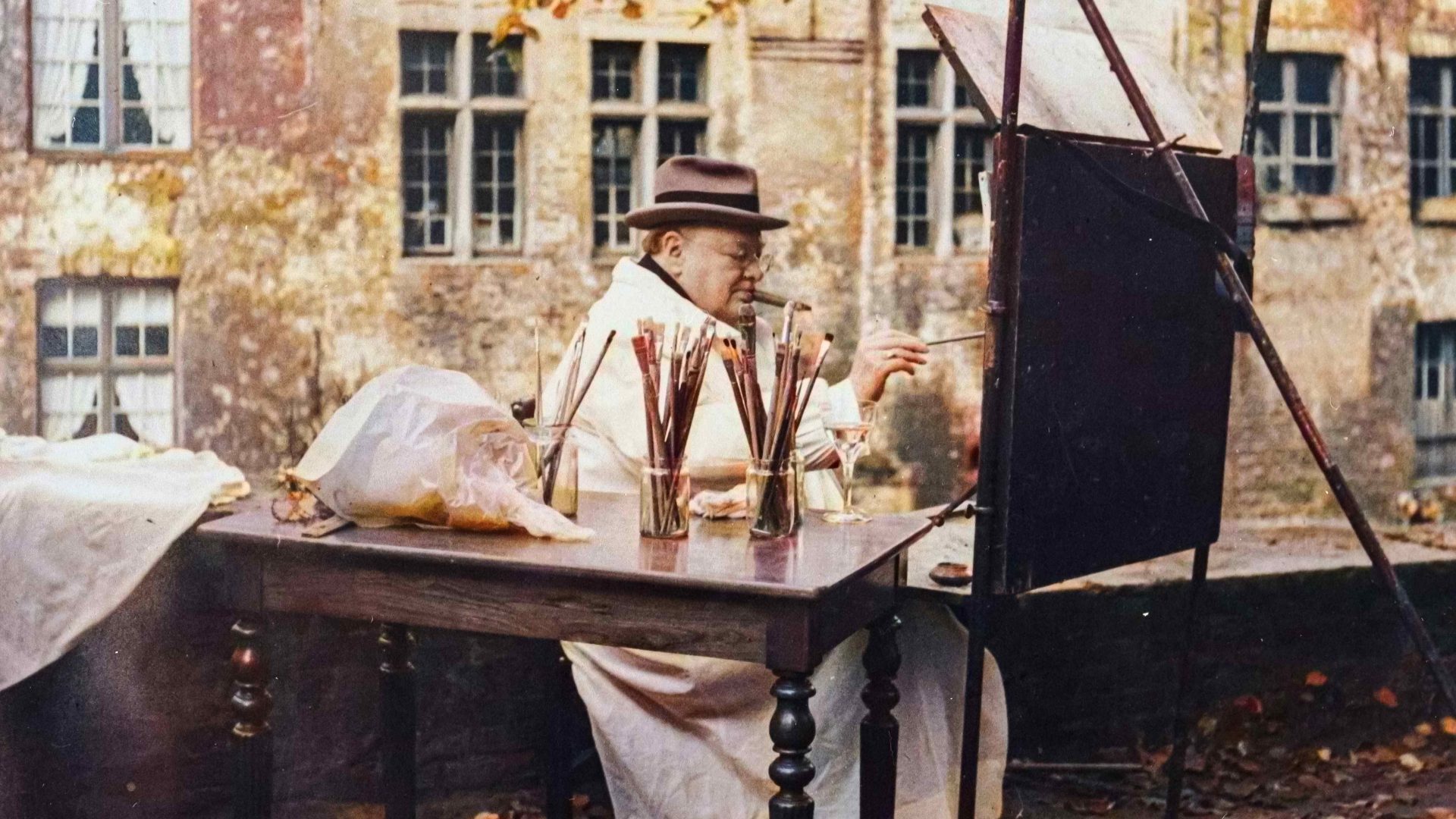
The enormous bronze sculpture of Sir Winston Churchill in Parliament Square recently had red paint sloshed over it by a political activist. Britain’s wartime leader might have appreciated the medium if not the execution, because he was a painter too.
In 1915, Churchill stood down as first lord of the Admiralty – the political head of the Royal Navy – following the disastrous Gallipoli campaign. His wife, Clementine, said she thought he would die of grief in political exile. Churchill described feeling like a “sea-beast fished up from the depths”, his veins threatening to burst from the sudden fall in work pressure.
To relieve the stress of failure, his sister-in-law Gwendoline, wife of his brother Jack, suggested painting. To encourage him further, the artist Hazel Lavery, wife of Irish portraitist Sir John Lavery, gave him a paintbox, leading Churchill to acquire a set of oil paints, canvas and easel.
Her advice was simply to “splash on the turpentine… wallop into the blue and white… [use] fierce strokes… on the absolutely cowering canvas.” It worked. Her guidance and those of his art mentors created a therapy to allay his “black dog” of depression.
Where does a fortysomething novice painter begin? In 1915, Churchill’s favourite artists were French: the Impressionist Claude Monet, post-Impressionist Paul Cézanne and the Fauvist Henri Matisse. He admired their use of vibrant colour and painterly freedom. There is a hint of Cézanne in Churchill’s La Dragonnière, Cap Martin c.1930s, and of Monet’s waterlily paintings in The Goldfish Pool at Chartwell, 1932, where golden orfe create reflective ripples in greenish water, at Churchill’s home in Kent.
But before the freedom of experimentation, Churchill’s first mentor was John Lavery, who taught him the principles of composition using light, colour harmony and direct observation, as in Lavery’s own Portrait of Sir Winston Churchill, 1915. Lavery often painted subjects on a plain, dark background with a beam of light on the sitter. In Lavery’s London studio, Churchill copied this method closely in Self-Portrait 1915, and John Lavery in his Studio, 1915.
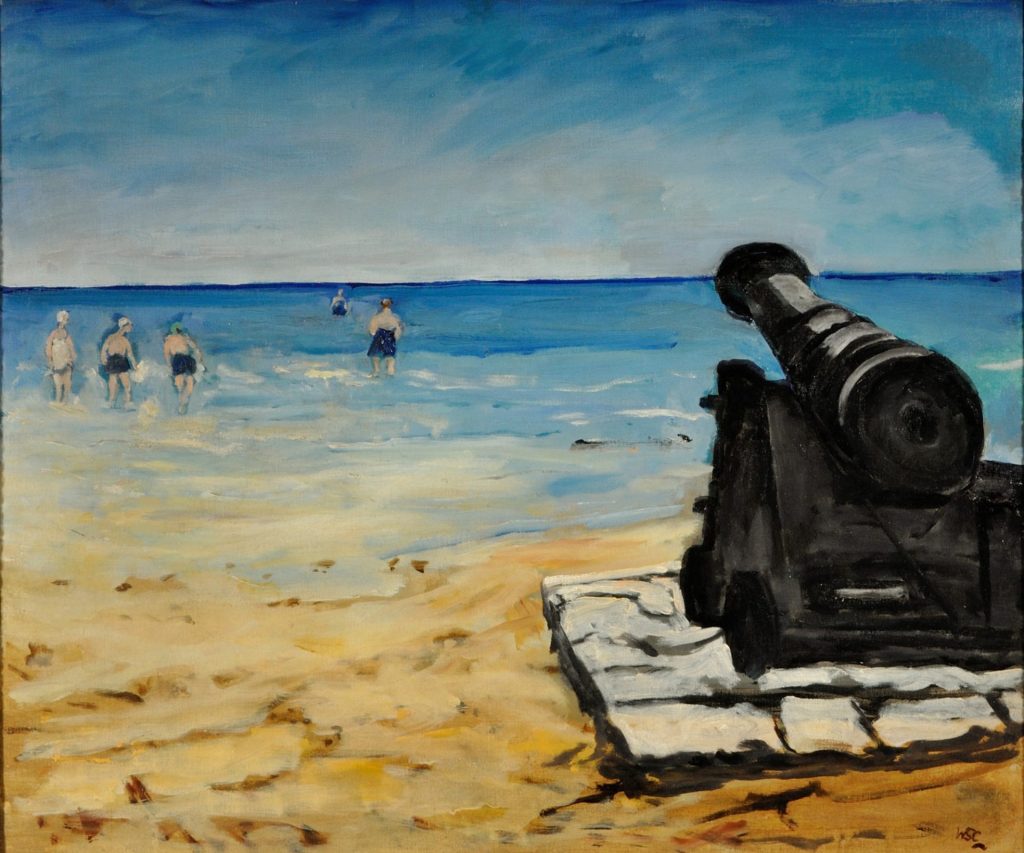
To help him master still life and landscape, Lavery introduced Churchill to the artists Walter Sickert and William Nicholson. Nicholson became a regular visitor to Chartwell. One method was to learn by copying, and Churchill’s The Swimming Pool at Chartwell, 1935, is a near-replica of Nicholson’s The Swimming Pool at Chartwell, 1934-35.
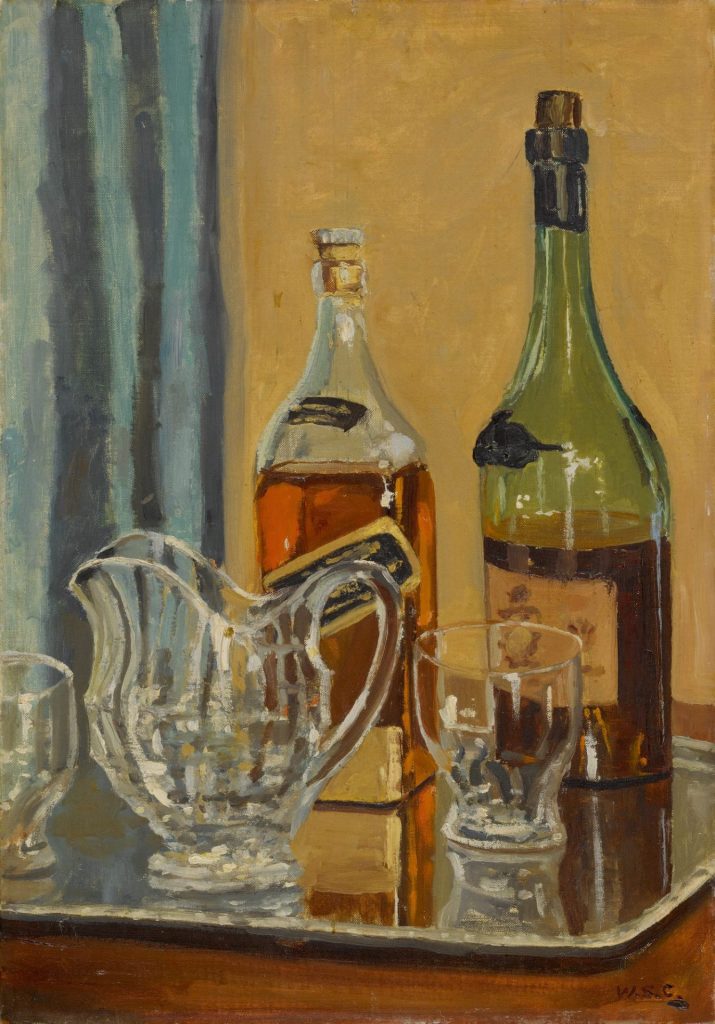
On wet days, they painted comparison still lifes in Churchill’s painting studio. His work lacks the refinement of Nicholson’s, but Churchill had the determination to keep trying. Still Life, Silver, c.1930, is a stab at catching the reflective surface of metal objects, and Magnolia, c.1930s, attempts to replicate the delicate softness of flower petals.
Churchill admired Sickert for the psychological content that gave his paintings an expressive emotional depth. In cropped compositions, the key was photography. Churchill took black-and-white photographs of his subject to draw horizontal and vertical grid lines on a printed photograph, then to paint each section, one square at a time, on canvas.
For the painting Blue Grass – La Capponcina, 1954, a gridded photograph of the location shows exactly how it was created. And Sickert introduced Churchill to the “magic lantern”, an epidiascope for projecting positive and negative images on to a canvas from a photographic negative.
Using this, Sickert advised Churchill on how to prepare a canvas using monochrome tints, a camaïeu, to emphasise areas of light and shade. Churchill’s letters often describe what he is painting, like the “fertile red and black soil, gushing streams of water… translucent air, swarms of picturesque inhabitants…”.
Churchill was keen to help others discover the pleasure of painting, and in 1932 published the self-help Painting as a Pastime. One person to read it was President George W Bush, who was inspired to publish his painted portraits of military war veterans in Portraits of Courage, 2017. Art lovers might consider this to be yet another mistake by Dubya.
Painting as a hobby inspired dictators, too. General Franco, who ruled Spain from 1939-75, practised portraiture best described as insignificant. Better as an artist, if not as anything else, was Adolf Hitler. From 1907 until he became Nazi leader in 1931, Hitler made his living from selling his small-scale works of traditional scenes, producing more than 2,000 paintings.
In the five decades until his death in 1965, Churchill created more than 500 paintings. Fifty of them are now on show at London’s Wallace Collection. It is the first major retrospective of his work for over 50 years; around half are from private collections and rarely viewed publicly.
This exhibition offers a chance to study Churchill’s paintings closely. His art mentors taught him techniques, but as a painter, was he any good?
Art critics say at best he was a “Sunday painter”, splashing on the paint as a hobby, not seeking critical reviews. Churchill himself referred to his paintings as “daubs” but cleverly used them as “soft-power” diplomatic gifts to political allies, including three American presidents: Franklin D Roosevelt, Harry S Truman and Dwight D Eisenhower.
Suggested Reading
Why did artist Ruth Asawa bring her work home with her?
The sand-yellow Tower of the Koutoubia Mosque, 1943, was the only painting created by Churchill during the second world war. He took out his paints for Roosevelt, to mark their meeting in Marrakech, looking on to this view.
After Roosevelt’s death, it was sold, eventually residing in the collection of the American actress Angelina Jolie. It was then auctioned in 2021 for around £8.3m, a record for a Churchill painting.
We can be sure that the price was more for the artist than the art. But then, what Winston Churchill did in those war years was invaluable.
Winston Churchill: The Painter is at The Wallace Collection, Hertford House, London, until November 29