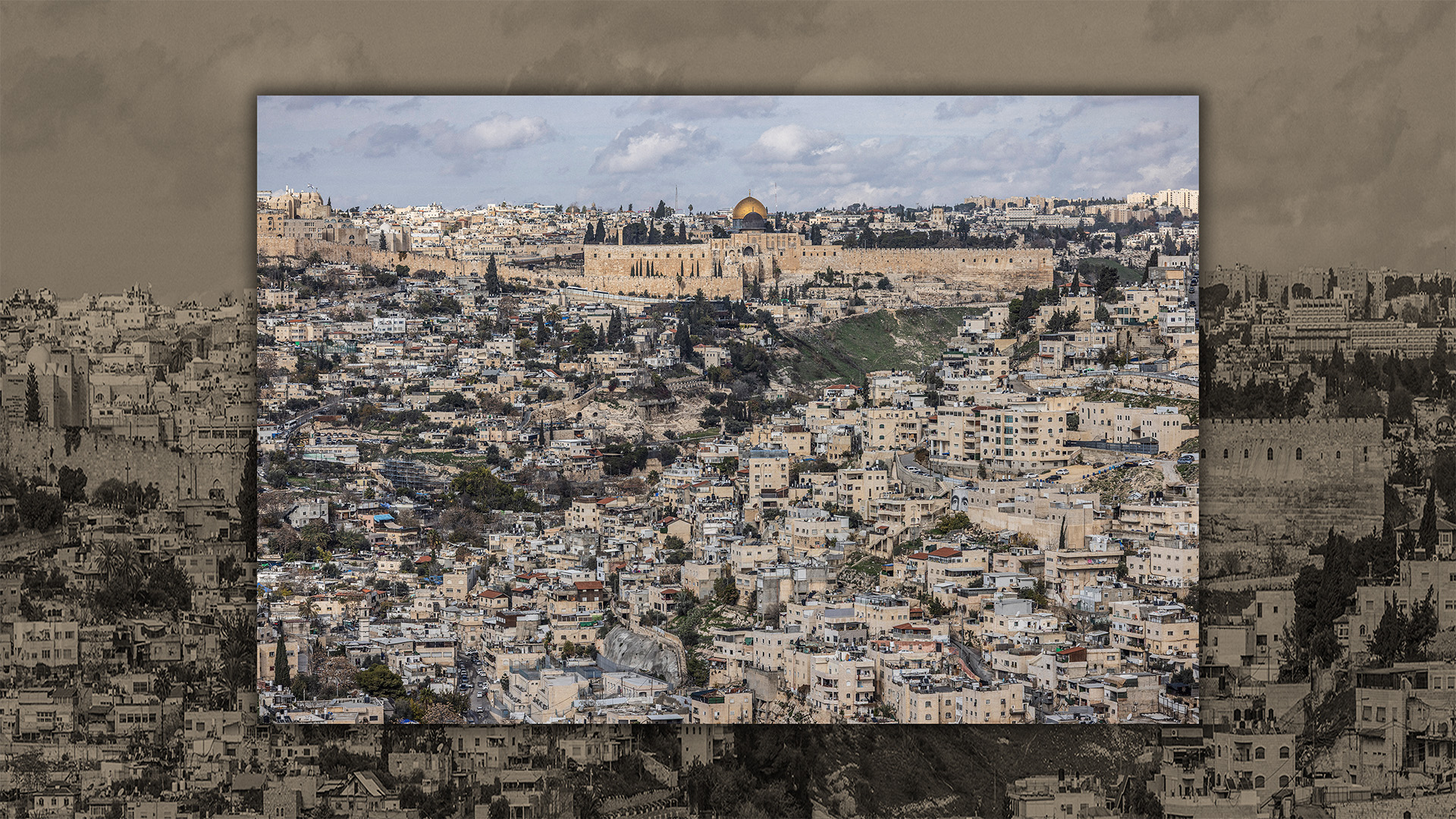
The sun’s about to set in the al-Bustan neighbourhood of Silwan, East Jerusalem, and Fakhri Abu Diab’s just returned home from al-Aqsa Mosque. He opens the large, metal gate to his home looking dapper – gray hair combed, face freshly shaven and aftershave that smells like a meadow. He wears a smart, black collared coat over a black turtle neck with pressed trousers, clearly taking the utmost care to look his best for Friday prayers. “Come in, come in,” he says warmly. “Welcome.”
I follow him through the gate into a scene of total destruction. The rubble is the height of a double decker bus and spans the area of a tennis court. Bricks, wires, drawers, pipes and wood panels give little indication of the family home this once was. The only recognisable part of the carnage is the kitchen, which still has the original cabinets and floor tiles intact. To the left, a gutted, gaping wound where the bathroom once was; next to it a mobile home Abu Diab bought in an attempt to console his wife.
“After they destroyed my home, my children moved away from us,” he says. “Me and my wife moved into this caravan which they also want to demolish. I am in trauma every day. It’s very, very difficult. I suffer from ill health in many ways. They make our lives black.”
Abu Diab is the spokesperson for the committee for the defence of Silwan land and chairs the al-Bustan residents’ committee. He tells me he was forced to pay 43,000 Shekels (£10,000) for the demolition of his own home including the police’s lunch that day, and he still pays 5,200 Shekels (£1,250) each year in council tax for his uninhabitable land.
“They want to make a park because 3,000 years ago King David was here,” Abu Diab says. “But I was also here 3,000 years ago. I was born here. This is my mother land. I have many, many generations here. But they do not want us here.”
Abu Diab walks with a slight limp – the result of diabetes – and he’s not the only one with health issues in al-Bustan. Many of his friends suffer from hypertension, heart disease, high blood pressure, insomnia, depression and anxiety. His wife hasn’t stopped crying since their home was partially demolished on February 14th 2025 and fully on November 5th 2025, and there is no respite. Every week, they find new demolition orders from City Hall written in Hebrew pinned to their metal gate, this time targeting their mobile home.
Fakhri holds one up. It shows a map of al-Bustan with a bold yellow line marking out his neighbourhood. “It says all of this area will be taken and turned into a car park,” he says stoically, his eyes deep wells of grief.
The car park will serve visitors of an archaeological site just two streets away called The King’s Garden. It has multiple mentions in the Bible, which the Israeli government uses to justify its excavation, effectively confiscating the land and its surroundings from Palestinians. Right next to the excavation site an Israeli flag marks a settlement. I watch an armed settler walk through a car park built only for their use.
The excavation of The King’s Garden is part of a wider project called Jerusalem Walls National Park. First declared in 1974, the project spans an area of 110 hectares, most of which is in East Jerusalem, encircling the Old City walls and swallowing up the neighbourhood of Silwan.
The State of Israel has always had its sights set on Jerusalem in its entirety. Annexed since 1967, Israel has used settlement construction and land confiscation as a tool to maintain an Israeli majority and further solidify Jerusalem as its capital.
Palestinians also consider Jerusalem (al-Quds in Arabic) their capital, and although its annexation is considered illegal under international law, that does nothing to stop the expansion. Construction on a settlement called E1 begins imminently, which will slice the West Bank down the middle and cut off major roadways between Bethlehem and Ramallah. Israel’s far-right finance minister Bezalel Smotrich says it will “bury the idea of a Palestinian state”.
Dr. Yoni Mizrahi is an archaeologist and founder of Emek Shaveh, an Israeli NGO working to prevent Israel’s weaponisation of archaeology as a tool to take over Palestinian land.
“The King’s Garden is not something new,” Mizrahi tells me. “Actually, Israel began this way. They come and say that we have religious and historic sites, not just in the Old City but the neighbourhoods around it, that are part of our identity and our history as Jewish people.”
Mizrahi says that about twenty years ago the settler movement began to realise their presence alone was not enough. “So the tool is to use the importance of religious sites,” Mizrahi explains. “Places identified with the Judean Kingdom, with King David, King Solomon, anything connected to the Second Temple, they come and take over the land for tourism benefits.”
These heritage sites are used to justify Israeli preeminence. “It’s saying the theology we find shows that our ancestors were here thousands of years ago, and we are not intruders, or colonialists, or newcomers,” Mizrahi says. “It’s saying we are actually indigenous, people with deep roots in the history of the land, so for Israel it is a very important tool needed to justify our presence here.”
On a road south of the Old City to Silwan you’ll find Valley Farm, a beautifully landscaped oasis in the heart of Jerusalem, a space for Jewish learning, summer camps and school trips. The grass is immaculate, the trees lush. A pair of camels graze calmly on straw.
Along with Fakhri, Angela Godfrey-Goldstein is an activist who campaigned with Fakhri against The King’s Garden plan in 2005 as advocacy officer for The Israeli Committee against Home Demolitions.
“Make no mistake,” Godfrey-Goldstein says as we walk by Valley Farm. “This is a land grab.”
Suggested Reading

The biggest losers of Trump’s Iran fiasco: Israel and the US
Valley Farm sits on the border of East Jerusalem on Palestinian land, although there’s no mention of that on their website. There is, however, reference to “the extraordinary burial caves found in its territory.” The site also states that, “throughout the year, the farm works to preserve the ancient agricultural crafts according to the seasons of nature, just like in ancient times.” Local Palestinians do not have access to it.
“In 1967, when Israel annexed Jerusalem, they only gave 13% to Palestinian residential use, which was already fully built up,” Godfrey-Goldstein tells me. “So from the get-go, the policy was forcible transfer, which is a war crime.”
This isn’t the only land grab disguised as tourism. Just beyond Valley Farm you’ll see the Guy Ben Hinnom Bridge, “the longest suspension bridge in Israel.” It connects Ben Hinnom Gorge to Mount Zion for no apparent reason other than to encourage the country’s Israeli population to edge closer into East Jerusalem without fear.
The most successful of these projects is the City of David, known locally as Wadi Hilweh, where the Israeli government says King David “built the original city of Jerusalem” 3,000 years ago. The archaeological site lies on a narrow ridge running south from the Temple Mount, which houses the Al-Aqsa Mosque and the Dome of the Rock. It’s in the heart of Silwan. However Palestinians do not have access to it. Each year around half a million domestic and international tourists flock there, while the Palestinian houses nearby are damaged or made uninhabitable by the tunnels dug under their homes.
Alongside the Israeli government, several NGOs spearhead these projects, but the most dominant is Elad. Since 1986, Elad has sought to strengthen the Israeli connection to Jerusalem through tourism, education programs and archaeological excavations. They are one of Israel’s best-funded not-for-profits. Russian-Israeli billionaire Roman Abramovich donated over $100 million in the 12 years to 2020 through offshore companies. They receive millions of shekels each year from annual budgets dedicated to expansion in East Jerusalem, often under programs titled “Jerusalem and Heritage”.
But Palestinians and the international community are fighting back however they can, including with art. When you look over Silwan from a distance you’ll see many sets of graffitied eyes staring back at you. This is a project called “I Witness Silwan”, which aims to raise awareness of the ethnic cleansing of the neighbourhood and remind the Israeli government they’re being watched. But with all eyes on Gaza since October 7th 2023, global attention has been diverted from East Jerusalem.
So with a demolished home, and a soon-to-be-demolished caravan, where are Fakhri and other Palestinians in East Jerusalem expected to go?
The Shuafat Refugee Camp sits just beyond the separation wall but within Jerusalem’s borders, which means the municipality is legally responsible for the welfare of its inhabitants. It’s characterised by looming high rises seemingly inches apart from one another, flanked by an expansive checkpoint which the Palestinian population must pass through to access Jerusalem. Israeli authorities do not touch it. Everybody describes it as No Man’s Land.
“Over the last few decades, roughly one-third of Jerusalem’s Palestinian population has been forced into the Shuafat refugee camp or Kufr Aqeb neighbourhood,” Godfrey-Goldstein tells me. “There are no services, no garbage disposal, no police. The police are afraid to go there. I went in one time and the kids were ready to throw stones at us. There’s huge volatility and crime.”
When the E1 settlement is built, access to Jerusalem from the East will become even more difficult, and people living in Shuafat refugee camp will languish even further. The land used by E1 is the last remaining open land where Palestinian East Jerusalemites can expand out. Without it, they will be forced into cramped, volatile ghettos such as this one.
“E1 is much more than splitting the West Bank in two,” Godfrey-Goldstein says. “It also prevents access to East Jerusalem, tourism revenue, holy sites, hospitals, university campuses. They’ve already closed off the north and south with the wall, settlements, road systems and checkpoints, but entry to Jerusalem from the East is still viable.”
Despite Abu Diab and Godfrey-Goldstein’s regular meetings with western ambassadors, including film screenings in the rubble of Fakhri’s home, no one seems able or willing to help.
“I used to think everyone wanted peace, but they don’t,” Godfrey-Goldstein says, surveying the remnants of her colleague’s house. “In days of war, the army grabs more land and frames militarism as security, which I don’t believe. I think it’s the opposite. If you learn somebody’s language, deal with them as human beings, give them their rights and treat them as equals, that’s security.”
 Most popular

My truly deranged encounter with Trump apologist Kellyanne Conway


Suella Braverman’s book has sold only 106 copies. This is why

The moral depravity of Robert Jenrick

Hungary’s lesson to the world: Populism isn’t permanent