I’m working in the shop unpacking boxes when a very thin woman in black leggings and a Barbour jacket has her partner carry in five bin bags of clothes and rich-person accessories like diving-holiday duffel bags and a Ritz-Carlton Yacht Collection tote. The clothes in the bin bags are from COS and Zara, with the same items bought over and over: small square black handbags, loose dresses in black or white.
There is so much stuff that I ask her if she is moving house. “Yes,” she says, before adding: “Everything in here is really good.” If a slim COS fan comes in, they will be very happy, but there is also a lot of old gym kit, trainers and slippers, and bobbly gloves.
The next week, an unpleasant surprise is waiting outside the shop. Fifteen small grey bin bags of clothes have been dumped on the pavement. They are possibly from a house clearance but no one has stuck around to explain.
Inside the bags it is mostly Principles and Primark: navy-blue T-shirts, shapeless trousers, synthetic, beige lace-trimmed shirts, some florals, some side frills, some touches of embroidered flowers – all outdated, stained and stretched out of shape. Dumped clothes that no one cares to hand over properly have a sad feel to them, stripped of all joy and worth.
Apart from a few T-shirts, the entire collection goes in the textile waste sack, which is known to us as the ragbag.
The number-one donation to our charity shop is clothes. It is the same everywhere – charity shops are crammed full of clothes whose labels sketch out the world: “Made in China…Bangladesh… Vietnam… Mexico…Turkey… Romania”.
An endlessly growing mountain of clothes bought and then given away to charity. Between 2000 and 2015, global clothing production is said to have doubled in quantity; over the same period, the average number of times a garment is worn decreased by 36%.
A lack of transparency in the fashion industry means we do not know how many pieces of clothing are manufactured each year, with figures ranging wildly from 80 to 150 billion items. It is this massive overproduction, followed by consumption and discarding, that creates the vast surplus of clothing that I am now pulling out of carrier bags and holdalls.
Suggested Reading


Frida Kahlo and the culture war over women’s pain
Why do brands make so many clothes? The short answer is money. A longer answer is that fashion is a system based upon profit maximisation where brands compete with each other to drive costs down and down while convincing consumers to spend money on an endless array of commodities. Volume is incentivised in this system – the more pairs of jeans a brand orders from a factory, the lower the unit price of each pair.
The system not only encourages but deifies consumption – consumption is king – imbuing clothes with promises of social standing, love, desire, job promotion and the ever elusive cool. These promises, and the fact that clothing consumption is a social act being carried out in a system that punishes those who do not keep up, mean that even people who already own lots of clothes keep shopping.
Everybody, including me, talks about the importance of clothing – about how clothes house the body, becoming one with our identity and the stories we tell. But in the back room of a charity shop, the great cultural significance of clothes seems simply to be how easily they’re thrown away.
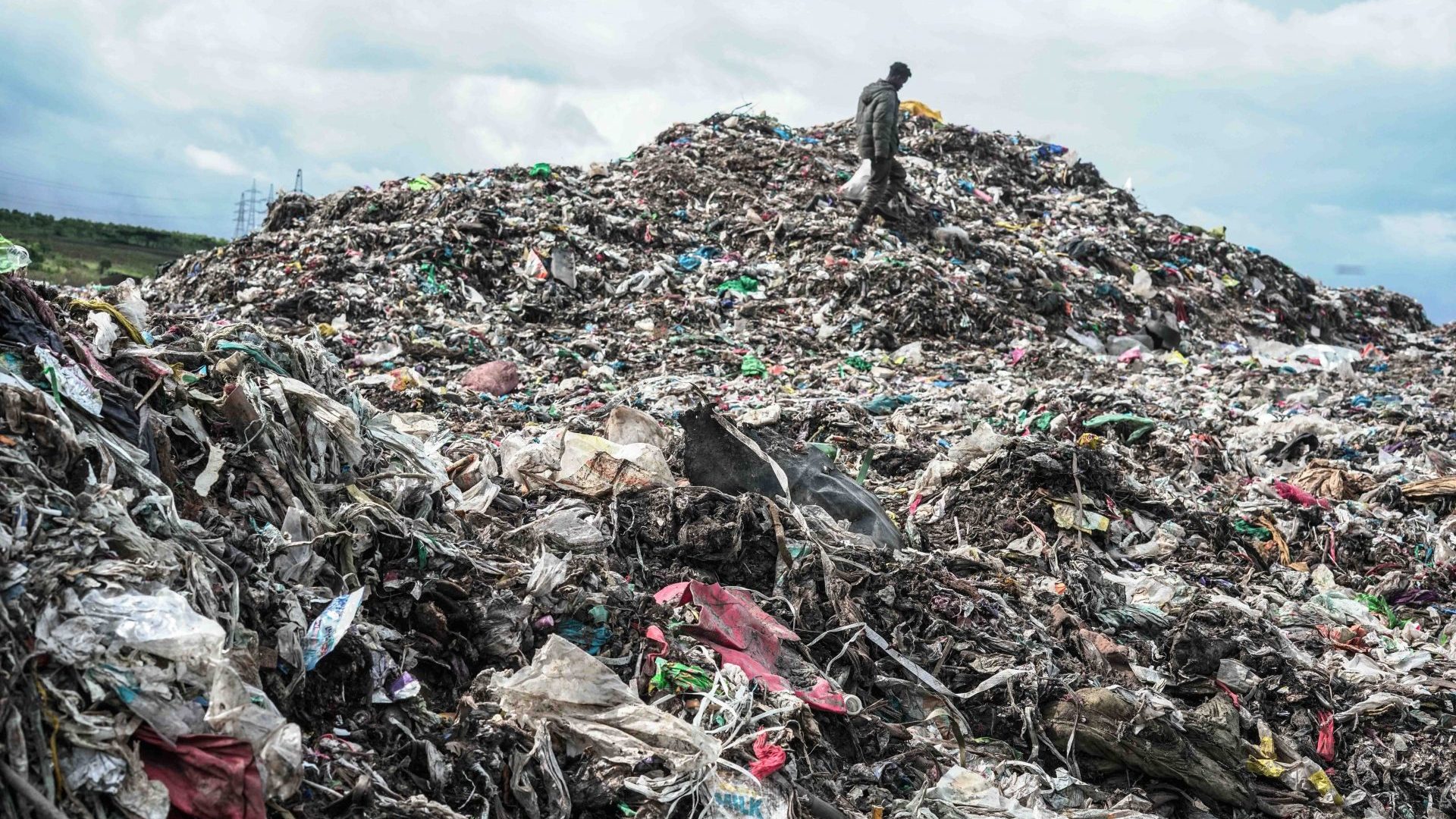
This broken system means that 92 million tonnes of textile waste was generated in 2015. To comprehend how much this is, picture a rubbish truck full of clothing arriving at a landfill site, or at an incinerator, every single second.
It’s not just the creation of this mountain of waste that is a problem. In the making of all these clothes, fashion and textiles account for somewhere between 2% and 8% of global greenhouse-gas emissions and 9% of the microplastic pollution that ends up in our oceans.
Selling suits, dresses, handbags and trainers has created some of the richest people in human history, but it is the planet that is carrying the burden of this greed. The planet and the 72 million people who work in the manufacture of garments and footwear, of leather and textile products. All these people are caught in an industry where life means dangerous factories, rock-bottom wages, brutal violence and sexual harassment.
The fashion industry generates $2.5tn in global revenues, making it one of the largest industries in the world, yet the truth of this industry and of the surplus it generates is that it is all the result of exploitation. Despite all these trillions of dollars, no major brand, whether fast-fashion or luxury, can prove that all the workers in its supply chain earn a living wage.
The poverty of this system is increasingly reflected in the quality of clothing. Thin, synthetic garments designed as a brief fling, not a lifelong companion, and all of them being dumped on charity shops that are struggling to cope with the deluge of fast and ultra-fast fashion.
When people complain that charity shops sometimes feel less satisfying than they used to, I try to point out that it is simply because clothes have become worse. This drop in quality is an open secret: a recent UK survey found 62% of people thought their clothes were lasting for a shorter time and were now more lightweight.
In 2025, a consumer movement encouraged people to post worn-out items back to the CEOs of fashion brands, with a letter saying that the items were unusable and unrecyclable.
Suggested Reading

How the publishing industry failed Jason Arday
One academic study, by Tim Cooper and Stella Claxton, gathered donated clothing from Oxfam, Traid and a textile recycler. The conditions of the garments revealed familiar problems, including fraying, thinning, colour fading and pilling of knitwear.
Far from being inevitable, these are technical issues solvable through better manufacturing methods – for example: using 100% natural fibres instead of polyester; abrasion resistance testing and the use of heavier fabrics; using stronger stitch-and-seam combinations; using high-quality zips and buttons; and conducting wearer trials. These steps should be implemented during product development and manufacturing – except that there are, in Cooper and Claxton’s words, “cost and technical constraints” when it comes to appropriate testing. In other words, brands do not want to pay to make clothes better, so they churn out rubbish.
Sorting through broken, torn and faded clothes, it is infuriating to know that increasing the active lifetime of clothing is one of the most effective actions to reduce footprints for carbon, water and waste. Make clothes last just nine months longer and their carbon footprint goes down by 27%, the water footprint by 33% and the waste footprint by 22%, according to the environmental charity Wrap.
Instead, we have a system whereby society knows what tests are needed, but brands and retailers are not compelled in any way to carry them out.
Cooper and Claxton’s study concluded that even if garments fail testing criteria and are considered substandard, it is common practice for brands just to attach a disclaimer. My own quick online search revealed brands using disclaimers such as “Delicate fabric may snag” or “This fabric may naturally develop marks” or “Please fold this product instead of hanging; fabric may stretch over time”. Ultimately, Cooper and Claxton found: “Clothing is a sales-driven industry, with fashion often taking a priority over quality.”
Suggested Reading

Sorry influencers, but most of you are just dicks
I unpack my first donation of used underwear today. It arrives in one of three bags dropped off by a middle-aged man. (Everyone I have told about this since has asked me if the underwear was clean – do they think I inspected it?)
Almost the entire donation goes straight in the ragbag – I have stopped wearing the blue plastic gloves all the time, but I’m glad I’m wearing them today. My manager says she reckons some people “just get a kick” out of donating their old underwear.
The overworked steamer is held together with tape and has no hooks, so there is no easy way to hang up clothes. My manager is taking rubbish to the community hall bins and the building-site skip (neither of whom minds us doing this when they have space) as ours are overflowing. It’s really difficult to keep the space tidy as more stuff is arriving every hour.
Lots of teenage boys’ sportswear arrives in a bag: tracksuits, shorts, T-shirts, jumpers. That much Nike starts to look like a fetish. Then a woman brings in a few bags of “having a clear-out” clothes. In one bag is a patent-silver leather sandal – but just the one.
It’s the school holidays and the shop has accumulated a record-breaking 33 ragbags in two days. The lean-to is so full that the man from the “recycling company” comes to do an extra collection.
I help carry the bags outside to take a look at the van. He’s putting each ragbag on a set of flat industrial scales and keeping a tally in his head.
Colours are pressed against the plastic of each bag I hand him: yellow gingham, black polyester with a floral print, blue denim and pink wool striped with purple and green. After weighing everything, he slams the doors, hands over a small amount of money and drives off.
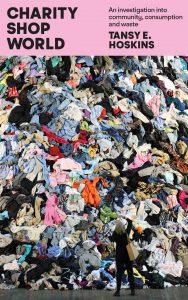
Charity Shop World: An Investigation into Community, Consumption and Waste by Tansy E Hoskins is published by The Indigo Press