“Creativity is a wild mind and a disciplined eye”
Dorothy Parker
Portraiture is an intimate business. This is especially so if you work repeatedly with the same people, as I’ve done over many years. Most notably: Joy Division/New Order; Morrissey; Manic Street Preachers, and Oasis.
The key to a powerful photographic portrait is, oddly, the symbolic removal of the camera. The subject must be comfortable enough with me for their gaze to cross the space between us, to neutralise the barrier of the lens, and to look directly at me, as though the camera does not exist at all.
When they look at me that way, that’s exactly how it will hit the viewer. And when that happens, as a photographer, you experience an emotional response, and consequently you hope that emotional response will affect any other observer of the image too.
When I studied photography, I wasn’t really interested in what people call “Rock photography”, an expression which belittled the art at the time, reducing it to juvenilia.
I studied Diane Arbus, August Sander, and Bill Brandt, photographers who worked in very different ways, but taught me to read a photograph, rather than look at it superficially.
After I graduated, I started photographing the people around me, many I knew who were forming bands in the wake of the Sex Pistols gig in Manchester in June 1976.
I worked with Buzzcocks mainly – and the Pistols – and shot a host of bands who wouldn’t be remembered by the time my prints were dry, never mind now.
I knew Peter Hook and Bernard Sumner slightly. They lived in Salford as I did. There was a nucleus of around 50 people I knew by sight from voraciously going to gigs.
I shot their first gig – as Warsaw – on May 29, 1977 at The Electric Circus in Collyhurst, Manchester. They weren’t the band who almost 50 years later we revere. They were derivative of many of the bands we saw at that level: angry and shouty.
I was just on the cusp of getting my work published in the NME (then the world’s biggest-selling rock weekly), along with fledgling writer Paul Morley. We submitted stories every week, some were even true.
I shot a couple more Joy Division gigs just to have on file, conscious that I was building an archive, something I learned from studying August Sander.
I wasn’t confident of ever telling anyone that back then. I was just one of the nucleus of 50 – albeit the one with a camera.
Then in December 1978, I was commissioned by the NME to shoot for a major piece on three emerging Manchester bands for an issue on new music and trends in the New Year. The bands were Joy Division, Spherical Objects and The Passage.
We left Joy Division until last, not convinced they’d have a lot to say. The band wanted to do the shoot on a Saturday, because they worked during the week.
I always went to see Man City on a Saturday, so for me it was a non-starter. Then during the week, we had heavy snow in the north, and Man City’s game (a third round FA Cup tie) was postponed because we were due to play the winners of Rotherham v Barnsley, which also fell foul of the weather. So, I was free to do my job…
I spoke to my editor on the eve of the session to let him know that Manchester was snowbound and to ask if he still wanted me to shoot the band the following day.
Thinking journalistically, I felt the snow might date the photos if we ran them a few weeks later when the weather had improved.
He suggested I took some photos in the snow and, if possible, also to take some indoors as a backup.
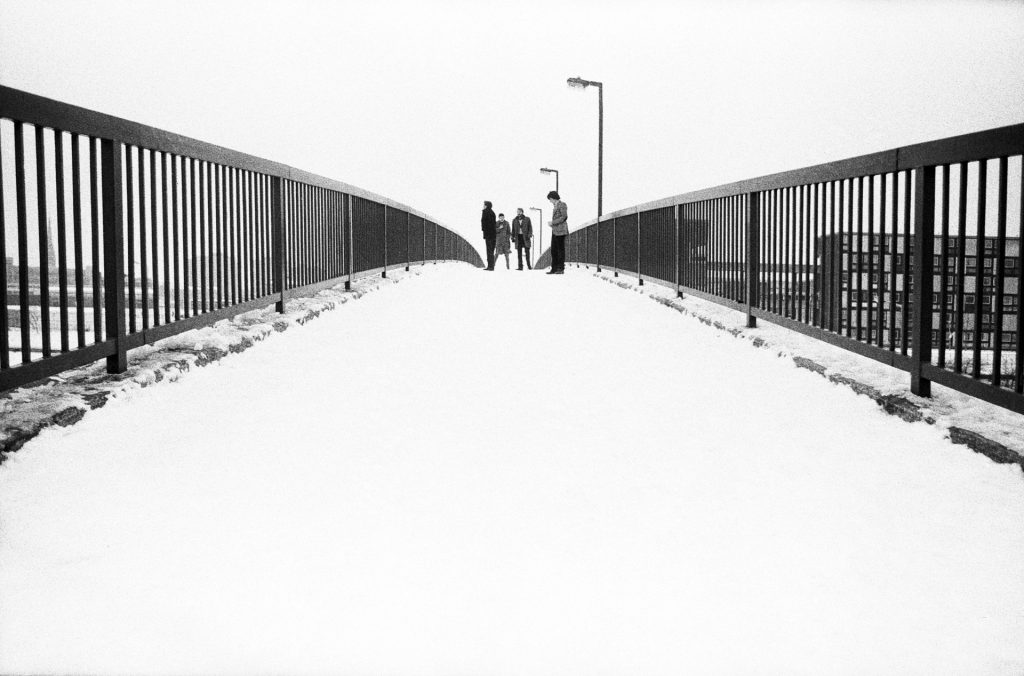
I took the band to the Epping Walk Bridge over Princess Parkway – the main road in and out of the city, to capture the bleakness of Manchester back then.
The original idea for the shot was to have them looking south as if they couldn’t wait to escape the frozen north.
I asked them to stand on the crest of the bridge and left them there, as I intended shooting from the road below.
Suggested Reading

A blue world hangs in the balance
As I reached the steps down to the road, I glanced back and it looked so bleak, so barren, that I shot three frames, thinking it made both an interesting architectural shot and would encapsulate the sparseness of their music.
I never did take the shot from below as the light was fading.
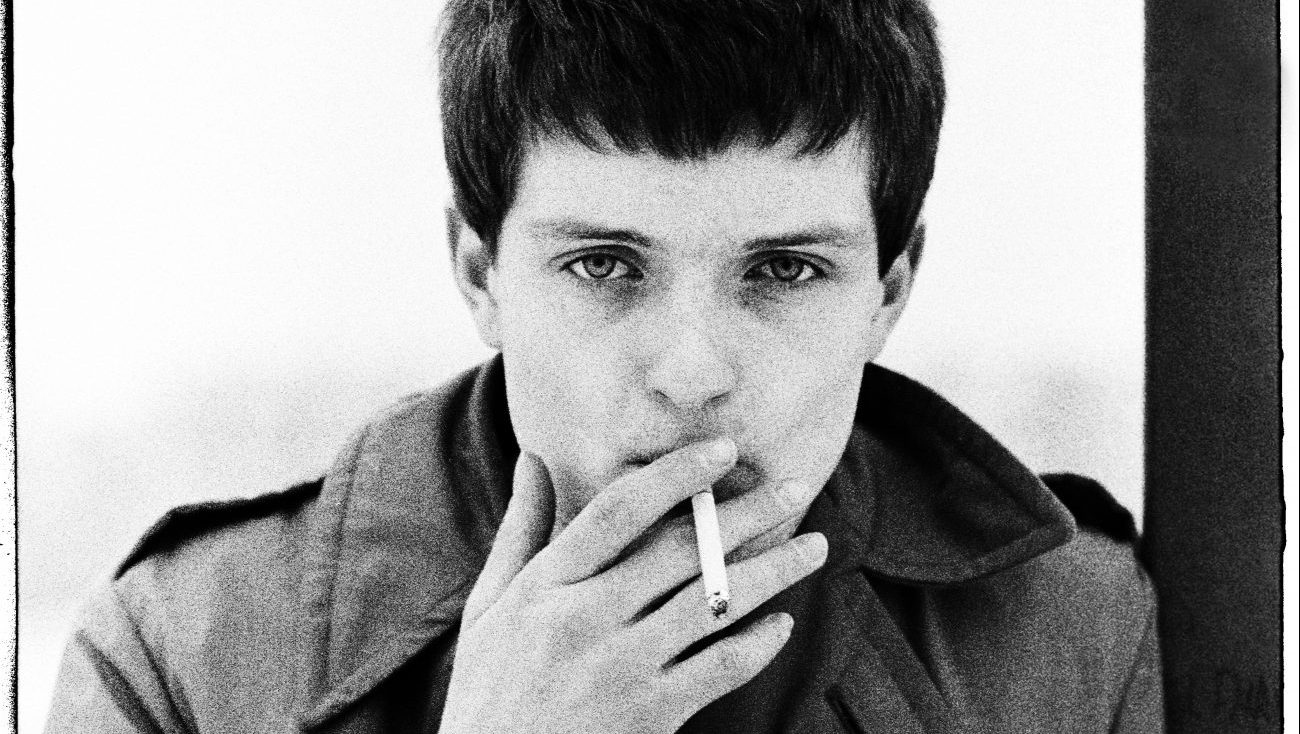
I quickly finished off the roll of film on some solo portraits of Ian Curtis smoking, and we drove back into the city centre to take some more shots in the warmth of a shop called Art and Furniture, on Chapel Walk, Deansgate.
I only had two rolls of film. I couldn’t afford more than that. I’d be lucky to break even on the shoot. I had no way of knowing that we’d still be talking about the band – and my photos of them – almost 50 years later.
I went to see Joy Division many times. Mostly without a camera, as I couldn’t afford to always shoot film, although I felt I already had enough performance shots of them.
After my initial photo-session for the NME, I spent a lot of time with Joy Division – socially and professionally, both in rehearsal and on tour. They were typical of most young lads in their late teens/early 20s. We were a similar age.
The talk was mainly about music (Iggy and the Stooges, Velvet Underground, Bowie, Lou Reed), girls, books, football (with Ian – the others weren’t bothered. Ian and I supported Manchester City).
They weren’t really the serious young men of my photographs and Ian’s dark lyrics. People often imagine Ian sitting quietly backstage with his notebooks, reading and getting ideas from Kafka and Ballard. But the truth was he was part of a band of young lads. They’d mess around backstage winding one another up – taking the piss.
Ian did read a lot of poetry: Oscar Wilde, Thom Gunn, even Larkin, which he used to understand how lyrics could be constructed to tell stories.
Bernard would say that he didn’t really understand what Ian was writing about. It was just another layer to their sound.
Listening to some of these live recordings, many of them collected in the new box set Eternal, brings back a lot of mixed memories.
One thing I’d forgotten was how raspy and almost baritone Ian’s voice was at times when singing live.
He was a huge fan of Iggy Pop and Jim Morrison, and you can clearly hear how he modelled his singing voice on those two American vocalists. In real life, he spoke very softly with the Manchester accent of the time, which was almost Lancastrian.
Suggested Reading

The shots and the shadows
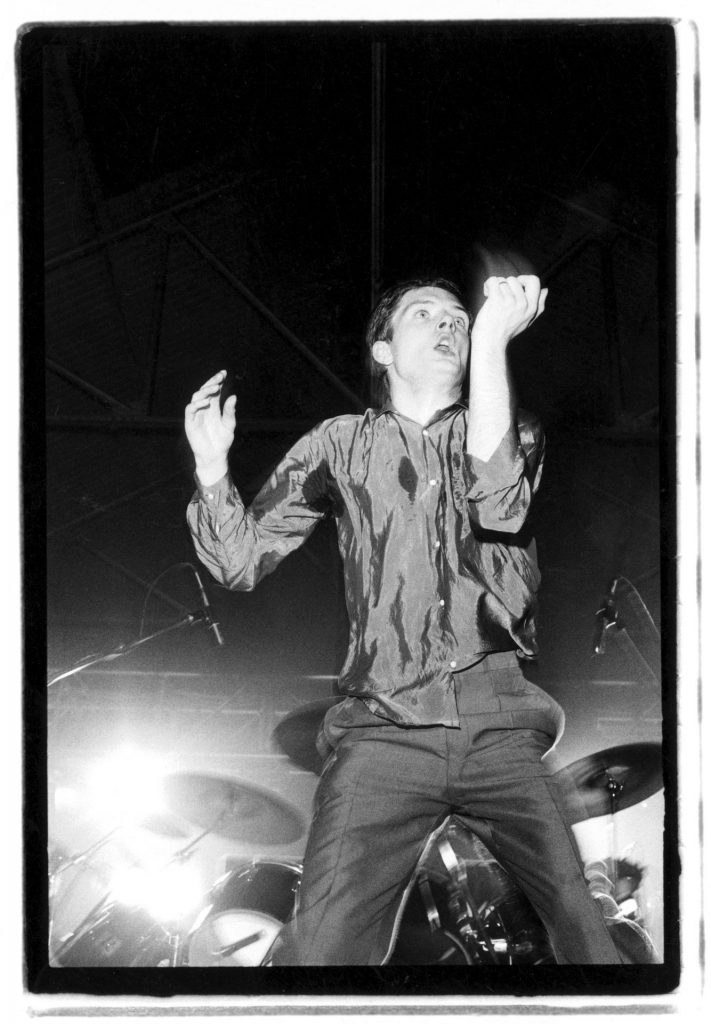
Watching them on stage was mesmeric. They were always an exciting band live. The stage was often backlit with minimal front light – possibly so as not to trigger Ian’s epilepsy. The three instrumentalists were very static – apart from natural movement as they played.
Ian Curtis was lost in his own world with his robotic dance; arms whirling while standing on the spot.
I’ve photographed a lot of bands in concert, but Ian, along with Iggy Pop, were the two most unpredictable front men. They both performed as if the audience and fellow band members weren’t there.
For a young photographer up close, it was terrifying at times. Iggy threw a chair at me once (he later apologised, saying he hadn’t seen me).
I felt if I got too close to Ian, his whirling arms would destroy my camera. I spoke to him about it and he confirmed he didn’t know I was in front of him.
Later that year, on August 19, 1979, I spent the day with the band shooting a session at TJ Davidson’s rehearsal rooms, which were used by most emerging Manchester bands.
When I photographed Ian in this space in Manchester city centre, the wall behind him looked black and he looks isolated, alone, and rather serious. It doesn’t matter that the wall was brown and the rest of the band were around him telling jokes and trying to make him laugh.
The reality of the photograph is that in that second, this was the story the image was telling. Therefore, although it’s a truth, it’s also partly manipulative. As a photographer, one is guiding the viewer to see which part of the photo is important by the way the image is composed.
This in turn I think shows ways in which photography is connected to fantasy.
Although as a photographer I can manipulate an image, ultimately, I have no control over how it is read.
I see many comments on my photos of Ian that I post on Instagram. Many men just say “Sad Eyes” – they’re projecting their thoughts of what, in hindsight, they think Ian was like – which wasn’t the Ian I knew and photographed.
Women mainly tell me he looked so hopelessly vulnerable and young.
He was young, of course. He was 22 or 23 in my portraits from 79 and died on May 18, 1980, before reaching 24.
When I photographed Joy Division, I wanted them to look like serious young men. Unsmiling, icily unapproachable. That was the image I projected onto them, an image that endures to this day.
The execrable semi-fictional biopic of the band released in 2007 was based largely on this image. A manipulated untruth.
The relationship between photography and truth, though, is quite a slippery one.
It would be fair to say there is no absolute truth within the frame of a photograph – and this is something the writer Susan Sontag believed – photography is about lots of things, but least of all the truth.
While I wouldn’t go that far, I do think at best a photograph offers a version of the truth. You give parts of the story within the frame, and the viewer doesn’t need to know anything outside of that.
I’ve always been interested in the power of mythmaking in photography. Richard Avedon’s magnum opus, In the American West, is a perfect example of this. The photographer as author, telling the story he wants to tell.
If you look at Avedon’s casting Polaroids for this project, it’s sometimes difficult to match them with the huge 60x40in prints of these supposedly normal people, styled as confident tricksters, hustlers, waitresses, manual workers et al.
Photographs can be about yearning or desire or even longing. Sontag describes this really well when she says in On Photography:
“A photograph is both a pseudo-presence and a token of absence. Like a wood fire in a room, photographs — especially those of people, of distant landscapes and faraway cities, of the vanished past – are incitements to reverie. The sense of the unattainable that can be evoked by photographs feeds directly into the erotic feelings of those for whom desirability is enhanced by distance.”
When I took some of my most well-known photographs, I did not predict that they would have the cultural life they have developed.
I’m often asked why Joy Division still fascinate people around the world when other bands have long disappeared from memory.
Two studio albums, with tortured lyrics, timeless production from Martin Hannett, artwork and photographs that constructed an image, again with a timeless quality, and a poetic, brooding frontman who tragically died when he was only 23. All these factors contribute to their longevity.
We’re fascinated with those who die young: James Dean, Marilyn Monroe, Egon Schiele, Jeff Buckley, Nick Drake, Brian Jones, Hendrix. Their work endures because it’s finite.
Over the years I have become more confident as a photographer, less shy, and more comfortable.
In my early days I didn’t direct people because it was easier to just let them do what they wanted. But now I’m happier to give instructions or collaborate on an image, as I did many times with Morrissey, and the Manics.
On reflection, I can look at photographs that I took in my early years, such as Joy Division on the bridge, and know everything that is “wrong” with it and how I would shoot it now.
The danger there is that if it was technically perfect, it might not be the picture that it is.
Perhaps it is the naive charm that works? I guess we’ll never know.
Eternal (Live) by Joy Division is released on September 25