
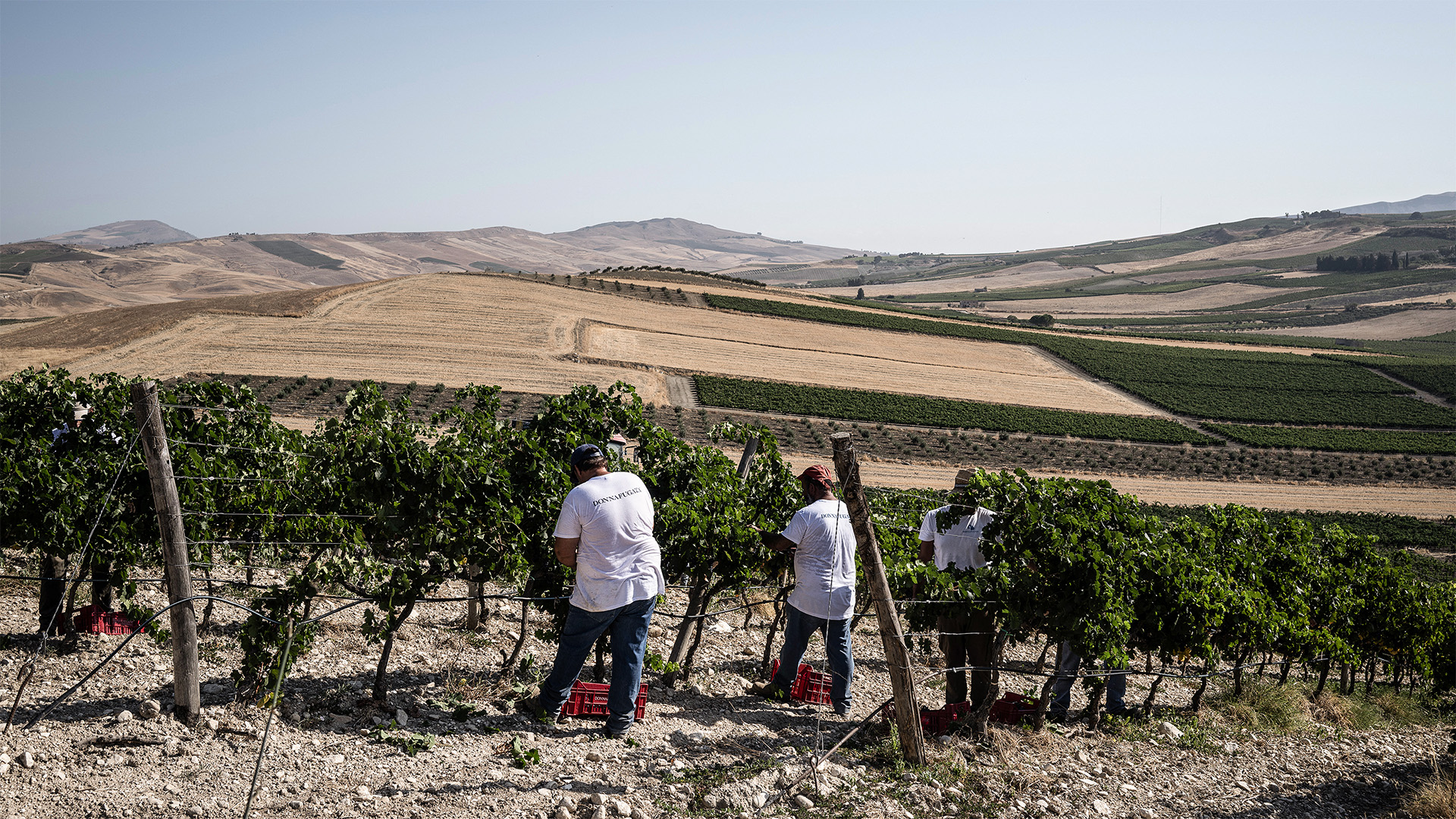
Driving along the highway from Rome to southern Italy, you can see the weird, bright plantations dotting the landscape. It’s not so surprising to see kiwi fruit growing here, but passion fruit – that’s much more unusual.
The climate is changing across southern Europe and the temperature is rising. That’s why farmers across the south of Italy, in Sicily, Calabria, Puglia, Basilicata and even Latium near Rome, have started trading traditional Italian fruit for more exotic varieties. The usual crops around here are oranges and grapes. But nowadays people grow bananas, mangoes, papayas, pineapple, guava, pomegranate, star fruit, and even Japanese medlar. The weather, and the landscape are changing. Even on Mount Etna, hikers will now come across fields of avocados that dot the lava-rich black soil.
Rosolino Palazzolo is a farmer with land in the village of Terrasini, close to Palermo. There he cultivates bananas, papayas and also pitanga (Surinam cherry), acerola (Barbados cherry), black sapote, annona and coffee and chocolate plants. Over 40% of Rosolino’s 11-hectare farm is used to cultivate tropical produce.
Even if this new, exotic agriculture in Italy is still a niche sector, accounting for just 1,600 out of a total 500,000 fruit production hectares, the tropical component has tripled in the past four years. Families all over Italy are now buying Italian-grown bananas and papayas at their local markets.
But there’s a dangerous side to this new agricultural shift. Farmers who have swapped oranges for mangoes are, perhaps inadvertently, contributing to Italy’s increasing water shortage, which is an urgent problem not only here, but across the entire Mediterranean region.
Tropical fruits require a huge amount of water to grow. But Italy does not get enough rain to sustain them, so farmers over-irrigate their fields which can involve draining water from community basins, rivers and ponds.
“It makes me furious when I hear the word ‘tropicalisation’ of the Mediterranean,” says Christian Mulder, professor of ecology and climate emergency at the University of Catania. “It’s a mistake. The tropics are characterised by heavy and months-long abundant rainfall – unlike here. The truth is we’re heading towards a ‘desertification’ of Sicily.” The island’s climate is now indistinguishable from that of north Africa.
Suggested Reading

Overtourism is killing Rome
“Rainfall is now concentrated in different, fewer periods of the year compared to the past, and when it does rain, the water isn’t properly collected and stored for the needs of the community and farmers. It evaporates, flowing back into the sea from overflowing reservoirs”. The Mediterranean, he now says, is like a “steam cooker”.
Palazzolo, the farmer near Palermo, complains that it hasn’t rained sufficiently in Sicily in months but says he is using “clever and targeted micro-irrigation systems” to avoid using too much water for his tropical fruit.
New techniques are always welcome, but in the meantime a much greater shift is under way. A recent report by Italy’s leading environmental lobby Legambiente, warns that, by 2035, over a third of Sicily will have become desert. This means that, by that time, it will be impossible to keep traditional livestock such as cows, sheep and goats.
With the exception of the Alcantara, nearly all Sicilian rivers are already partially dried up, and as the summer heat begins to build, the water levels will drop even further. At certain points along the Simeto river, Sicily’s largest, the riverbed is already exposed, and beginning to crack in the harsh sun.
“Gone are the glorious days during the Roman empire when Sicily was known as the ‘barn’ of Italy, providing crops for the entire peninsula,” says Mulder, adding that water scarcity and lower river levels are affecting all other southern Italian regions, including Sardinia.
This is having a huge impact on people’s lives and on tourism, too. Last summer in the southern Sicilian town of Agrigento, tourist hotels had to shut due to a lack of running water.
“The real issue is that when it does rain, the infrastructure designed to collect and store water such as reservoirs and basins isn’t upgraded to modern standards, so most rainfall is dispersed and wasted,” says Mulder.
Suggested Reading
Alpine divorce and the dangers of falling for a bastard
Regional authorities in Sicily are introducing policies to try and change people’s behavior, such as giving vouchers to resident families to help them buy dish washers, which tend to use less water than washing by hand. But in rural Sicily, dish washers are still a rarity – for centuries, housewives in Italy’s south have rinsed dishes, clothes and furniture, first in public fountains and then at home using tap water.
But even if you can change these traditional Sicilian practices, Italy is just one Mediterranean country facing water shortage. According to the European Environment Agency, water scarcity is prevalent all-year-round across southern Europe, with 30% of the population living in areas with permanent water stress and up to 70% in areas with seasonal summer stress. Greece, Romania, Portugal, Italy and Spain have the worst water scarcity, particularly during spring and summer.
Stella Tsani, climate change expert and associate professor of economics at Kapodistrian University of Athens, warns that, by 2050, water demand is expected to double or even triple, while a 2°C rise in global warming will reduce precipitation by up to 15% in the Mediterranean.
Agriculture is among the most vulnerable sectors, she says. Reduced water availability affects agricultural yields, particularly of water-intensive crops, and increases irrigation costs.
Natural ecosystems and biodiversity are also under significant pressure. River systems across southern Europe are increasingly experiencing lower flows, particularly during summer months. “Over 80% of Greek territory faces an increased incidence of drought,” says Tsani. “Impacts are particularly high in islands, coastal regions and tourist destinations where seasonal demand increases significantly.”
The regions most at risk are generally those where limited natural water availability coincides with high agricultural, urban or tourist demand. The islands in the Aegean Sea and parts of Crete, are among the most exposed as they have limited natural freshwater resources, strong seasonal tourism pressures and increasing climate-related water stress.
“Greece faces a systemic water-management challenge,” says Tsani. “The pressures are being felt even in Attica and Athens, as ageing infrastructure, increasing water demand and prolonged drought conditions have brought it to its most severe water shortage in more than a decade.”
Suggested Reading


Caroline Lucas: No10 ignored MI5 and MI6 warnings on climate change
In her view, the water shortage issue needs to be met with a long-term strategy. This will require investments in creating wetlands and in restoring natural ecosystems. “At this point and with the climate change and temperature rise limit targets being off track, it is essential to move beyond water supply management. Instead, water demand management should become a central policy priority”.
Back in Rome, residents living in the northern countryside are bracing for yet another sultry summer without rain. Romans who don’t go to the beach tend to cool down in Lake Bracciano, a few kilometers from the city. Once an active volcano, the dormant crater is now lined with cafés and pebble beaches where you can rent canoes and pedal boats amid swans and otters.
Last year, because of drought and all the helicopters continuously picking up water to extinguish wildfires, the lake ran completely dry. There was not a single drop of fresh water. All that was left was a slimy, green layer of mud. It stayed that way for months, until the late summer rains came, and started filling the crater again.
 Most popular

My day out with Danny Tommo

I was at Eton with Charles Spencer – this is how it explains his battle with the royals


Emily Maitlis’s diary: Trump doesn’t fear the AI apocalypse – but he’s terrified about the midterms


Memo to Burnham: this is how you beat the populists