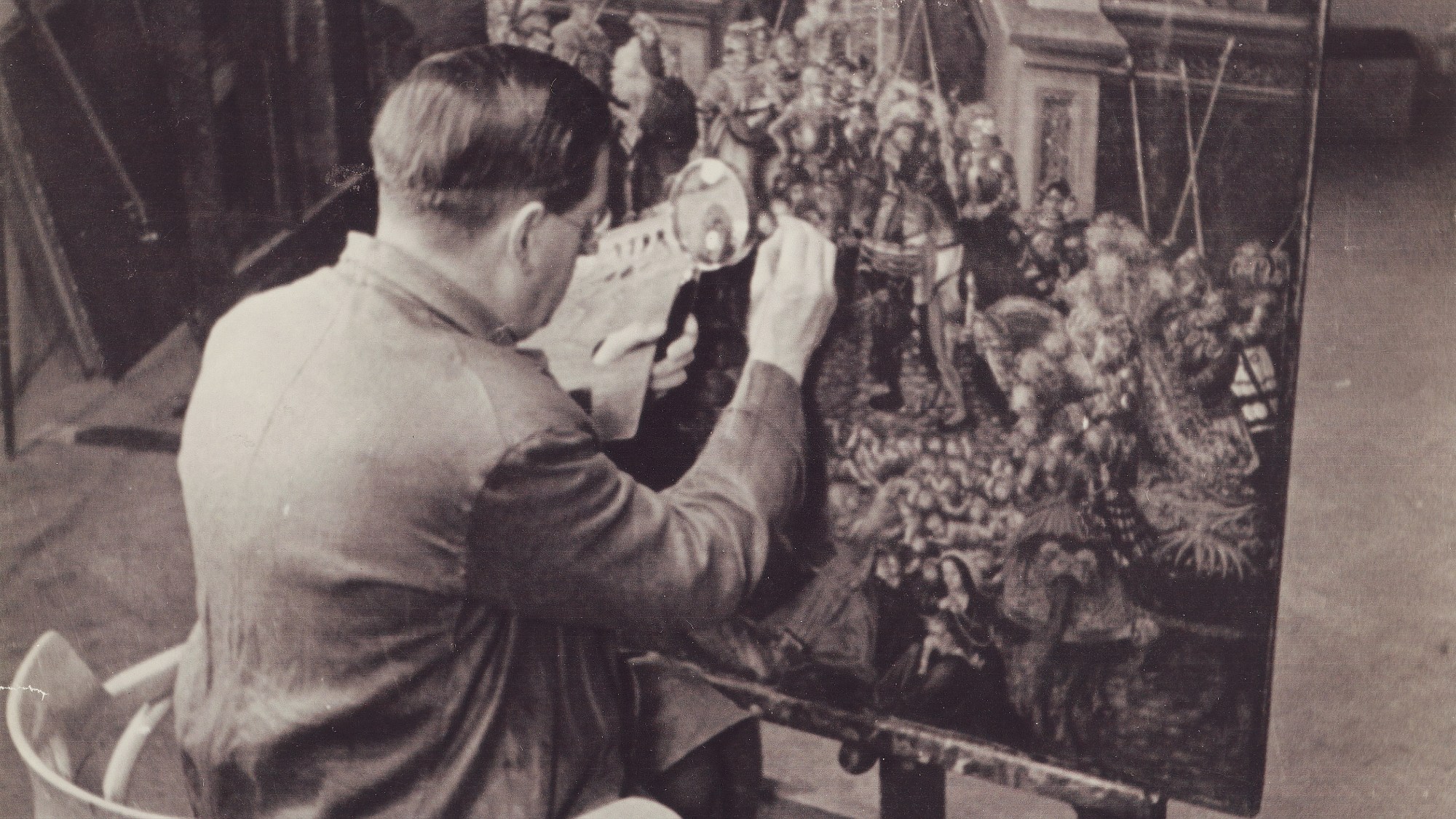
On May 20, 1942, the German-language newspaper Pariser Zeitung published a photograph of the Austrian restorer Eduard Kneisel, apparently hard at work on a painting in Nazi-occupied Poland. The accompanying report claimed that the painting, then believed to be by the German master Lucas Cranach the Elder, had been rescued from negligent Polish hands, and safely delivered into the care of its rightful – German – custodians.
In the report, the painting itself is almost entirely obscured by Kneisel’s palette. This is no coincidence, argues paintings conservator and historian Morwenna Blewett in her revelatory book, Art Restoration Under the Nazi Regime: Revelation and Concealment.
The painting was The Massacre of the Innocents, its subject the New Testament story of King Herod’s mass slaughter of baby boys. The theme is common enough, but here the optics were potentially disastrous: as Kneisel carried out his stage-managed restoration work, writes Blewett, “less than 50 kilometres away at Auschwitz, hundreds of thousands of men, women, and children deemed unworthy of life were being murdered”.
The diligence with which the picture’s message of mass murder was concealed beneath a narrative of care and recovery of German cultural symbols is at the heart of Blewett’s book. In it, she presents evidence of the widespread, willing assistance offered to the regime by art restorers, whose knowledge and skills enabled the large-scale theft and manipulation of cultural property, and sent countless innocent people to their deaths.
The research is an adjustment to the more familiar focus on the mass theft of art and other cultural property by members of the Nazi high command. At least 20% of European art was looted by the Nazis between 1933 and 1945 – a statistic that co-exists in the popular imagination with the grotesquely cartoonish spectacle of Hitler and his inner circle mooning over 19th-century schmaltz as they plotted persecution and genocide.
Suggested Reading


What happened to Marisol, the celebrity artist who disappeared?
Individual members of Nazi high command amassed astonishing quantities of cultural property. Hermann Göring, who fancied himself as a connoisseur, thieved his way to a personal collection of well over 1,000 works of art. Hitler shared Göring’s aesthetic sensitivities, and had plans for a vast Führermuseum to showcase the stolen art that he believed demonstrated the superiority of the German “race”.
There is mounting evidence that in addition to the criminal activities of the Nazi elite, there was widespread collaboration by ordinary Germans, many of whom were prepared to acquire furniture and art that had been confiscated from Jewish owners. Not only did this make the wider population complicit in their persecution, it also reinforced the division between what the Nazis termed the Volksgemeinschaft – the “German community” – and those condemned as “outsiders”.
Blewett’s study stems from curiosity about the fate of her own profession under the Nazi regime, but its scope is much broader. Visual culture was the means by which the Nazis articulated and shared their ideas on everything from race and gender roles, to the concept of the “German spirit”; the interpretation, confiscation and “redistribution” of cultural property affected German society at every level.
Susan Ronald set the scene for aspects of Blewett’s research in her 2015 book Hitler’s Art Thief, on the Nazi art dealer Hildebrand Gurlitt. In it, she implicates art historians and critics in the mobilisation of fine art as propaganda – not a minor matter, she makes clear: “Fine art, as the most visible form of culture at the time, became the foundation and silent battleground for propaganda on both the western and eastern fronts.” While art dealers are often characterised as morally lax, art historians claim a mantle of scholarly respectability that implies disdain for base criminality.
Blewett taps a similar vein in her focus on restorers (as conservators were known until the mid-20th century), a profession that strives for neutrality – “a fool’s errand”, Blewett tells me – and whose work carries distinct medical overtones.
But not only did restorers prove essential to the practicalities of looting and expropriation of art in occupied countries, assessing and sorting the mounting spoils. They provided ready-made networks through which art could be acquired and disposed of: sometimes this was done for financial gain, sometimes because by acting as a “fixer”, an individual could ingratiate themselves with the regime.
Perhaps most damning of all, Blewett has found incontrovertible and plentiful evidence of paper restorers and bookbinders working to return historic church and civil records to a legible state, which from 1933 were used by the Nazis to establish “racial purity”.
Initially, German citizens were required to provide evidence of their ancestry in order to be accepted as a member of the Volksgemeinschaft and considered eligible for certain jobs and benefits. Anyone with three or four Jewish grandparents was deemed Jewish and denied citizenship: ultimately, writes Blewett, failure to prove one’s “Aryan” ancestry amounted to a death sentence. Those involved in making the documents available, were, in Blewett’s words, “paving the path to genocide.”
Often centuries old, insect-infested, dirty and damaged, the documents kept by churches, synagogues and civil authorities were essential to this research, which was intended not only to expose people of Jewish ancestry, but to legitimise their persecution via a bureaucratic process. All of these documents had to be made available and “usable”, often at the expense of the documents themselves which were damaged in the process, and Blewett’s devastating research shows the efforts made to achieve this, and also the extent to which both the Protestant and Catholic churches not only cooperated, but in some cases “went above and beyond what was expected”.
Documents were photographed on an industrial scale, and by 1942 around 20,000 church books from across Germany had been recorded on film. To make the process easier, bindings were removed, creases were ironed out, and grubby pages were rubbed with glycerine to make them more legible. When church officials objected, writes Blewett, “this was on the basis of concerns about the physical safety of their archives, but there appears to be no ethical resistance to the use of the church books to victimise Jews.”
Suggested Reading

The tiny dolls with souls at the heart of a museum repatriation debate
The catalogue of culpable names is vast, and includes not just the church, restorers, art historians and officials, but other ordinary people who for reasons very hard to fathom as a distant third party, were motivated to steal and exploit the weak and persecuted. Morwenna Blewett’s book should have significant repercussions within the art world, but by demonstrating the central, inescapable role of cultural material in the Nazi project, she exposes the fragile foundations of civilised society.
“War is never far away and the destruction, manipulation and theft of cultural property always accompanies it,” she tells me. “Russian forces have stolen over 1.7 million items of Ukrainian cultural heritage and museum collections so far. Some of these items will be worked on by conservators directly for those who have stolen these items or for onward clients.” And so it goes on.
Art Restoration Under the Nazi Regime: Revelation and Concealment by Morwenna Blewett is published by Palgrave Macmillan