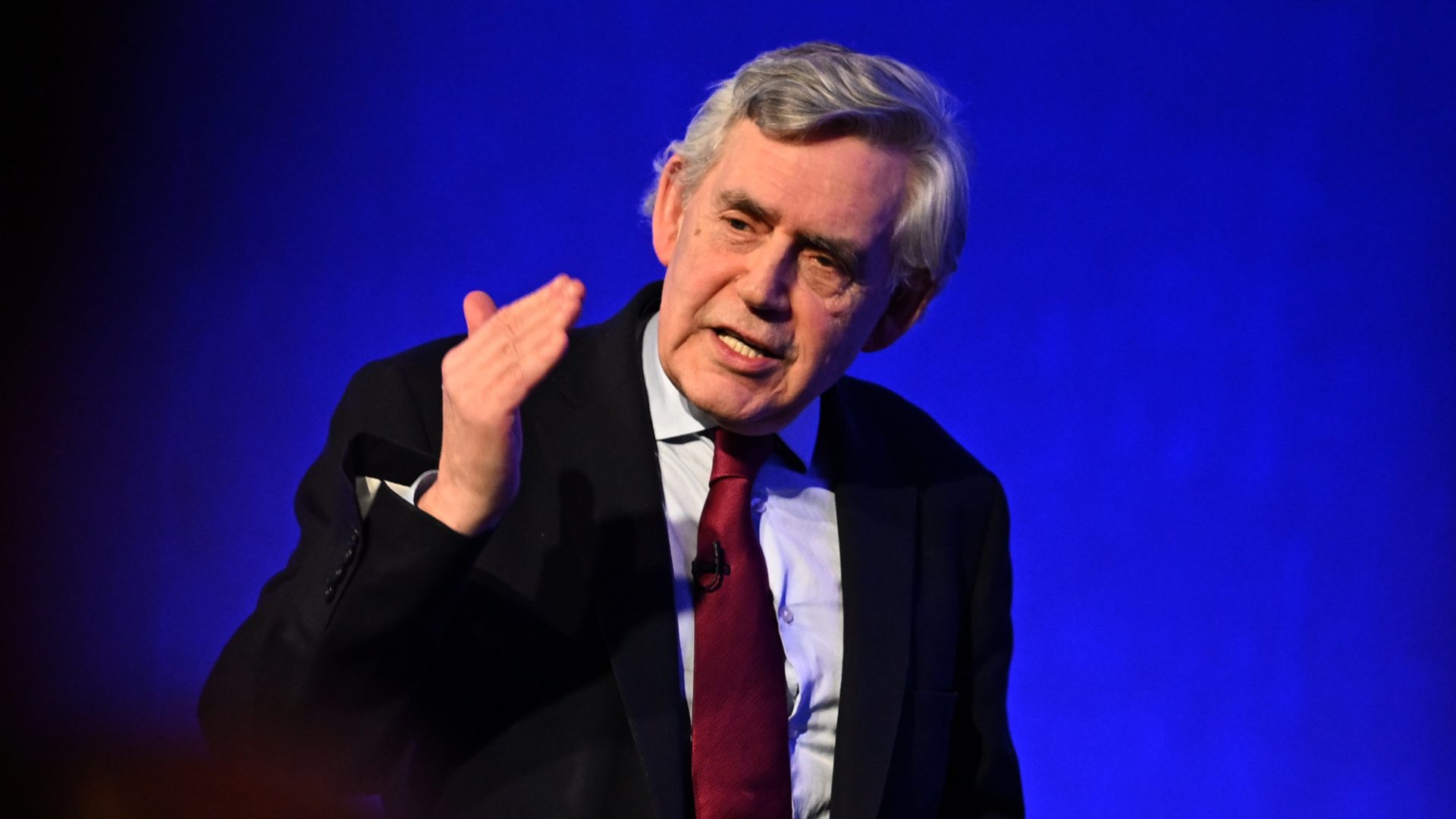
Why must it be so dull? It feels slightly heinous to criticise Gordon Brown’s latest book, The Future Starts With Us.
The former PM is a serious man with a largely distinguished record in government. His grasp of economics and geopolitics is unparalleled among recent British prime ministers (Rishi Sunak took little interest in foreign affairs). To dismiss his diagnosis of the world’s problems would be jejune.
Yet – a couple of chapters excepted – this is an arduous read. One problem is that Brown’s canvas is extraordinarily broad.
The Future Starts With Us believes passionately in multilateral cooperation, but the author knows that international financial instruments and cooperation are not enough to inspire most voters. He has commissioned research to show that people do want their leaders to work productively with other countries, even if they prefer to vote for isolationists, because they rightly see that it makes war less likely and global warming less terrifying.
And he argues that if we spend more time participating in our communities – playing football, joining unions, going to church and so on – our outlook will become more generous and open-minded, thereby making us less fearful and nationalistic. In turn, support for parties like Reform will fall away and Britain can lead a new era of middle-power internationalism.
Suggested Reading

The dirty secrets of Britain’s 1960s
This analysis will resonate with a lot of despairing readers. It builds on Robert Putnam’s famous Bowling Alone. The American political scientist found that as people watched more TV, they spent less time outside the home talking to and meeting other people, which led to lower levels of trust.
“A community that is strong and inclusive is less likely to give in to intolerance and instead may be a bulwark against the fallout from financial disappointments and even national economic decline,” Brown says.
The divisions that fermented during the pandemic, when most of us had to stay at home, do indeed suggest that a lack of face-to-face contact can make people more unhappy and intolerant. The opportunity to find unlimited bile online makes the problem worse.
Brown points out that working from home makes people less likely to meet people of a different ethnicity, belief or class than themselves, which is a point worth exploring.
But to suggest that volunteering at the local Scout group will result in a new respect for the United Nations, let alone enable it to keep the peace, is probably a step too far. When people join in a common cause, their motives are not always liberal or generous. Consider the village of Piddington, which recently organised a referendum to protest against plans to house migrants nearby.
You can argue – and many do – that the residents have been radicalised by things they see online. But getting together has not changed that.
The shadow of Gillian Duffy, who berated him about eastern European immigration in 2010, hangs over this book. He told off his advisers for allowing her to talk to him, describing her as a “bigoted woman” while not realising he was still miked up. Labour went on to lose the general election.
Well, there are a lot more Gillian Duffys out there now, and while Brown does not mention the incident, the disconnect between high-minded diplomacy and the woman in the street clearly preys on his mind. He wants to convince us that the ordinary Briton would benefit from constitutional reform and a deeper commitment to human and social rights.
“A requirement to ensure equity between regions and nations should be part of every country’s constitution,” he writes. Should it? What sort of equity? Who would enforce it, and how? The intention is good. The detail is lacking.
Occasionally – when he is talking about his home town of Kirkcaldy, or trust, or hope – Brown’s prose loosens up and, while it is rarely compelling, feels more heartfelt. At other times he does not even try to engage the reader, miring himself in the minutiae of global institutions.
Writing about what a multilateral charter of principles might look like, he observes that “these themes recur in the Pact for the Future, which recognises that interdependence structured around extraction and asymmetric adjustment undermines legitimacy, whereas reciprocity transforms interdependence into partnership.” NGOs come up with less turgid prose.
He laments the effect that globalisation has had on job opportunities in places like Kirkcaldy, but is curiously optimistic about the ability of the ordinary person to influence tech and AI. “The public can direct and manage how this latest disruption plays out. We do not need to be victims, subject to the whims of fate or… unaccountable Silicon Valley ideologues,” he writes.
Tell that to someone rejected from hundreds of jobs by AI recruitment software, or – and this is his suggestion – setting up a local Facebook group to bring together people with shared hobbies. How exactly can they “direct and manage” the communication tools they have to use, when Meta decides whether the content is provocative enough to deserve an algorithmic boost?
Tony Blair’s verdict on his chancellor was cutting: “Political calculation, yes. Political feelings, no. Analytical intelligence, absolutely. Emotional intelligence, zero.”
Brown was “strong, capable and brilliant”, Blair acknowledged. But he was unable to meet voters where they were. Like Keir Starmer’s much-mocked “son of a toolmaker” line, the book reveals a man who understands he must share a part of himself in order to win over voters. That is not enough.
Suggested Reading

Sky’s The Wargame might be prescient – but it’s also propaganda
The Future Starts With Us tries hard to move from the particular to geopolitics, but the leap between a football ground in Kirkcaldy and the World Health Organization is too wide to breach.
Like most of us, Brown fears the rise of nationalism. He is right to trace the widespread anger with international institutions back to the global financial crisis in 2008 and the unfairness it exposed. The Future Starts With Us is a valiant attempt to seek democratic legitimacy for multilateralism. It strives to inspire. But it fails to convince.
There is no mention, of course, of the man with whom he ran the country for 11 years. Maybe – as a couple of active seventysomething men with similar interests – they should try meeting up and talking to each other. Or perhaps some divisions are simply too hard to overcome.
The Future Starts With Us is published by Simon & Schuster