
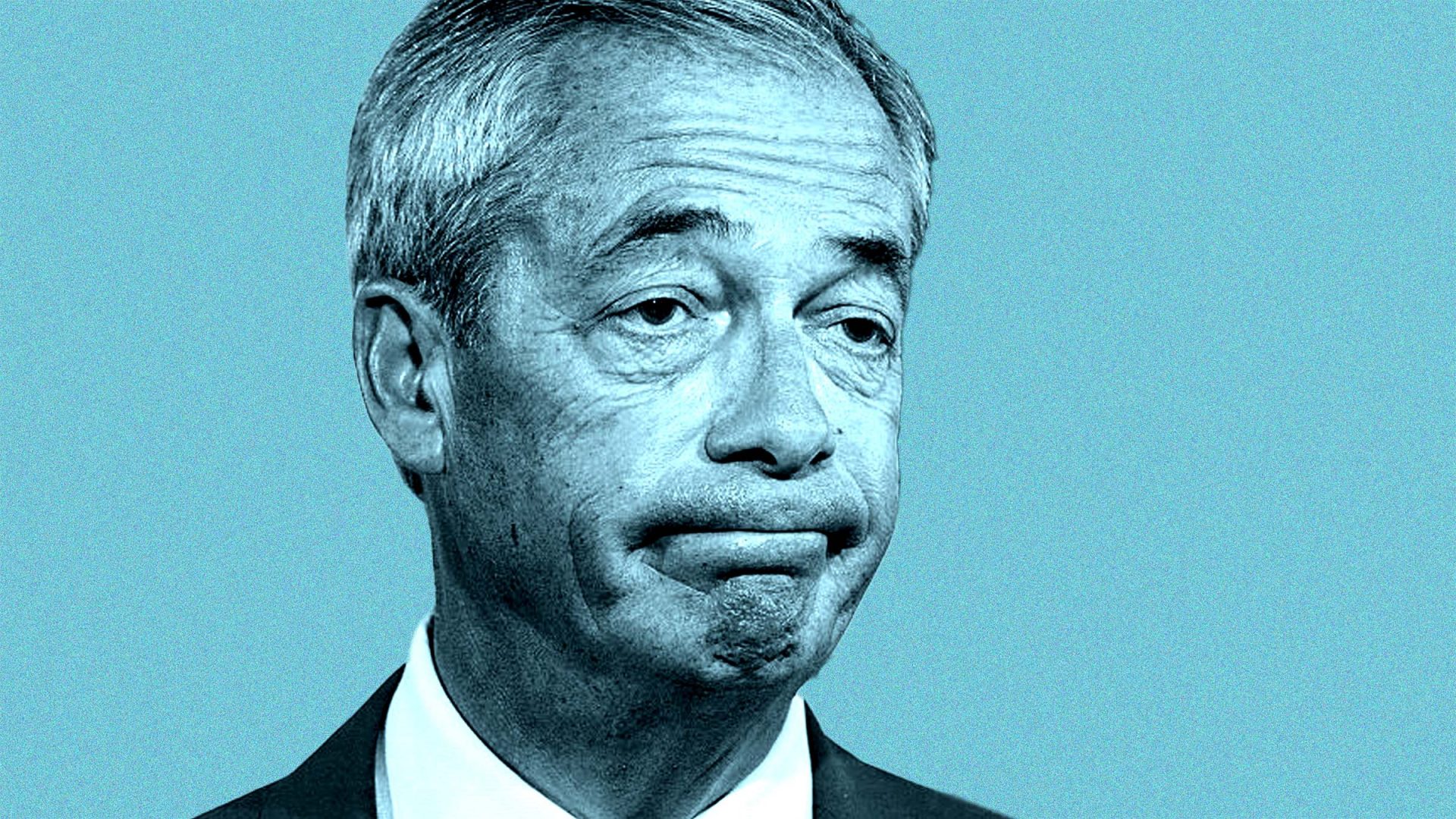
In the strange interregnum between the completion and publication of a book, a writer runs a gamut of heightened emotions. For Nick Tyrone, author of The Rise Of Reform: The Inside Story Of Britain’s Political Disruptors, this period may well have been spent rocking back and forth, crying, with his head in his hands.
The problem is this: in the time it takes to print words on a page, Reform UK have giddily torpedoed Tyrone’s central argument that the party is a government in waiting. With ruthless efficiency, the predictable submission by Nigel Farage and friends to scandal of various resplendent hues has rendered his book wishful, dated, and naïve.
Evidently, the storm clouds were gathering while the writing was still in progress. After confidently (and grandly) predicting in the book’s early pages that “not only have I concluded that Reform could win the next general election, I now believe that it is probable that they will win it,” come the final chapter Tyrone is tethering his claim to a weighty caveat. “That is,” he writes, “if they learn from their mistakes and don’t blow it up for themselves.”
Fat chance. Embroiled in media stings and ever-widening police investigations, rather than correcting course, Reform UK’s appetite for questionable publicity is becoming gluttonous.
In recent days, news of a record-breaking donation of £72million from a pair of crypto types – possibly a stunt ahead of a backdated ban on political cash from British ‘expats’ – has been superseded by the resignation of the party’s Welsh leader Dan Thomas after he was arrested on suspicion of assault and controlling or coercive behaviour, allegations which he denies.
Meanwhile, Reform’s farcical performance in local government continues: in just five months, 64 councillors have abandoned their posts, the party is in internal chaos in its flagship council of Durham and its new Norfolk police and crime commissioner Colin Sutton, on £79,000 a year, has caused huge embarrassment by announcing (and then cancelling) a 127-date theatre tour of the UK, in which he would have discussed his time as a murder detective.
In the face of such tumult, I suppose I should feel sympathy for Nick Tyrone. Never mind a book, at this rate, I’m worried that this article will have faded into obsolescence by the time it’s published.
Tyrone is a former Lib Dem turned Spectator writer whose previous political predictions have included, pre-Brexit referendum, that Remainers should show “gratitude to Nigel Farage for hanging around the British political scene just a little bit longer” so “the pro-Europeans win”. To be fair to the author, he has put in a shift on this book, and his views seem to have shifted, too.
Over 18 months travelling up and across the country, this self-described “Neoliberal Centrist Dad” meets scores of Reform activists whom he claims to like without exception. In the orbit of a bored-sounding Zia Yusuf, he seems mildly starstruck. Alarmingly, following an interview in North Yorkshire, he has nothing but praise for Robert Jenrick.
Suggested Reading

Farage’s £72m of crypto donations could swing the general election
Throughout, though, the Big Dog remains elusive. Stymied by “the Brylcreem Boys” of the party’s paranoid London operation, The Rise Of Reform has at its core a hole in the shape of Nigel Farage. Deprived of up-close access to the man himself, Tyrone is reduced to filling his agreeably written pages with passages that veer from the generous to the gullible.
Take this, for example. “The pact between the Conservatives in the 2019 general election was another traumatic event for Farage,” he writes. “Given Boris Johnson subsequently made a hash of Brexit, at least according to Farage himself, he must have sorely regretted the decision not to challenge the Tories in their own constituencies, thus enabling their election win.”
Must he, though? Seven years ago, the decision by Farage’s Brexit Party to stand down 317 candidates in seats held by Conservative incumbents was justifiably explained as the surest way of unifying the pro-Leave vote. Fine.
But this radical reverse-ferret also had the added benefit of keeping the man who dragged the once swivel-eyed notion of Britain exiting the European Union to the very centre of British politics in his happy place. Granted license to shout about how politicians with genuine responsibilities were making a Horlicks of Brexit, for years, there were no flies on Nigel Farage.
Crucially, Tyrone fails to appreciate the difference between exerting influence from the touchline and the kind of power that dirties one’s hands. That the man without whom his book would not exist leans heavily towards the former, sees him seeking answers in the wrong places. Rather than asking if Farage would make a good, or even a plausible, prime minister, surely the question should be whether he wants the job at all?
He doesn’t seem to. Under Farage’s command, the parliamentary branch of his party is a shambles; as well as being without “shadow ministers” for health, foreign affairs, transport, and more, Reform UK doesn’t even have anyone covering the defence beat. For a leader who was quick to insist that Britain join the United States’ ongoing misadventure in Iran, this is about as deficient as it gets.
For all his talk, Farage seems to understand that practical application of his strident ideas will imperil his fortunes. While Donald J. Trump ravened for high office – as the surest way of staying out of jail, for one thing – his English idolator is no more than peckish. In the face of such an evident lack of desire, and heart, his tawdry efforts to transpose American-style political venality onto the British scene serve only to widen the divides in an already uncharitable public square.
So too does pretending that the world is out to get you. Compared to the deranged sense of grievance emanating from in and around the White House, Reform UK’s complaints about the kind of scrutiny to which the Labour Party has been subjected for as long as I’ve been alive sound pallid and frail. Suck it up, wimps. Oh, and welcome to the NFL.
Such brittle weakness gives Farage’s opponents the kind of opening that has long been denied them. After failing to hit the target with the tiresomely familiar refrain that our so-called man of the people is a former commodities trader who went to a posh school, meaningful resistance might just be roused by pointing out, time and again, that this lover of grape and grain and tabs lacks the fortitude and application required of a British prime minister. In short, he’s not right for the job – and I reckon he knows it.
Suggested Reading


Why Slavoj Žižek probably hates you
Nigel Farage became the most significant political player of the 21st century by not practising politics. He transformed the landscape while leaving others to deal with the consequences of bare-knuckle rhetoric. The man is a walking-talking op-ed column from a disreputable newspaper.
Yet there is every sign that his antenna is starting to fail him. Despite at first claiming that the recent gift of £5 million from Christopher Harborne was for security, he can’t even be arsed to hold constituency surgeries in his Clacton seat.
Since closing the covers on The Rise Of Reform, only one revelation has stayed with me. In a telling sentence, its author is indiscreet enough to let slip that he was sweet on Reform UK from the off. “Nigel Farage… [seems] like not such a bad option, even to a liberal like me,” he writes. “And that’s what I thought before I started researching this book.” In the parlance of US sports journalism, this is known as writing the headline while en route to the ballpark.
For his part, barely a fortnight after being sworn in for a second time to the House of Commons, Farage returned to host his lucrative thrice-weekly primetime show on GB News. Holding court with guests who understand the rules of engagement, monologuing windily to camera, only here can he maintain the kind of control that has proved elusive since about the time
Nick Tyrone has mistaken Nigel Farage as the cure for much of what is wrong in Britain. Instead, he is the cause of it.
The Rise Of Reform: The Inside Story of Britain’s Political Disruptors is published by Forum
 Most popular

Emily Maitlis’s diary: As I was saying to George Clooney just the other day…
Why Slavoj Žižek probably hates you

There’s only one reason Trump went to Ireland – it wasn’t to meet the Taoiseach

A new film about Elon Musk reveals him as so awful it’s almost tragic. Almost