
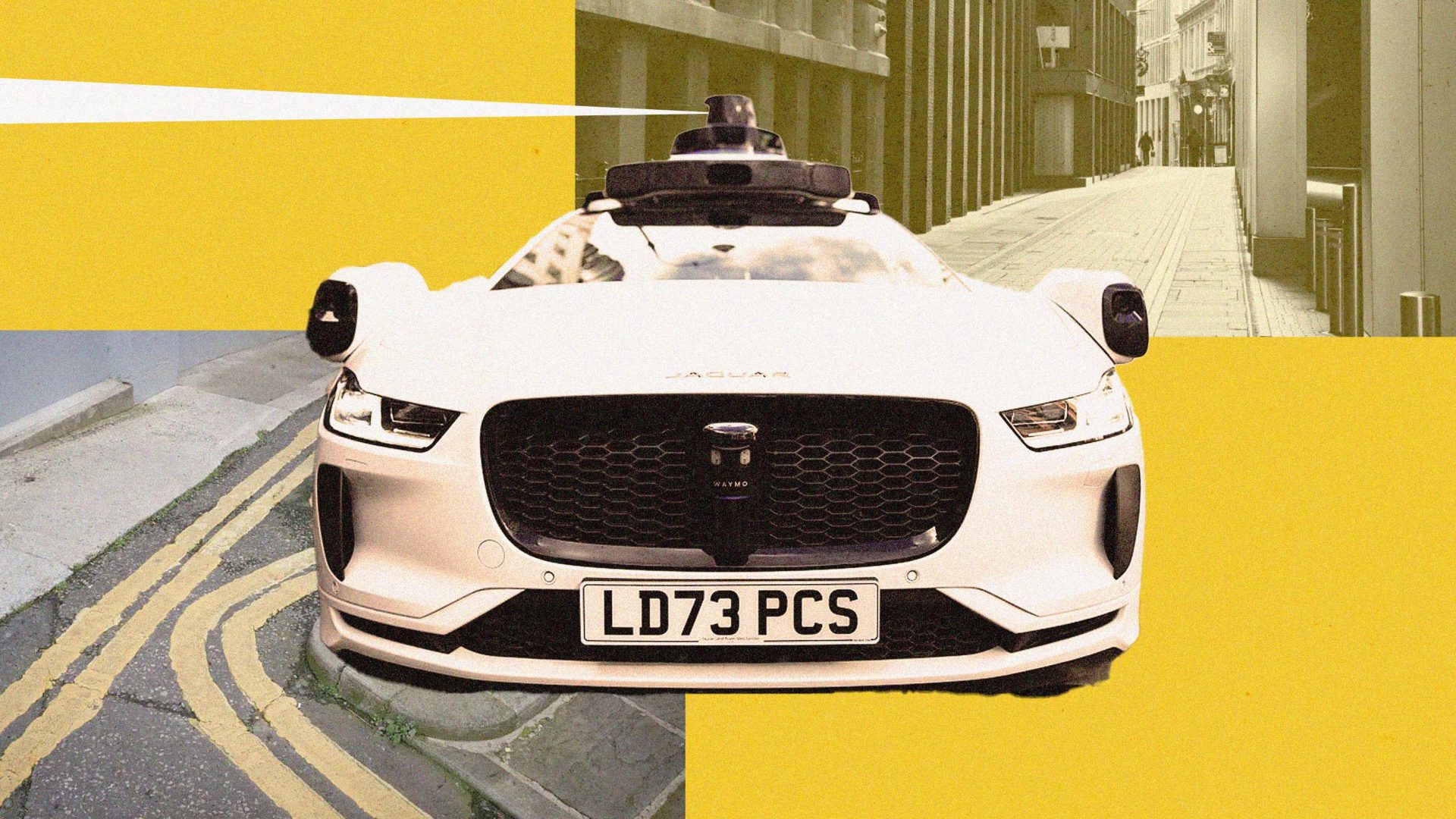
If you live in London, you might have already noticed the beginning of robot invasion. If you live in Shoreditch, it might have kept you awake at night. The robots move among us unseen, even though they don’t look like us. That’s because they look like a white Jaguar SUV. One of these vehicles got stuck in a narrow residential road in the east London district, beeping and whirring in the middle of the night as it tried to manoeuvre out of the predicament.
The cars are operated by Waymo, the “robotaxi” company owned by Google’s parent company Alphabet. Fleets of these automated vehicles are already giving rides to paying passengers on the roads of Phoenix, San Francisco, and other US cities.
The company is now training them to run on London roads – at this stage still with human “safety drivers” in the cars – in preparation for an intended roll-out later this year. That’s if legislation is devised and approved, a process currently underway with the government. Given how starry-eyed Starmer’s team is about the prospects for AI generally, Waymo can reasonably expect a green light.
But do we need robotaxis? And do we want them? In surveys, many people attest to being nervous about climbing into a driverless cab. Others find the idea exciting. Surveys before a technology has been widely introduced tell us rather little, however, about how it will be regarded and used if and when it becomes mainstream.
Suggested Reading


Why science needs to talk about failure
Waymo leads this field in the US but is by no means alone. The Chinese company Baidu, which provides the Chinese equivalent of the Google search engine, has also invested in robotaxis and operates fleets in Beijing, Shanghai, Wuhan and other major cities in China. It too is looking to expand into the European market, with eyes on London as a testing ground.
Uber is also exploring self-driving technology, and last year Sarfraz Maredia, the company’s head of autonomous mobility and delivery, said that “having recently appointed a dedicated leader for our UK autonomous efforts, we look forward to working with regulators and partners to deploy this technology safely in Britain.” The taxi service Lyft also hopes to introduce robotaxis when the regulations are in place.
Transferring the technology between nations is not trivial, however. “Just because the technology works in one place doesn’t at all mean that it’ll work in another”, says Jack Stilgoe, professor in science and technology studies at University College London and an expert in driverless vehicle technologies. “The companies have been judiciously choosing places where the technology will be able to work safely.”
Waymo began operating in Phoenix, Stilgoe says, because it is “one of the most car-friendly and pedestrian-hostile road environments in the US.” I don’t know about Phoenix myself, but I can testify to that in Houston, where Waymo is operating too, alongside Los Angeles, Dallas, Atlanta, and other cities. Wide streets with clear lines of sight, few pedestrians and cyclists, and a gridiron street plan are the perfect conditions for robot drivers. London, of course, is the opposite.
It’s not just about different road rules or designs, says Stilgoe, but about differences in road cultures and public opinion. “What is acceptable for pedestrians or other road users in the US might not be acceptable to those in London.” Zebra crossings and no restrictions on jaywalking all make the challenge different. The problems need to be solved anew, and the regulations renegotiated, for every new location.
Suggested Reading
The dangerous myth of ‘neutral’ technology
What’s more, unlike car-loving Phoenix, London has a congestion policy. “One of the things that the robot taxi companies are up against is a very successful set of policies that have been taking cars out of our city centre for the past two decades”, says Stilgoe. “So anything that looks like introducing more cars runs against the grain of current policy.”
Waymo argues that robotaxis have clear benefits. For one thing, they can be safer. Automated drivers don’t get tired or drunk and don’t break the speed limit or other rules of the road. And in principle, driverless vehicles could, by making smarter choices of route, reduce congestion relative to the same numbers of human drivers. “We believe,” says Waymo’s website “autonomous technology can complement and enhance London’s world-class transportation network. We can help improve air quality [Waymo’s cars are fully electric], reduce congestion, and make getting around safer and more accessible.”
But do these claims stack up? Waymo’s vehicles have a complex, 360 degree “vision system” that uses laser-based sensing – lidar – and radar as well as cameras and microphones, all linked to a computer system. This gives the automated driving systems more “awareness” of what’s around them than any human driver.
Despite the attention given to accidents – some of them fatal – involving autonomous vehicles, especially those operated by Elon Musk’s Tesla, the safety record for Waymo’s fleets is actually pretty good so far. The company says that its cars have covered 100 million miles on public roads without a single fatality.
In comparison, there were 79 reported fatalities (passengers and other road users) for London black cabs in 2024. Problems can arise, though, when the autonomous cars face the unexpected – as when an empty Waymo in San Antonio recently drove into a flooded road and was swept into a creek.
Suggested Reading
Driverless cars are coming. But can we trust them?
Safety claims tend to rely on Waymo’s own data, however. “It’s absolutely vital to have independent assessment of the safety records of these things, so that we’re not just letting them mark their own homework”, says Stilgoe. While in the US the default has been to let companies decide when they’re safe enough to take out, those developing UK regulations are insisting on an external driving test.
The government says that updates to the 2024 Automated Vehicles Act will require self-driving vehicles to “achieve a level of safety at least as high as competent and careful human drivers.”
Yet London roads today are already relatively safe. “If robot taxis are being offered as a solution to the safety problem, you probably wouldn’t start in London”, says Stilgoe. “It’s very clear that [for a company like Waymo] you come to London because you want the attention and the money, rather than because that’s where the problem is.” Safety is more of an issue on rural roads, but Waymo’s scheme won’t work there. “So there is a mismatch between the technological possibilities and the real needs.”
Robotaxis are very much an urban project. Waymo imposes strict boundaries (“geo-fences”) within which their fleets can operate, those being the limits of their training patch. So you won’t be taking a Waymo from London across the Channel to Berlin, say. You won’t even be able to take one to Heathrow.
Waymo argues that its services can improve accessibility to transport. Robin Spinks, head of inclusive design at the Royal National Institute of Blind People (RNIB), who is blind himself, has said that robotaxis “represent a new dawn in mobility, not just for those of us with vision loss, but for anybody.”
But what is a Waymo ride actually like? “I’ve been surprised by people’s willingness to get into these things,” says Stilgoe. But once they do, “the overwhelming experience is that it’s just exceptionally boring”. Cost might be more of a deterrent: Waymo calls it “competitive”, but it’s not cheap. People seem willing to pay more in San Francisco, but that could be a Silicon Valley thing. Robotaxis might just serve a wealthy elite.
All the same, says Stilgoe, “the bigger issue is about the opinions of the rest of us who will have to interact with these things” – whether that’s cyclists trying to second-guess the robo-driver, or the emergency services, or pedestrians.
There seems a good chance that robotaxis will be approved in London. The government seems keen – its webpage on “connected and autonomous vehicles” enthuses that “ [the] industry could create 38,000 jobs and add £42bn to the UK economy by 2035”. Waymo hopes to launch the first paying-customer robotaxi services by September.
Suggested Reading


Elon Musk’s next plan: to become a space invader
“Beware of being seduced by the siren sound of technology,” warns Glenn Lyons, professor of future mobility at the University of the West of England in Bristol. “It can be all too easy to mistake engineering ingenuity and its big-tech, big-bucks backing, for progress. Governments have a tendency to be drawn into a ‘race mentality’ where the promised prizes on offer are jobs creation, inward investment and ‘world-leading’ status.”
What if, for example, robotaxis develop a near-monopoly and then start to hike their rates, as Uber did? And if automated vehicles are so good for society, why is Waymo not also developing robobuses?
“Maybe the most interesting and transformative development of this technology might be something more like a self-driving bus operating in a rather dull way on fixed routes, but in a way that opens up [new] transport options for people and doesn’t make the congestion problem worse,” says Stilgoe. “We shouldn’t get trapped in the idea of it just being a car where somebody plucked out the driver and dumped in a computer.”
“We don’t know whether this is a flash in the pan or whether it’s a long-term sustainable transport option that people build into their lives,” he says. “In five years’ time it might still just be a gimmick.”
Perhaps in the end it’s not quite clear what the problem is that robotaxis are intended to solve. It’s not safety, congestion, cost, or convenience. Not, in general, passenger preference. And they fill no gap in the existing transport ecosystem.
The key question, says Lyons, is “how to ensure driverless vehicles deliver societal impact that is acceptable and beneficial”. That question has never been confronted in relation to robotaxis. But arguably, it was also never faced, let alone answered, for vehicles that have a driver behind the wheel.
 Most popular

I was at Eton with Charles Spencer – this is how it explains his battle with the royals


Emily Maitlis’s diary: My deep dive into Jeffrey Epstein’s hidden empire – and the network that let him get away with it


The linguistic logic behind dropped syllables

Putin’s wartime economy is heading for catastrophe