
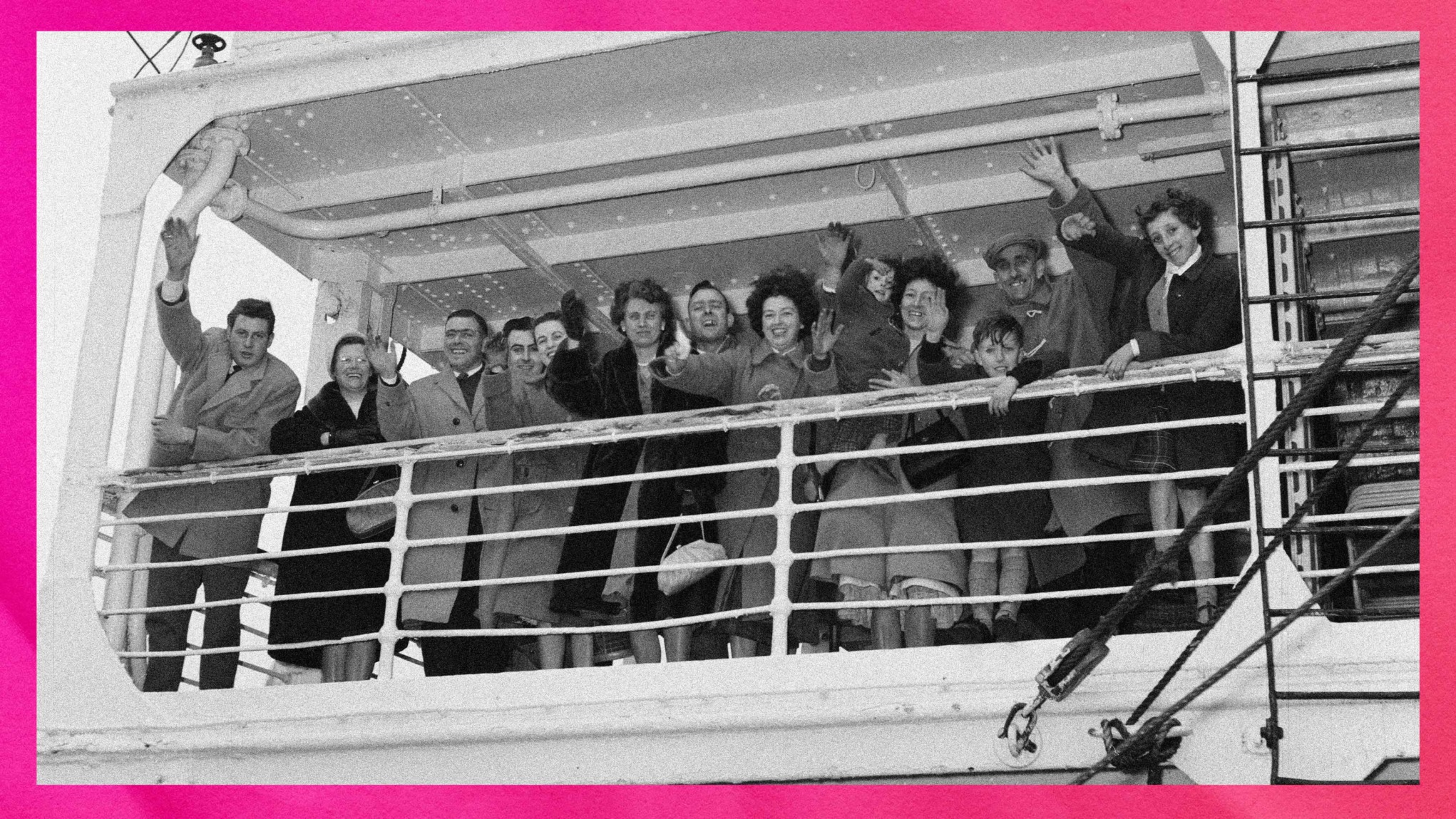
A country enters “net negative migration”, or net emigration, when the total number of immigrants who arrive in a given year falls behind the number of people who leave. And it appears that in the UK, this mind-bending notion may soon become reality.
Bar a blip in the early 1990s, the phenomenon of net negative migration has been foreign to our shores for over 40 years. But for most of the period from the end of the second world war to the mid-1980s, it really wasn’t. In postwar Britain, arriving was often less popular than leaving, providing a ready-made symbol of the national decline that supposedly tormented us throughout those decades.
In the aftermath of the war, the country was exhausted by the effort to beat Hitler. Not for nothing did George Orwell base the crap food and broken, leaking buildings of Nineteen Eighty-Four on the London of 1948. At the point of victory in 1945, one in five people wanted to leave Britain; within three years, that more than doubled. Between 1946 and 1952, almost three-quarters of a million departed.
Dreams of leaving seem to have been particularly vivid among the moneyed middle classes, who took to squealing about the Attlee government’s taxes. Some of the more hysterical among them insisted that Britain was sliding into an Orwellian nightmare.
Suggested Reading

Martin Rowson’s cartoon: Pimp My Bunker
The travel writer HV Morton, for example, announced that Britain was going communist. In 1948, he decamped to South Africa – just as it was introducing apartheid. That same year the bestselling author Nevil Shute, who was also handily a pilot, flew to Australia. On coming home, he “felt oppressed by British taxation” and decided to move his family to a farm near Melbourne. There he settled down to write denunciations of his homeland such as the sub-Orwellian novel In the Wet, about an England groaning under the reds in 1983.
As ever with migration, however, there were pull factors too. Most people who left went to Australia, Canada and New Zealand, often with the help of “assisted passage” schemes operated by the receiving governments.
Nonetheless, from the late 1950s, the image of Britons leaving took on a new symbolic power. This was the era of the “brain drain”, a term popularised by a 1963 Royal Society report on the increased rate of departure among scientists.
That October, Labour’s new leader, the grammar-school meritocrat Harold Wilson, seized on this in a famous speech heralding the “white heat of the technological revolution”. He pointed out that the report revealed that fully “12% of new PhDs are now leaving this country every year to go abroad”. Britain had to “put a proper value on its trained scientists” – rapidly promoting them, without waiting for incumbents to retire. If it didn’t, Wilson warned, they’d be lost to America.
Australia and Canada might have offered British migrants a nicer quality of life, but they weren’t necessarily any more modern or dynamic. But much as Brits continued to move to the old Commonwealth, this new talk of a brain drain crystallised a rising fear: that as its imperial power fell away, Britain was falling behind the future-focused US.
Wilson insisted that the scientists were fleeing because the US had better research facilities. Recent research suggests, however, the main reason Brits didn’t come back across the Atlantic was because American salaries were higher.
But either way, the sense that our best and brightest were heading across the Atlantic just reinforced the sense of anguish that had descended on Britain’s commentariat about the nation’s supposed decline. Yet according to the Royal Society, the number of scientists leaving permanently each year was just 60.
Wilson was not the only politician invoking the spectre of emigration. On April 20, 1968, Enoch Powell stood up in a hotel in Birmingham and delivered his poisonous “rivers of blood” speech – and used that existing symbol of British decline, emigration, to dramatise the supposed impact of immigration. Powell claimed a working-class constituent had confided that he wouldn’t be happy until he had seen his three grown-up children “all settled overseas”. Why? Because, the man had supposedly told Powell: “In this country in 15 or 20 years’ time the black man will have the whip hand over the white man.”
Suggested Reading


The Join campaign starts here. And it’s all about the future
Untroubled by the revulsion that rightly followed, Powell kept linking emigration and immigration to tell his tale of national decay and establishment betrayal. On October 4, 1969, he noted that the previous year more than 138,000 Brits had left, and that around almost as many people had arrived – from Asia, Africa, Ireland and elsewhere.
On January 24, 1970, he was at it again, bewailing a survey of a thousand Cambridge students, of whom 270 were apparently planning to leave. (The fact that he himself had gone to work in imperial India as a young man, he insisted, was not the same thing at all.)
In the 1970s, like so many aspects of postwar British life, emigration reached the point of crisis. It was also a useful metaphor for those who argued that the economy’s stagnation was now terminal.
In 1974, a second miners’ strike within two years helped to bring down the Heath government. The basic rate of income tax that year was 33%; inflation hit 16% and kept rising. In March, the new Labour chancellor, Denis Healey, warned that if inflation was not slowed down, “the political and social strains may be too violent for the fabric of our democratic institutions to withstand.”
Unsurprisingly, interest in leaving hit a postwar high. Queues appeared outside the High Commissions of Canada and Australia. As the historian Dominic Sandbrook notes, in 1973, applications to move to Australia leapt 50%, and applications for Canada 65%. New Zealand announced restrictions on British immigrants. They were – wait for it – putting too much pressure on housing, employment and public services.
That winter, the foreign secretary, Jim Callaghan, joked to cabinet colleagues that when he went to bed at night, he sometimes thought “if I were a young man, I would emigrate”. The new Conservative leader, Margaret Thatcher, had similar thoughts about her children. If she lost the next election, she told a friend, she would help them move to Canada.
In her conference speech on October 8, 1976, Thatcher turned apocalyptic, lamenting that for “those who leave this country in increasing numbers for other lands… hope has withered”, while “for we who remain it is close to midnight.” In 1977, the BBC made an Orwellian drama series called 1990, in which an authoritarian left wing government tries to stop people fleeing the country.
By the mid-1980s, as the economy lifted – albeit at devastating cost – net negative migration ceased.
Suggested Reading


The return of the 1971 film that saw Trump coming
And yet here we are again, once more worrying about bright graduates and expensively-trained medical professionals departing, about the US attracting our most talented people and about falling behind in another technological revolution. And lo and behold that long-time admirer of Enoch Powell, Nigel Farage, has been on hand to insist it’s all evidence of our national decline. In 2023, he announced that “the 1970s brain drain is back”.
But if today’s brain drain symbolises anything, it’s the failure of what came after the postwar settlement. A housing market that has locked young people out and a financialised economy whose vertiginous inequality and comatose growth rates make the shabby old Britain of the postwar years look impressive by comparison. All of this is helped along, of course, by the disaster that was Brexit.
And where was Farage complaining that young people were fleeing to? That would be Italy and Portugal.
Phil Tinline is the author of The Death of Consensus, Ghosts of Iron Mountain and Power Failure.