Following last Friday’s agreement in Brussels, Andy Burnham cited an opinion poll that showed backing for a closer relationship with the European Union. He said three-quarters of British voters wanted it.
As a recovering pollster, I applaud the prime minister for quoting poll results. Public opinion should always be taken seriously. However, politicians, journalists and the rest of us should beware cherry-picking.
Here are two recent poll findings: In one, 53% want to join the EU. In the second, only 36% want to join. Why such a difference? The first is in a poll commissioned by Lord Ashcroft. It asked how people would vote in a new referendum – other companies report similar findings.
Suggested Reading

The Join campaign starts here. And it’s all about the future
The second, much smaller, figure comes from Opinium. Instead of offering respondents a straight choice, “in” or “out”, it presented four options: join (36%); a closer relationship but staying outside (24%); the same relationship as now (17%); a more distant relationship (13%).
We should not be surprised when a policy that is one of two options attracts more support than when respondents have four to choose from. The problem is that polls put respondents into fixed boxes with simple labels. Voters’ real views are often complex, contingent and tinged with doubt. Interpreting them must be done with care.
Two YouGov polls are telling. Both concerned UK-EU relations. One was conducted for the anti-Brexit campaign, Best for Britain, the other for a pro-Brexit campaign, Britain Unbound.
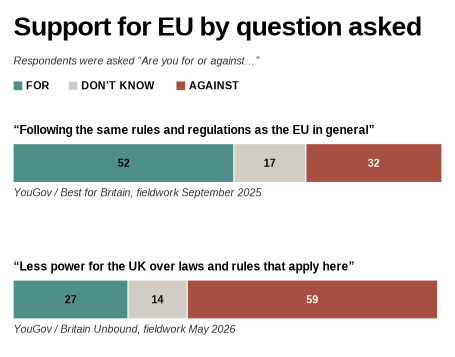
By a large margin, we favour “following the same rules and regulations as the EU in general”, but by an even larger margin we reject “less power for the UK over laws and rules that apply here.” Securing harmony is more popular than losing control, even if both are the same in practice.
So words matter. This is not just a matter of studying polls with care – it has important lessons for campaigners either promoting or resisting change. They need more than the right policy; they must frame it the right way.
Pro-Europeans can learn from the 2016 referendum. Brexiters promised to “take back control” and framed the choice as cash for the EU versus cash for the NHS. If Burnham is to carry voters with him on Europe, he must win the next framing war as decisively as Remain lost the last one.
 Most popular


The noughties were rotten – and we were all part of the problem
I read David Walliams’s autobiography – and one revelation in it could spell trouble

Burnham’s new EU deal has left Farage trapped and humiliated

If we join the EU again, what happens to our happy fish and patriotic pint pots?