In the days after the Brexit vote, the Chinese Ministry of Foreign Affairs noted that it respected the results, and hoped for early agreements between London and Brussels to help clear up uncertainty. Three weeks later, voices in Beijing had a better grasp on what had happened – and in particular realised that the promises given by Brexit’s chief cheerleaders were hopelessly naive at best and downright dissimulations at worst.
As it emerged that there were no dynamic plans as to how Brexit would be achieved, what the price would be, or what Brexit even meant in practical terms, briefings turned to the statements made by senior figures in the run-up to the referendum. There was much discussion in Chinese state media and in think tanks as it became clear that comments by luminaries such as Michael Gove such as “the day after we vote to leave, we hold all the cards” might not be quite accurate; or that a UK–EU trade deal might not in fact be “the easiest in human history”, as Liam Fox had promised; or that there appeared to be very considerable negatives to the decision to leave the EU, despite David Davis’s assertion that there was “no downside to Brexit, only a considerable upside”.
When David Cameron resigned the day after the vote, Chinese state media started to take a different line, in contrast to the measured responses of the first hours of the referendum results. The British, said an editorial in the Global Times, the Chinese Communist Party (CCP) mouthpiece, had a “losing mind set”; those living in the UK, it went on, “may become citizens of a nation that prefers to shut itself from the outside world”, isolated not only from Europe, but also from the international community.
Worse, said an editorial in China Daily, reaching a Brexit deal – of any kind – would take years and involve hundreds of UK officials. While Chinese foreign affairs specialists wondered what lay ahead for the UK, CCP officials and political elites were quick to grasp the main takeaway: namely that China should never gamble on giving people a vote on topics which they did not understand and which could throw up results that might damage the state itself. “For the Chinese people, who are at a critical time to learn about globalisation and democracy”, said the Global Times, “they will continue to watch the consequence of Britain’s embracing of a ‘democratic’ referendum.”
In other words, the principal lesson was to understand that “democracy” and voting for one’s own destiny should serve as a warning. Similar views found echoes elsewhere. In Nigeria, for example, columnists asked “what has the United Kingdom just done to itself, its people and the future of its youth?”, noting that it was “difficult to fully understand why a country taking a decision about its future will decide on a false option” by voting for a process that would damage the UK’s economy.
The worry, noted Reuben Abati in the Guardian (Nigeria) was that the Brexit vote might lead to “copycat plebiscites” that could undermine the relevance of the African Union – an organisation, he noted, that had been modelled on the EU. The Ethiopian press carried commentaries by leading economists such as the Nobel laureate Ken Rogoff to explain what had happened. “Did the UK’s population really know what they were voting on? Absolutely not,” wrote Rogoff.
Suggested Reading


Brexit: a burden carried by the young
“Indeed, no one has any idea of the consequences, both for the UK in the global trading system, or the effect on domestic political stability. I am afraid it is not going to be a pretty picture.” Worse, he said, “this isn’t democracy; it is Russian roulette for republics. A decision of enormous consequence… has been made without any appropriate checks and balances.”
Even those in the rogues’ gallery were dismissive of Brexit as a failure of leadership. President Bashar al-Assad of Syria was scornful of British politicians for allowing the vote in the first place, stating that they were “disconnected from reality”. Others were more sanguine about the relevance. It would take two years for the implications of the Brexit vote to become clear, said Retno LP Marsudi, the foreign minister of Indonesia. Until then, it would be better to wait and see what would happen.
Another who pointed out that it would take a long time to assess the results was Vladimir Putin. “The traumatic effect of the referendum results will be felt for a long time,” said Putin at the end of June 2016. He too warned that the key thing to consider was what Brexit meant for open, liberal states. “Let’s see how principles of democracy are being put into practice,” he said, in a jibe at critics of his own autocratic rule of Russia that had already lasted more than a decade and a half. Anyway, he continued, “Brexit is the choice of British nationals.” Of course, he added, in a helpful signpost for those interested in Russian engagement in online and other activities before the vote, “we have in no way interfered and are not interfering with this process”.
Then there were small, but vocal, camps in other countries that rejoiced in the UK’s decision to leave the EU. Some in India noted that Brexit had sunk sterling, making Indian competitiveness improve by making imports from the UK, as well as visits to Britain, considerably cheaper. Donald Trump, who was campaigning to become president of the US, declared that it was “a great thing” that the people of the UK had “taken back their country”, without explaining either the costs or the reason for the jubilation.
Those close to Trump were clearer about why Brexit was positive: Wilbur Ross – who became commerce secretary after Trump’s election in November 2016 – told financiers at the end of that year that Brexit was a “God-given opportunity” for the US and others to take business from the UK and to benefit at its expense. It was not just Trump’s inner circle who saw Brexit as a moment that would weaken the UK. On a visit to the UK in April 2016, just two months before the referendum, president Barack Obama had made clear that he believed that Britain was at its best when “helping to lead” a strong EU and that membership made it a “bigger player” on the world stage.
That would change if people in the UK voted to leave the EU, he said, warning that, if this happened, the US would not be able to offer extensive trade privileges. On the contrary, warned Obama, Brexit would mean that the UK would go to “the back of the queue” of countries trying to strike trade deals with Washington – a comment derided by leading Brexiteers, who complained that the US president was interfering in British politics, rather than stating an obvious, hard, cold truth.
As I wrote in the aftermath of the Brexit referendum in a book called The New Silk Roads, the most important question around Brexit – and the single most significant way it was looked at, assessed and understood outside Europe – was its timing. In the quarter of a century since the end of the Cold War, the trend in global affairs was towards higher levels of cooperation, rising regional trade integration and preparing for uncertain futures.
Although the referendum took place before Trump’s election, there were already concerns about the fact that there was a set of existential problems that required collaborative approaches and action. The most obvious example was the Paris Agreement of 2015, where countries acknowledged the growing risks posed by global warming and climate change and agreed a framework to try to address these.
There were other areas, too, that required deep thought – such as the long-term effects of the global financial crisis of 2008 that had left many rich countries with enormous national debts and led to austerity measures that scarred communities around the world for the next decade, if not longer. Then there was the emergence of new digital technologies which had already, in the words of general Keith Alexander, head of the US National Security Agency, resulted in the “greatest transfer of wealth in history”, as a result of booming cybercrime.
Furthermore, alongside economic fragility there was profound geopolitical uncertainty as a new world order was being born. In many countries, that was the cue for deep thought about how to benefit from the opportunities, while protecting from some of the more difficult challenges.
In some parts of the world, that was addressed through the development of long-term plans that set out pathways to navigate between the good and the bad – such as in Vietnam, with its National Master Plan for 2021-30 that aims to turn the country into a high-income economy by 2050, “characterised by a just, democratic, and civilised society, and supported by modern and comprehensive infrastructure”, or states in Central Asia such as Kazakhstan with its Kazakhstan-2030 and Kazakhstan-2050 plans, which provide blueprints to make the country become “a welfare society based on a strong state, a developed economy with universal labour opportunities, as well as to enter the club of the top thirty most developed countries of the world”.
Having a long-term plan does not mean that success is guaranteed; nevertheless, what these – and other similar plans, such as Golden Indonesia 2045, or India’s Project Mausam, its Cotton Route or its Mahasagar initiative that was announced in 2025 – do is establish a narrative, set the direction of travel and pinpoint a clear set of aims that can be benchmarked. Then, of course, there is China’s Belt and Road Initiative, which purports to boost economic cooperation despite “differences in race, belief and cultural background” and thus emulate what the ancient Silk Roads had done.
More recently, there is a new swathe of other initiatives proposed by Beijing, such as the Global Security Initiative, the Global Development Initiative and the Global Civilisation Initiative, which are intended to provide forums in which traditional Western leadership can be discussed and challenged.
Suggested Reading
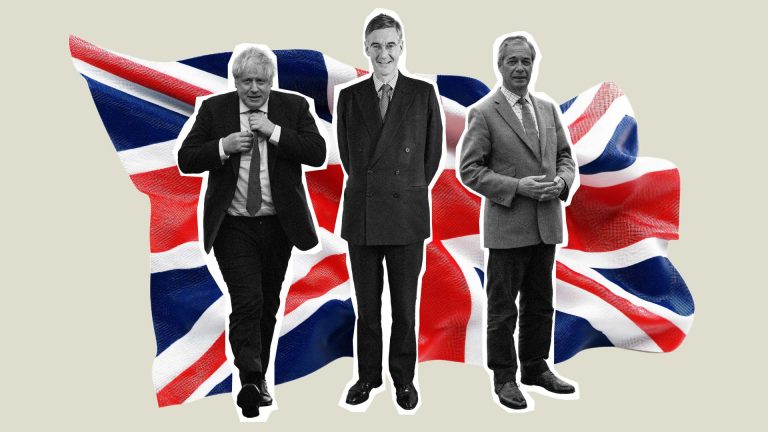

Whatever happened to the Brexiteers?
While Brexit promised sovereignty and independence, other states have been capitalising on finding ways to boost their collaboration. One obvious example comes from the BRICS grouping, which – ten years on from Brexit – has now expanded to cover states that are home to over half the world’s population and around 45% of global GDP if members and observers are included.
Or there are the Shanghai Cooperation Organisation, the Lancang Mekong Cooperation, the Eurasian Economic Union and ASEAN – the group of Southeast Asian nations, whose combined trade has more than doubled since the Brexit vote. Seen from the rest of the planet, the UK’s decision to go it alone does not so much buck the trend as defy belief. While other states are working together, the UK is paying the price. According to recent analysis, the UK economy is 6-8% smaller than it would have been without Brexit. That is an enormous number: the equivalent of wiping out the entire economic output of Wales, or losing roughly £2,000-£2,500 per person every year.
Moreover, that is only part of the story, for investment – the spending that drives future growth – has been hit even harder. Firms have cut investment by 12-18%, partly because of uncertainty about trade rules, regulation, supply chains and staffing. For almost a decade, businesses repeatedly delayed projects, cancelled expansions or diverted management time to Brexit planning instead of innovation or productivity improvements. Employment, too, has suffered, having been reduced by 3-4%, as a result of lower demand and because of the collapse in EU migration, which has particularly affected sectors such as logistics, hospitality, food processing and healthcare. As seen from the rest of the world, this is not political bravery, but economic self-harm.
What I hear again and again across Asia, Latin America and many parts of Africa is that, in the last decade, the UK has shown no vision beyond the severing of ties with Brussels. There have been vague declarations about doing new trade deals with former and potential partners, all of which take time to achieve, and few of which have resulted in terms that are better than those that the UK previously enjoyed as a member of the EU.
In contrast, ambitious new actors who are seeking to shape the world in their image have stepped into a vacuum left by Britain – as well as by other states in Europe. Take, for example, Qatar, which has positioned itself as a key negotiator not only in the Middle East, but also in Afghanistan and, most recently, with Venezuela, too. Or there is Türkiye, which has formally banned the use of the label “Central Asia” in favour of Turkestan as a mark of its rising ambitions in the region, and has become one of the most active geopolitical players not only in the heart of the world, but also in Ukraine and Russia, in Syria and the Middle East, in East Africa and in much of sub-Saharan Africa too.
In 2023, Türkiye continued its rise in the annual Lowy Institute Diplomacy Index, to third place in terms of the number of diplomatic missions abroad, behind the US and China. The UK, in contrast, has cut back the size of the Foreign Office, has cut development budgets to the bone, reduced the British Council to its knees and, something that has caused jaws to drop around the world, scaled back the much admired BBC World Service. All these actions have reduced the UK’s global footprint; each shows a nation struggling with its self-confidence and with being able to articulate its place and role in the world.
To many anglophiles, this has seemed baffling. Back in 2017, Steven Erlanger of the New York Times wrote an article entitled “No one knows what Britain is any more”. He contrasted the view that many British people have of themselves as “a brave galleon, banners waving, cannons firing, trumpets blaring” with the reality of being a small ship adrift on the oceans, “unmoored, heading nowhere” with a fire on deck, and with the prime minister (at that time, Theresa May) lashed to the mast.
While adamant Brexit supporters are convinced that the decision to leave the EU was the right one, what stands out in other states has been the chaos of the UK’s political system. One key lesson from governance is that stability is a hallmark of success. That, of course, means something different in autocracies, where the turnover of leaders is determined by elites or by single individuals, from what it means in democracies, where voters choose who governs.
But, by all standards, the “Mother of Parliaments” in London has been a basket-case – one that has produced gasps of disbelief around the world. In the decade that followed the referendum, for example, the UK had six different prime ministers, eight chancellors of the exchequer, nine foreign secretaries and ten ministers of education. As observers around the world understand it, the UK is a country deep in turmoil, with poor leadership, bad governance and a political system that lends itself to drama and chaos, rather than long-term planning.
Worse, that has come at the cost of a sharply diminished global profile. As Simon Fraser, former permanent secretary at the Foreign and Commonwealth Office, noted in 2017, “It is hard to call to mind a major foreign policy matter on which we have had a decisive influence since the referendum.” That damning assessment has not improved in the years that followed, with the withdrawal from Afghanistan, a disastrous full-scale attack on Ukraine by Russia in 2022 and the playing out of events in Gaza following the horrific Hamas attacks of October 7 2023 that left tens of thousands of men, women and children dead and many times that number homeless.
Through all these – and more – the UK has fiddled while Rome burns, unsure of what role to play in each and in all. One reason for this, as Jonathan Powell – who is now back in government as national security advisor – put it, is because the Whitehall machine was forced to turn inwards to deal with Brexit as it unravelled, as negotiations trundled on with Brussels and as posturing about Europe consumed almost the entire political bandwidth for a decade.
Suggested Reading

The shocking lesson of the BBC’s Brexit: A Very British Civil War
Large parts of the world were completely ignored as deliberations rumbled on about how to treat pets crossing the Channel, how to cope with guarantees underpinning the Good Friday Agreement and how the UK could break international law, as one cabinet minister put it, in “a specific and limited way”. All this took place as the world became more complex, better connected – and richer. As seen from afar, the UK became obsessed with a question that was decades old (its relations with Europe) rather than facing a new, modern age. What is the UK’s view on reform of the UN, for example? What is Britain’s take on empowering voices in low-income countries, or the Global South? Does London distinguish between former colonies or future allies in its foreign policy? What role, if any, does the UK play in global governance around AI, or in leading on issues such as climate change, social media regulation or clean energy adoption? What is the UK’s role in global poverty alleviation, in religious tolerance or in social welfare reform?
‘What I hear again and again across Asia, Latin America and many parts of Africa is that, in the last decade, the UK has shown no vision beyond the severing of ties with Brussels’
The UK was and is a key part of the global geopolitical architecture – by dint of its permanent seat on the UN Security Council, its membership of the G7 and G20, its key role in Nato and of course its historical connections to many parts of the world that give it almost unequalled convening powers. And yet, rather than the UK seeing a decade of enhanced visibility or of a greater role in shaping the world in its own, liberal image, Brexit has been seen around the world as a cause of retreat and withdrawal, as a motor propelling weak leaders into positions that they did not deserve and from which they did not deliver, and as a demonstration of a once-mighty power that has accelerated its own demise. As such, it is seen as having provided a signal lesson that sometimes the best thing to do is to have an argument, rather than to settle it.
When I was in Central Asia in the summer of 2025, I was asked about Brexit and why it had not been obvious that there would be costs and chaos. I said that one of the joys of living in the UK is that, when mistakes are made, they can be corrected. That drew a bemused look from my host, who then produced an interview with Guy Verhofstadt, former prime minister of Belgium, in the spring of 2016. If the UK voted to leave Europe, Verhofstadt said, “the only winners from a Brexit would be Nigel Farage and Vladimir Putin, who would relish a divided Europe”.
Verhofstadt had his detractors, for sure. But, ten years on, it is hard to argue that he was wrong. At the time of writing, Farage is the dominant force in British politics, for good and for bad – and one of the very few who has clearly benefited from Brexit. The same can be said for Vladimir Putin, whose assessment that Europe was weak, divided and (to paraphrase Emmanuel Macron’s comments on Nato) “brain dead” certainly played a role in his decision to launch a full-scale invasion of Ukraine in 2022.
As my Central Asian host noted, the worry for all and any former part of the Soviet Union is that Russia has become emboldened by a meltdown in Europe, of which Brexit was not the only part, but certainly a key factor. That boldness does not end in Ukraine. As with foreign policy scholars in China, the conviction in Moscow is that Europe has lost its way and is a spent force. For countries like these, Brexit was a declaration of paralysis, a statement that the UK could not cope with a changing world and wanted to shift to a pose that preserved the status quo at all costs. One way to do that was to inflict damage on the EU – by leaving and therefore weakening it.
Ironically, that chimes with views that have taken hold in the US that see Europe as not only a fading power, but one headed for obscurity. The National Security Strategy that was published at the end of 2025 talked of Europe being a place where political liberty and sovereignty are being undermined, where migration policies are transforming the continent and creating strife, and where free speech is censored and political opposition oppressed. Europe did not only face “cratering birthrates, and loss of national identities and self-confidence”, stated the report, which was introduced by President Trump; it faces an economic decline that “is eclipsed by the real and starker prospect of civilisational erasure”.
The election of Donald Trump in 2016 and again in 2024 has brought another disruptor to power, who has done more to overturn the international order that has held since the end of the Second World War than any other global leader. Trump, though, holds a very different hand of cards from those in the hands of the UK. And while Brexiteers have long held a special affection for their cousins across the Atlantic, this is rarely reciprocated in meaningful terms. The US has levers it can and does use to coerce others to do its will; the UK does not. That, then, is the problem that is apparent around the world. The UK is not able to match its ambitions with its actions – and has gained a reputation of over-promising and under–delivering.
For what it’s worth, that is not an equation that has to stay static or permanent. It does, though, demand new ways of doing things. As King Wuling of Zhao (in what is now northern China) put it in 307BC, “a talent for following the ways of yesterday is not sufficient to improve the world of today”. That is the legacy of Brexit in a nutshell.
An extract from The Brexit Effect 2016 – 2026, edited by Anthony Seldon and published by Cambridge University Press on June 18
In next week’s special 10th anniversary edition of The New World: A History of Brexit in 256 Disasters, Jonty Bloom’s brilliant analysis of Britain’s lost decade