When authors publish a new novel, they tend to promote it at bookshop events amidst hastily assembled fold-out chairs, with perhaps the non-fiction table shoved temporarily to one side to accommodate the small but engaged audience. The more popular the author, the more likely warm white wine will be served.
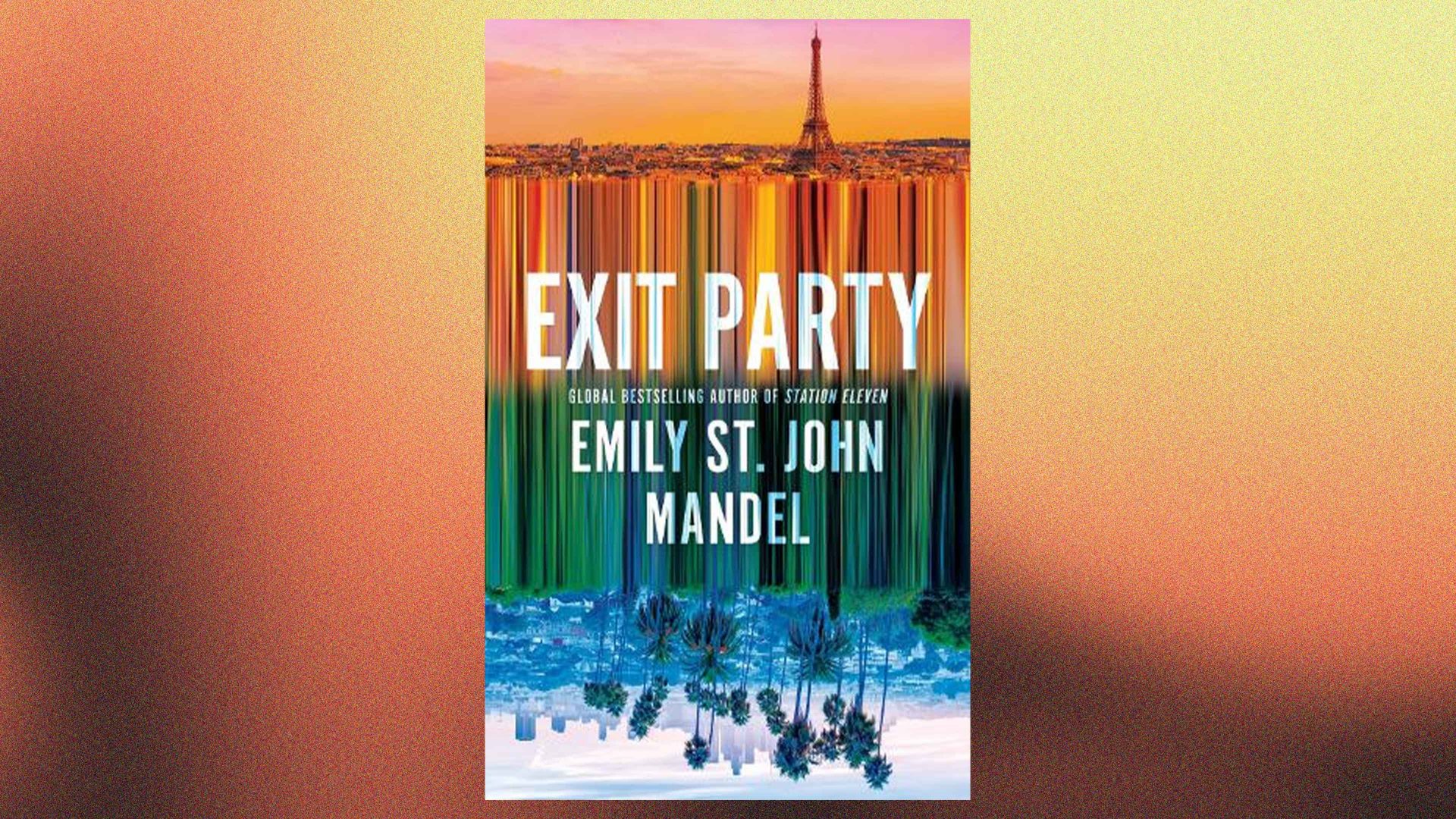
But when Emily St. John Mandel meets her readers, the venues tend to be somewhat grander, the queues longer. (The wine does remain at room temperature, though. Industry standard.) Next month, to accompany the release of her latest book, Exit Party, she will be speaking before several hundred people a night at venues across America, the UK and beyond.
“I’ve been doing these large-scale events for about 12 years now, ever since Station Eleven came out,” Mandel says. “People can have an intense emotional relationship with certain novels, and that did happen for me with that book. They would tell me how much it meant to them, how it affected them.”
Station Eleven followed the lives of a travelling symphony 20 years after a global flu pandemic had killed most of the world’s population. Those who survived not only had to rebuild society, but also remind everyone of the importance of the arts, of Shakespeare and music. Without it, they suggest, mere “survival is insufficient”.
“When people tell me about their relationship with the book, it does have an emotional weight,” she says, “which I have to say I feel underqualified for. I’m not a psychologist, after all. But what I can do is listen, and sometimes that’s all people need from you: to absorb what they are saying.”
Readers flock to her events in such large numbers not just because she’s a terrific writer, and her novels so compelling, but because of her chosen genre: speculative fiction set in the near future, where this great experiment of ours – companionable societies, law and order – has imploded dramatically. But Mandel is not an entirely bleak novelist by any means. Her books all maintain kernels of hope. This is important, she says.
I ask what it’s like to be taken not merely as a writer but some kind of oracle?
From her apartment in New York, she laughs. “Well, firstly, never trust an oracle! And I am very much not one. All I am trying to do is imagine the world in the same way everyone else is.”
Suggested Reading
Patrick deWitt’s strange road trip through America
She looks out of her window, blinks slowly, then turns back. “Margaret Atwood once made the point about The Handmaid’s Tale that what she was writing about had in fact already happened somewhere in the world, at one time or another. That’s what I do. While writing my new book, I was thinking about the Stasi in East Germany, and the use of technology and surveillance in present-day China. So you can call it dystopian if you like, but it’s actually not. It’s real, it’s here.”
Exit Party makes for unavoidably unsettling reading. The book opens in 2031. America is at war with itself. There are cameras everywhere, curfews, and collective mistrust. California has declared itself a republic.
Before leaving Los Angeles to travel through these newly disunited States, Mandel’s furtive protagonist Ari attends a party where she meets people and then, later, their doppelgängers who have slipped through a portal from a parallel universe, where life is different. As the decades unfold, and order never fully restored, Ari continues to encounter various hostile interlopers. Trust no one, Mandel seems to be saying.
“While writing this I was thinking about meteorology,” she says, unexpectedly. “Climate scientists talk a lot about global temperatures rising by three or four centigrade, and the range of possible scenarios that could lead to. Dystopian fiction behaves very much along these lines. And so these are some of the possible destinations I think we might come to if we continue on the road we’re presently on.”
And will we continue down it? Should we be worried? Panic? She shakes her head.
“I don’t think so, no. And I don’t want to write books in that vein anyway. You know, I loved Cormac McCarthy’s The Road, but that was the bleakest book I’ve ever read.”
McCarthy’s harrowing 2006 classic was set in a post-apocalyptic world. “Personally, I believe there is always hope, even in times of collapse.”
Emily St. John Mandel, 47, was born and raised in northern Canada, her mother a social worker, her father a plumber. “We had little money, but we read a lot.”
She was homeschooled, and initially wanted to become a dancer before settling for office work in her adopted Manhattan. But she did want to write, and did so assiduously on the side. “I spent most of my 30s in a small room, typing.”
She was eventually successful, publishing three novels between 2009 and 2012, but her breakout came in 2014 with Station Eleven. An instant bestseller, the book went on to reach the heights of a sacred text by 2020, as new readers – in this time of a real-life global virus outbreak – were drawn to its prescient themes. Had she predicted the future?
She smiles her practiced smile; readers ask her this all the time. “No, I did not. I just watched the news.”
She has remained a bestselling author ever since, and the novels that followed it – The Glass Hotel (2020), about a shipping executive and a bartender, and The Sea of Tranquillity (2022) about colonies on the moon – were both eerie, destabilising and entirely hypnotising.
“It still feels extraordinary that I get to do this full time,” she says, “but never trust the writer who tells you they became successful by luck. There’s an awful lot of effort and sacrifice that goes into writing. Anyone who tells you otherwise is lying!”
Since her last book, she has divorced her husband, with whom she has a 10-year-old daughter, and married Laura Barisonzi, a photographer. She says that her daughter, a precocious reader, recently picked up Station Eleven, intrigued. And what did she make of it? “She liked it… I think.”
Given Mandel’s particular literary beat – essentially the end of the world as we know it – can she possibly remain optimistic for the world her daughter is inheriting? Shouldn’t she be echoing Cormac McCarthy after all?
Suggested Reading

The fiery feminist book I can’t stop thinking about
“We’re undoubtedly in the middle of an appalling geopolitical moment right now,” she concedes. “The rise of fascism can make people feel powerless, and I do think that life is objectively more frightening and unstable than it used to be. We live in a world where ICE raids happen, where people are disappeared or shot in the street.
“Am I optimistic about the future of the United States? Not particularly, no, but I do think there is still hope.”
Why? “Well, there’ve been other terrible times in history, and we recovered from those. Nothing is permanent, and so the real question is one of resilience, of finding those little flashes of joy. You know, we have our children, and we see our friends. There is always the possibility of a magical evening. So it’s not quite the end, I think.
“And even if it were,” she says, an optimistic lilt in her voice, “every ending implies a new beginning, right?”
Exit Party is published by Picador.
 Most popular

The problem is they just don’t care about us any more


The New World at 500: Independence isn’t our marketing slogan. It’s our business model


Churchill, the Beatles, St George: All the English heroes who aren’t actually English

Sorry Nigel, but the polls show you’ve had it