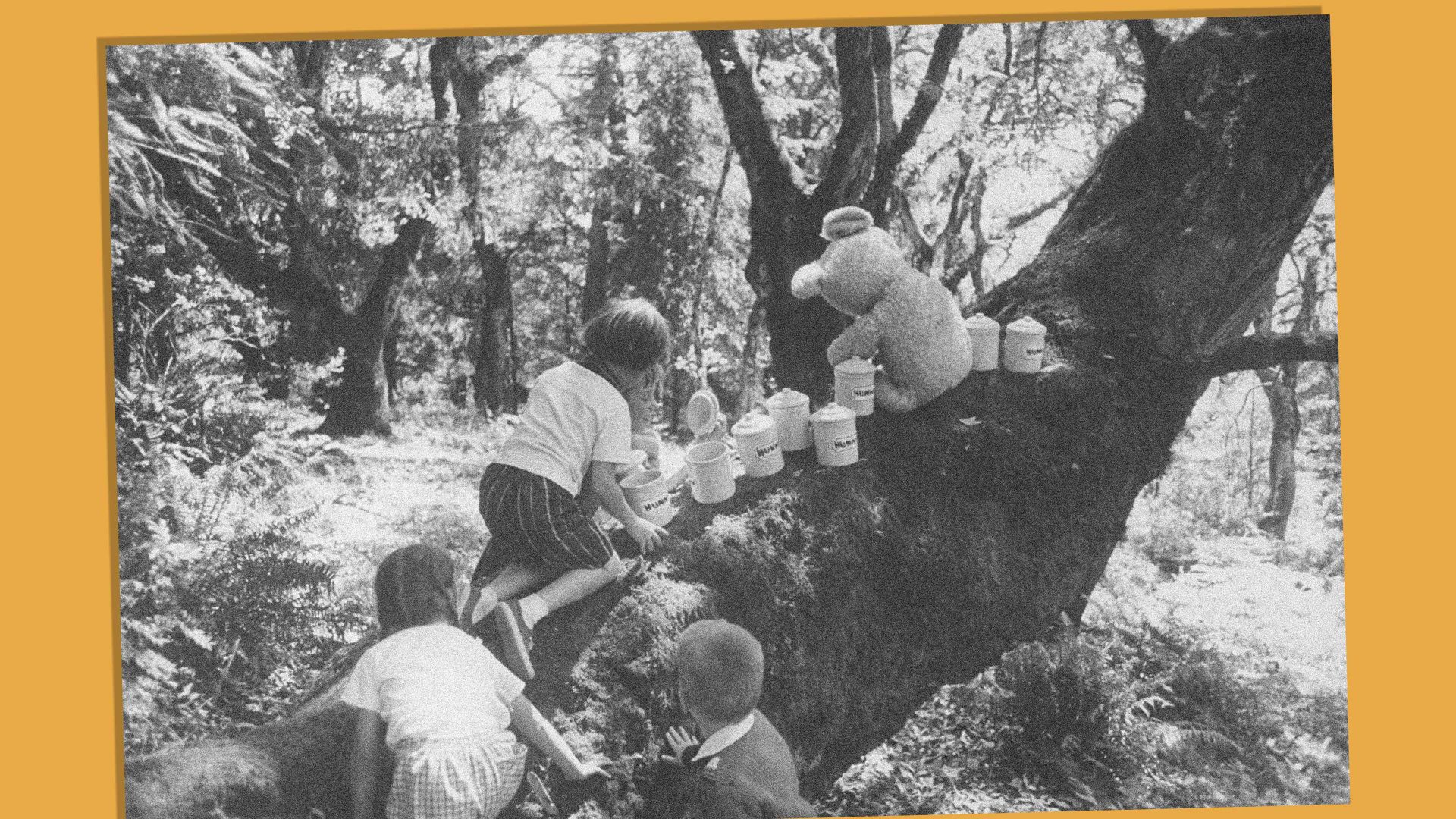
In 1921, AA Milne went to Harrods and bought a toy bear for his son. It was made by JK Farnell of Acton, as part of their “Alpha Bear” range. The bear was renamed “Winnie-The-Pooh” by Milne’s son Christopher Robin, after a Canadian black bear at London Zoo called Winnipeg.
Further stuffed toys joined Pooh – Piglet, Kanga, Roo, Eeyore, and Tigger – and, as we know, Christopher’s father was swift to incorporate them all in a collection of stories (unusually, these stories were not originally created to be told to the writer’s child, but for publication).
The rest is history: the Winnie-The-Pooh stories became enormously successful, selling millions in book form. They acquired even greater fame when the film rights were sold to Walt Disney, who added a new character (the very un-English Gopher) and gave Pooh his otiose red t-shirt.
Milne’s work famously brought his son no pleasure (the poem Vespers, which contains the couplet “Hush! Hush! Whisper who dares! Christopher Robin is saying his prayers” made Christopher’s life a misery at boarding school and was, he later said, “the one thing that has brought me over the years more toe-curling, fist-clenching, lip-biting embarrassment than any other.”
Indeed, Christopher Robin joins the long list of children frozen in time by their author parent: although he later claimed to have made his peace with the books after writing his own (in which he wrote that “it seemed to me almost that my father had got to where he was by climbing upon my infant shoulders, that he had filched from me my good name and had left me with the empty fame of being his son.”)
Suggested Reading
The bloody good feminism of streaming’s new Carrie
The Pooh books are, as previously noted, massively popular: they entered, bizarrely, the rock culture of the 1960s when post-war children raised on Pooh formed bands like Jefferson Airplane and Pink Floyd and sourced songs from the well of childhood (and famously, Rolling Stone Brian Jones drowned at Milne’s old home). Even the Muppets joined in, covering Halfway Down the Stairs from When We Were Very Young.
All of which is is due, not just to nostalgia (or to the Disney films, in which Pooh and his chums trade kitten-poster inanities like a bunch of Peanuts kids who have been repeatedly dropped on their heads) but to the books themselves which, in their 100th year, still retain their unique and individual character. Whether that character is a force for good or evil has created some debate over the years.
Most people are in favour. Others have their doubts. Take a moment, won’t you, to judge for yourself.
“What about a story?” said Christopher Robin.
“What about a story?” I said.
“Could you very sweetly tell Winnie-the-Pooh one?”
“I suppose I could,” I said. “What sort of stories does he like?”
“About himself. Because he’s that sort of Bear.”
“Oh, I see.”
“So could you very sweetly?”
“I’ll try,” I said.
So I tried.
The opening lines, there, of Winnie-The-Pooh. There is, to be frank, a lot of this sort of thing, all written in a prose style that constantly comments on itself and is perhaps sweeter than most adults are used to.
(It’s also filled with that strange autumnal melancholy which pervades another early 20th century children’s classic, The Wind In The Willows, a sense that the past was a better place than the present, and adventures are good but home is better – see also The Hobbit, whose opening pages are a nostalgia jigsaw of a country village in book form).
Naturally, such prose has not gone unchallenged over the years. Famously, there is Dorothy Parker’s review of Now We Are Six:
“Tiddley what?” said Piglet.(He took, as you might say, the very words out of your correspondent’s mouth.)
“Pom,” said Pooh. “I put that in to make it more hummy.”‘
And it is that word ‘hummy,’ my darlings, that makes the first place in The House at Pooh Corner at which Tonstant Weader Fwowed up.”
Even The Goodies joined in, with this piece of heartfelt doggerel:
“!!S??t! ???k! Listen who swears?
Christopher Robin has fallen down stairs.”
Most considered of all, there’s Michael Moorcock’s renowned essay, Epic Pooh, in which the great sci-fi and fantasy author sets out his stall early on:
“I never liked A. A. Milne, even when I was very young. There is an element of conspiratorial persuasion in his tone that a suspicious child can detect early in life. Let’s all be cosy, it seems to say (children’s books are, after all, often written by conservative adults anxious to maintain an unreal attitude to childhood); let’s forget about our troubles and go to sleep.”
Moorcock, in a wide-ranging piece that also takes in Tolkien, CS Lewis, Watership Down and most fantasy literature, concludes, “If the bulk of American sf could be said to be written by robots, about robots, for robots, then the bulk of English fantasy seems to be written by rabbits, about rabbits and for rabbits.”
And yet… And yet there’s a power to these books, that’s partly created by the constant knowledge that childhood does end, and that (to adults at least, and people who’ve not read the brilliant books of Jacqueline Wilson or Matt Goodfellow) those early years are a golden paradise: but that autumnal melancholy is a powerful thing.
There’s also the fact that Milne – who was assistant editor of Punch – is a very funny, if somewhat arch writer and has a sharp sense of humour as well as a good eye for character.
Yes, he can be cutesy: but then he’s writing for children. And clearly he writes very well for children. If there’s such a thing as mordant twee energy (and there is, I’ve seen 1980s indie bands) then AA Milne is its creator.
The final chapter of the last Pooh book is a brilliantly managed mix of sentiment and sadness: and while cynics will say you have to have a heart of stone to read it without laughing, I find it effective and moving:
“So they went off together. But wherever they go, and whatever happens to them on the way, in that enchanted place on the top of the Forest, a little boy and his Bear will always be playing.”
A century later, they still are.
David Quantick’s all-ages novella IMAGINE A FRIEND is out now
 Most popular
I was at Eton with Charles Spencer – this is how it explains his battle with the royals

Emily Maitlis’s diary: My deep dive into Jeffrey Epstein’s hidden empire – and the network that let him get away with it

The linguistic logic behind dropped syllables
Putin’s wartime economy is heading for catastrophe