May 6, 1915 – October 10, 1985
A Sunday evening in October 1938 and there is breaking news on the radio. Mysterious creatures and objects have been seen above New York City. Aliens are invading; we all need to get out of here. In absolute panic, some listeners gather what they can to protect their homes, run outside, look up to the skies.
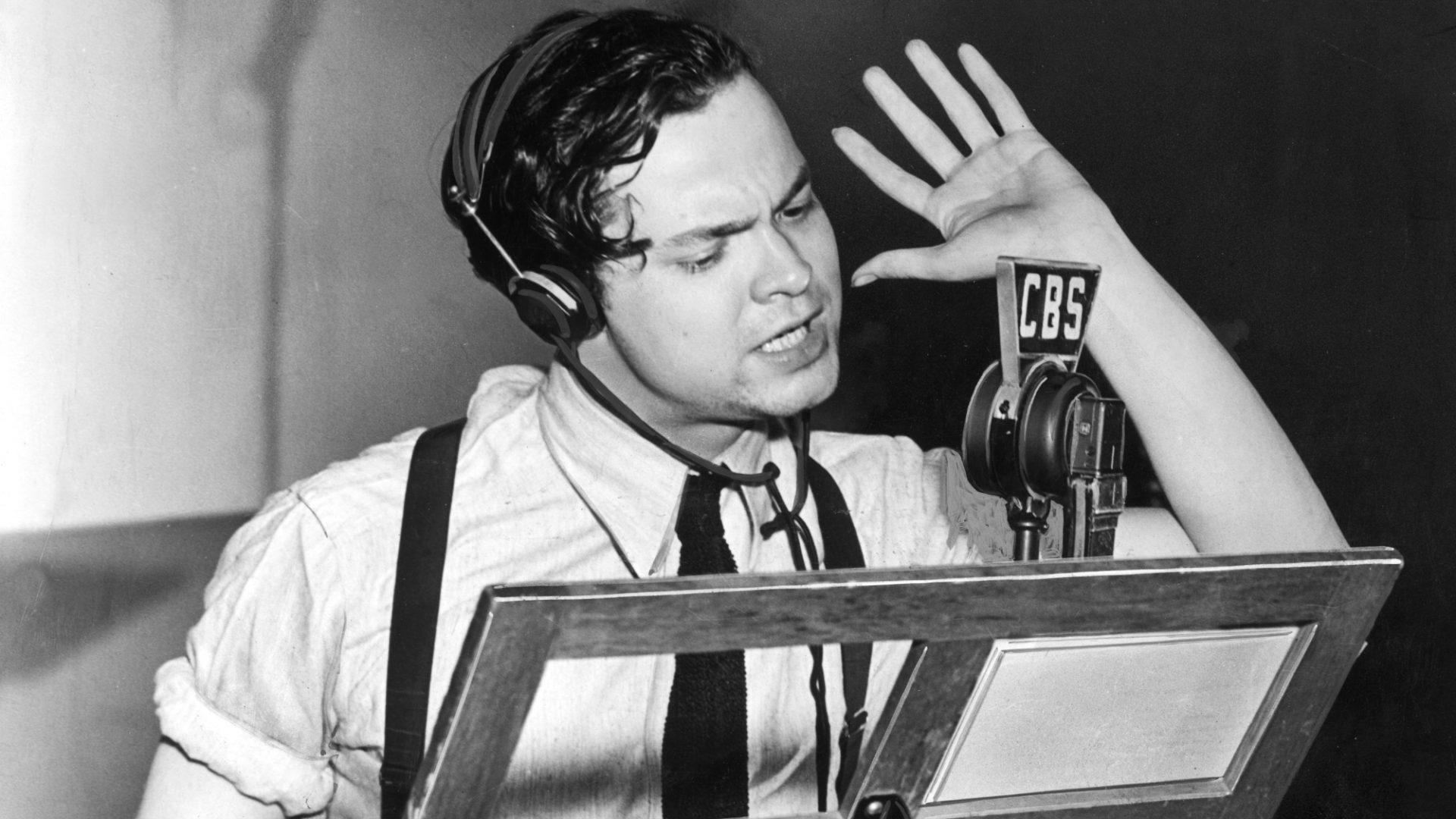
In the CBS studio on Manhattan’s Madison Avenue, Orson Welles stands with his arms raised, conducting every detail, special effects capturing the sound of space creatures, the cries and shrieks of the cast perfectly choreographed to transmit terror into homes across America.
Most of the six million people listening in their armchairs know this is fiction, the latest story in The Mercury Theatre on the Air series broadcast on CBS Radio on Sunday evenings, but such is the power of the storytelling that even some of those decide to phone the police or their local newspapers for corroboration.
Twenty-four hours earlier, the show had appeared doomed for disaster. The Mercury Theatre, founded the previous year by Welles and producer John Houseman, had originally given writer Howard Koch the task of adapting HG Wells’s 1898 novel The War of the Worlds.
Suggested Reading
Bessie Smith: the woman who faced down the Ku Klux Klan
Koch, however, took an instant dislike to what he thought was childlike science-fiction and the script showed his indifference. Deeply embedded in rehearsals for another production, Welles phoned in to ask how it was going. “Very dull, very dull,” a technician told him. “It’ll put ’em to sleep.”
Furious, Welles stopped what he was doing, realising he needed to intervene. Scrambling cast and crew, he barked instructions and passed out notes. It needed to be in real time, he bellowed, the dialogue had to sound more natural, more convincing. The listeners had to be terrified.
The next morning the story was front-page news, the reaction so extreme that Welles was summoned to the theatre for a press conference, a line of microphones waiting for the man who had spread panic across America. His reaction was of contrition and surprise, but secretly he was thrilled. Overnight, Orson Welles had become a star.
Young Orson, with a concert pianist mother and an inventor father, had grown up wanting to be a magician. He had always been encouraged to create, that the world was a stage: “Everybody told me from the moment I could hear that I was absolutely marvellous,” he later said.
His talent was matched by his ambitions – instead of just acting he set up his own theatre company and was determined to be radical in his storytelling, including an all-black production of Macbeth in 1936. “What is the point in doing something if it is not revolutionary,” he asked, “if it doesn’t pack a punch?”
A year after making the headlines with The War of the Worlds, Welles was again given creative control to write, direct, produce and act, this time with his first Hollywood feature film. With a cast and crew plucked from those he worked with at the Mercury, he set out to tell the story of newspaper magnate William Randolph Hearst for a new project: Citizen Kane.
Hearst made it clear to the industry that this was against his will, and his power meant that at the 1942 Academy Awards the film was continually booed. Citizen Kane was nominated for nine awards, and lost in every category except one, for best writing. His subsequent great films as a director – The Magnificent Ambersons (1942), The Lady from Shanghai (1947), Touch of Evil (1958) – were butchered by studio bosses and blasted by critics; other projects fell apart.
“Movie directing is the perfect refuge for the mediocre,” he soon claimed, as each one of his inventive, magical ideas met with resistance. Instead he found challenges elsewhere – in acting, in European film, but also in activism, painting, politics and bullfighting.
Here again it was not enough to be a spectator; Welles had to get on a bull, enter the ring, experience the thrill for himself. There were equally tempestuous romances, high living and unsuccessful battles to control both his finances and his weight.
Suggested Reading

The lesson that Jamal Khashoggi left behind
Perhaps Orson Welles never experienced again the exhilaration he felt that October night in 1938. “It had been an experiment,” Welles told his almost namesake HG Wells when they were interviewed together in 1940. “I have always been more interested in experiment than in accomplishment.”
Both storytellers would have been delighted at how the infamous broadcast has been mythologised over the years: reports of listeners fleeing in their cars, patrolling their homes with pistols ready. Years later, Welles explained that the show had been a word of caution: beware manipulation by this new media, do not always believe what you hear.
Even the news, he warned, could be manipulated by master storytellers or by outright liars. “Radio is new and we are learning about the effect it has on people,” he said. “We learned a terrible lesson.”