PICK OF THE WEEK
Blade Runner 2099 (Prime Video)
Philip K Dick, author of Do Androids Dream of Electric Sheep? (1968), had hoped that the android hunter Rick Deckard might one day be played on-screen by Gregory Peck: “powerful and sensitive and wise”. Instead, Ridley Scott cast Harrison Ford in the visionary cinematic adaptation released in 1982, less than four months after the novelist’s death at the age of 53.
The original movie was a commercial failure, a cult classic whose genius was not fully acknowledged until the director’s cut of 1992. A further quarter-century was to pass until Denis Villeneuve’s Blade Runner 2049, a superb film in its own right as well as a worthy sequel.
Now, against the odds, showrunner Silka Luisa has overseen the migration of the beloved franchise to an eight-episode streaming series – with spectacular success. From its opening sequence of fire, wind-swept ruins and neon-lit dystopia, we are back in the world of the Tyrell Corporation, replicants, and police cars flying across dazzling cityscapes against a plangent soundtrack of synth and saxophone.
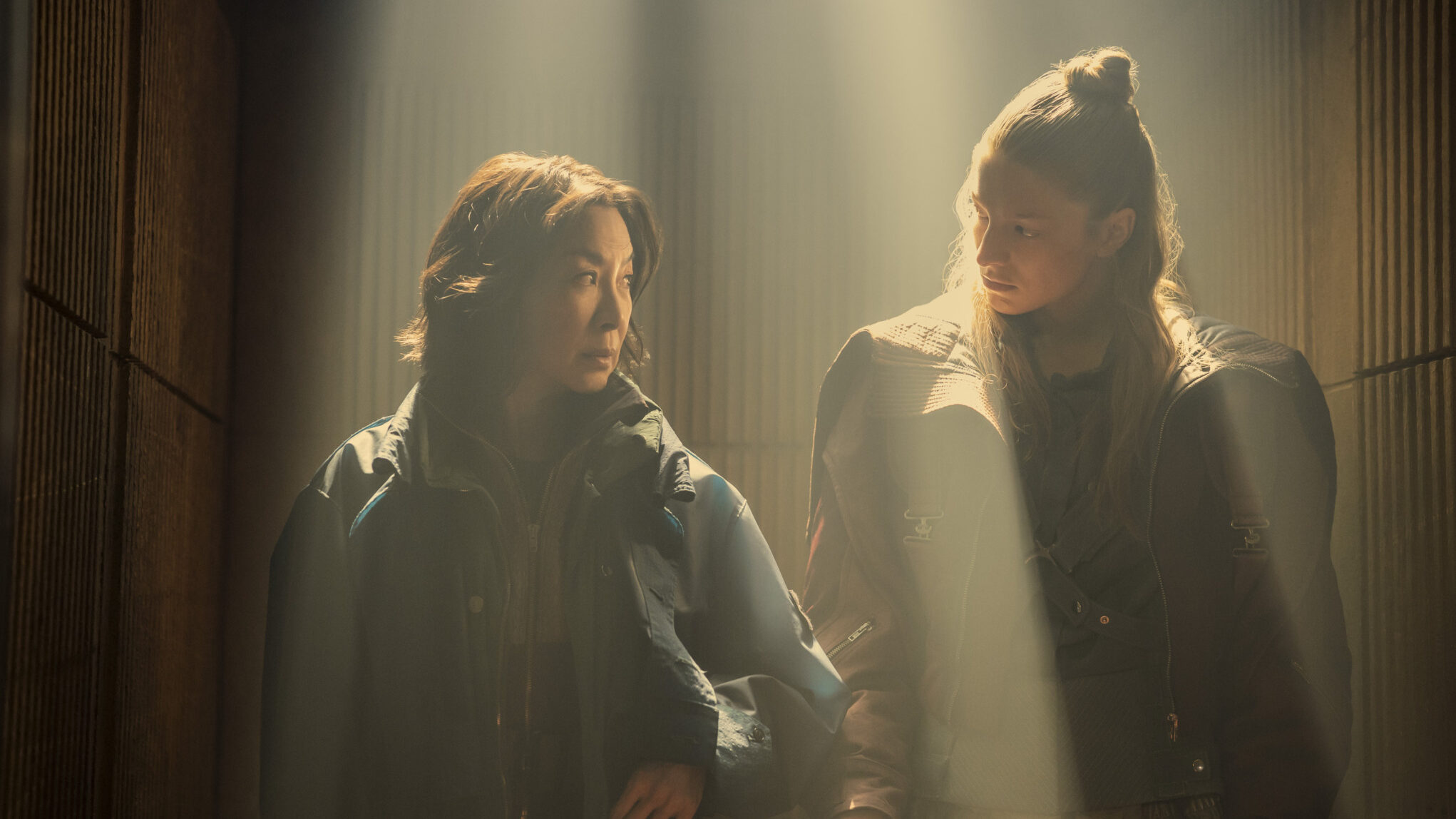
The twist is that, following a war, human beings are now the subordinate race, pursued by bioengineered blade runners such as Olwen (Michelle Yeoh), previously a terraforming specialist, or baumeister, on the off-world colonies of Namaka and Shimata. With only eight days of her allotted lifespan remaining, she hopes to track down her former partner Marek (Johnny Harris).
At her side is Cora (Hunter Schafer) – a human being who has stolen a replicant identity and infiltrated the LAPD as Marian Jessup, trying to find help for her disabled brother Elias (Lewis Gribben).
Yeoh and Schafer are both superb in a psychological game that oscillates between suspicion and growing mutual respect – and also leaves plenty of time for full-throttle action. Tom Burke is, as ever, terrific as Julius, a renegade replicant who is guarding what may be the greatest secret of this broken civilisation.
There are callbacks to the origami animals, body horror and even Rutger Hauer’s peroxide haircut in the original, and plenty of portentous rhetoric. “You’re so alone you’re not a person anymore,” Cora is told by her ID-dealer Bebeto (Dimitri Abold).
“Don’t be scared of dying,” Says Olwen. “It’s just trading one darkness for another”. And then: “I’ve been to the stars. I know how small I am. Even the sun dies”. Well, it is Blade Runner.
Best of all for fans of Dick’s fiction, Luisa includes the religion of “Mercerism” which did not feature in either of movies but underpinned the novelist’s idea of empathy as the capacity that distinguishes humans from machines. But is that necessarily true?
This is prestige television of the highest quality that will keep you gripped to the final scene. The more invested I became in the fate of Olwen and Cora, the more I kept thinking of the immortal line of Gaff (Edward James Olmos) in the original: “It’s too bad she won’t live. But then again, who does?”
FILM
The Further Mis-Adventures of Cliff Booth (selected IMAX cinemas; Netflix, December 23)
David Fincher’s hugely enjoyable comedy thriller is better appreciated as a Quentin Tarantino greatest hits jukebox than as a true sequel to the much more textured Once Upon a Time… in Hollywood (2019).
It’s June 1977, eight years after the first movie’s bloody, history-altering denouement, and Cliff Booth (Brad Pitt) is back: no longer Rick Dalton’s stunt double but making a living as a projectionist, barman, occasional porn star, stock car racer and all-purpose Hollywood fixer.
He is a legend around town – the man who “kicked Bruce Lee’s ass”, who enlisted aged 15 and is still venerated in Manila for his WWII exploits, who slayed Charles Manson’s murderous home intruders – but wears it lightly, so to speak.
Contacted by Karen Crosby (Elizabeth Debicki), agent to diminutive television star Charlie Peters (Scott Caan, son of the late James), Cliff is called upon to get him out of a serious jam. Along the way (of course) he and Karen fall for one another – leading us to a surprising discovery about Cliff’s sexual tastes.
In the end, I lost track of all the Easter eggs and in-jokes. Here’s Cliff picking up food for his dad Gus (Peter Weller) at Big Kahuna Burger (as sampled by Samuel L Jackson in Pulp Fiction). There’s Charlie playing out a television scene that mischievously recalls Inglourious Basterds. Now, there’s a body in a trunk, just as in Jackie Brown; and wait – that’s Margot Robbie as Sharon Tate (still alive in this timeline), advertising Red Apple cigarettes, which Bruce Willis buys in Pulp Fiction and also feature in Kill Bill: Volume 1, The Hateful Eight and…you get the picture.
In truth, this is all part of the fun rather than especially significant. Pitt and Debicki have an absolute blast with Tarantino’s screenplay and strike just the right tone for what is clearly not a canonical movie for either writer or director, but a riotous caper for their respective fans on the freeway heading towards Christmas.
Suggested Reading


Wild Horse Nine is a darkly funny buddy movie with a body count
FILM
Chaplin (STUDICANAL 4K UHD & Blu-ray)
This magnificent restoration of Richard Attenborough’s epic 1992 biopic is a double helix of rediscovery. First, it is remarkable to see Robert Downey Jr, still only 27 when the movie was released, playing Charlie Chaplin with such charisma and authority from the age of 17 to 83: from humble roots in vaudeville to his honorary Academy Award in 1972.
This was Downey the meteor, who had made his acting debut aged five in one of his father’s films, was already a cast member on Saturday Night Live aged 20 and won a BAFTA for Chaplin (for which he was also Oscar-nominated).
Three years and nine months after the movie’s release, he pleaded no contest to drug and weapon charges and went on to spend 16 months behind bars. Yet, since finding lasting sobriety in 2003, he has become a global superstar, picking up an Oscar for Oppenheimer (2023) and set to return to the Marvel Cinematic Universe as part of a reported $100 million deal in Avengers: Doomsday (general release, December 16).
Second, Chaplin itself, which received mixed reviews and was a commercial disappointment, has aged very well in the past 34 years. The casting of Geraldine Chaplin, the real-life daughter of cinematic legend as his mother Hannah seems more inspired than ever. Kevin Kline has never been better than as the silent movie icon Douglas Fairbanks, lover and then husband of his fellow star Mary Pickford (Maria Pitillo), who alongside Chaplin (and DW Griffith who, misleadingly, does not appear in the film) founded United Artists in 1919.
The scene in which Fairbanks scales the HOLLYWOODLAND sign (the “-LAND” suffix was removed in 1949) and dismisses the talkies with a charming chuckle – “it’ll never catch on!” – feels especially elegiac at a moment when movies are under a fresh and possibly existential threat from another galloping technology.
Also terrific is Dan Aykroyd as Mack Sennett, the founder of Keystone Studios and “King of Comedy”, who gave Chaplin his start in movies. John Thaw is memorably profane as music hall impresario Fred Karno, and Moira Kelly delivers a strong double performance as Chaplin’s first love Hetty Kelly and his fourth and final wife Oona O’Neill (an actor and the daughter of Eugene O’Neill).
This casting decision was criticised in 1992 as a sentimental deflection from Chaplin’s lifelong sexual appetite for young women (Kelly was only 15 when they met in London and O’Neill was 18 when they married) – though it is fair to say that writers William Boyd, Bryan Forbes and William Goldman make no attempt to conceal the actor’s pathological and sometimes unlawful behaviour – or the revulsion it provoked at the time.
No less controversial were Chaplin’s political commitments which made him the target of J Edgar Hoover (Kevin Dunn). At this distance, it is hard to convey how audacious was The Great Dictator (1940), released more than a year before America entered the war. Hitler was born only four days after Chaplin in April 1899 and shared a stubby toothbrush moustache with the “Little Tramp”. As Chaplin stands in front of a huge screen on which is projected footage of the Fuhrer’s rallies, he rages: “I know you, you bastard!”
As ever in the STUDIOCANAL Classics series, the bonus content is excellent. Another essential purchase for every committed cultural prepper.
Images of America…
Look at the three lonely customers and the counterman in Nighthawks (1942): if they wait long enough, they might be joined by EB White, John O’Hara, Holly Golightly, Holden Caulfield, even Don Draper, still selling furs.
Yet one of the many achievements of Louis Shadwick’s magisterial Edward Hopper: A Life (Yale University Press) is to reclaim the painter (1882-1967) from his caricature as the visual poet of 20th-century American urban isolation and to set his art in a much broader context.
Hopper was also profoundly affected by the legacy of Emerson, by the provincial landscape of New England, by the collective spirit of American nationhood. One of the very best biographies of the year.
In American Sophistication: How the Casual Became Cool (Princeton University Press), Ross Posnock traces the role of elegance, playfulness and ease – as opposed to authenticity, naturalness and sincerity – in the American story. His scope is extraordinary: from Thomas Jefferson and Henry James via Duke Ellington and Mary McCarthy to Susan Sontag and the Kennedys.
So: Gatsby isn’t sophisticated – he reminds Nick of a mannequin “leaking sawdust” – but Hannibal Lecter is, “perusing the Italian edition of Vogue.” In this version of American life, performance trumps pedigree.
Which brings us, of course, to Donald Trump, who wants to be considered a sophisticate (hence his clumsy takeover of the Kennedy Arts Center) but also resents the condescension of liberal snobs.
As Posnock writes: “Trump ends up a reminder of sophistication’s root function – to protect us from the depths of the subterranean.” A beautifully written book of rare insight that will make you think afresh of what America is, has been and might yet become.
 Most popular
Will AI kill capitalism? I built a new kind of simulation and found the answer

Westminster’s outrage machine has embarrassed itself over chicken nuggets
Inside the cult of Anthropic: The ‘good guys’ who could kill us all
GB News made him a star.. now he’s calling for the mass deportation of Jews