The American future has always exercised a narcotic allure: from Thomas Paine’s declaration in 1776 that the “birthday of a new world is at hand” and Ralph Waldo Emerson’s vision of a country that is “a poem in our eyes”; via Gatsby’s “green light” and Disney’s “community of tomorrow that will never be completed”; to JFK’s “new frontier” and Maya Angelou’s promise that the “horizon leans forward”.
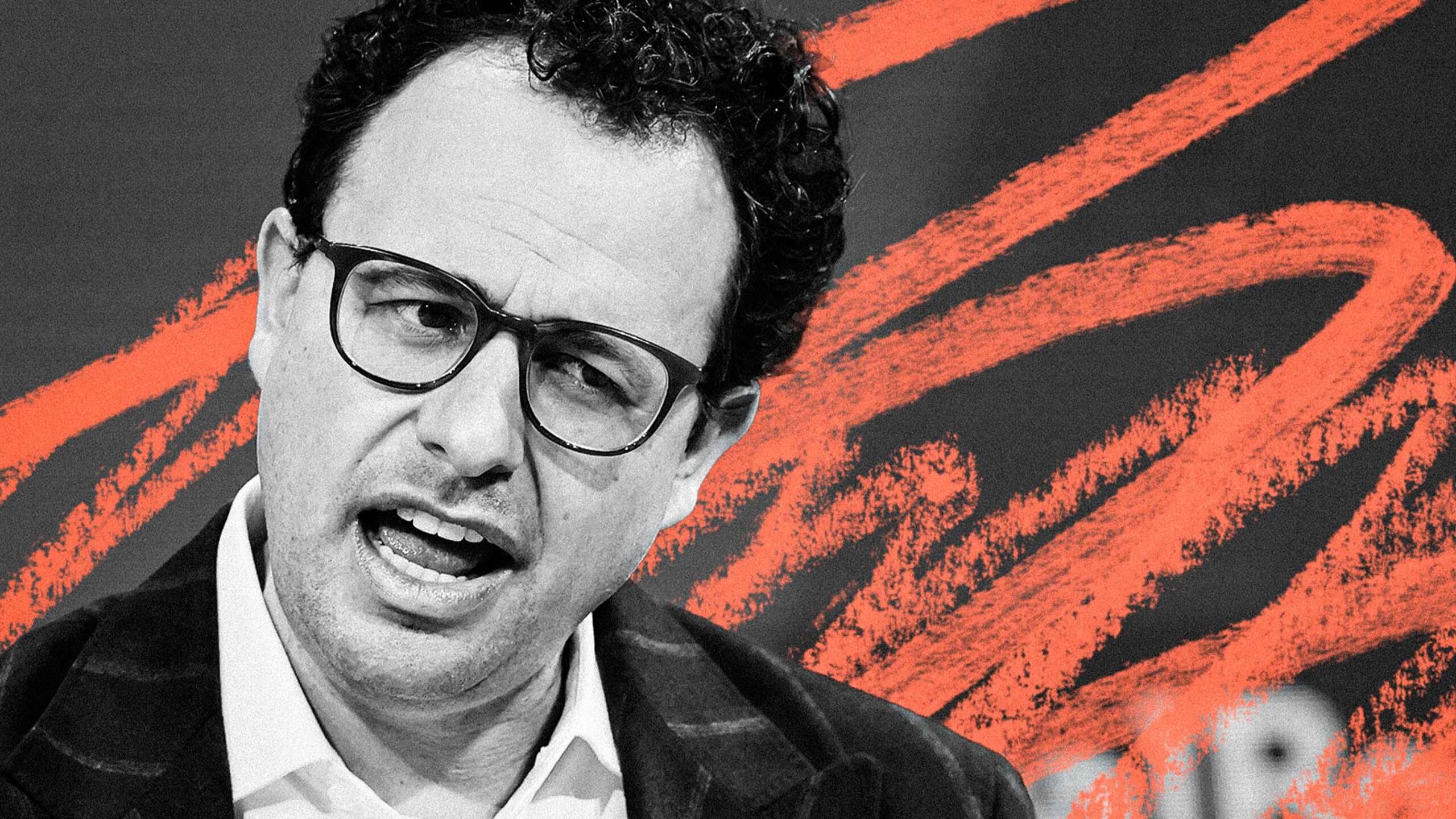
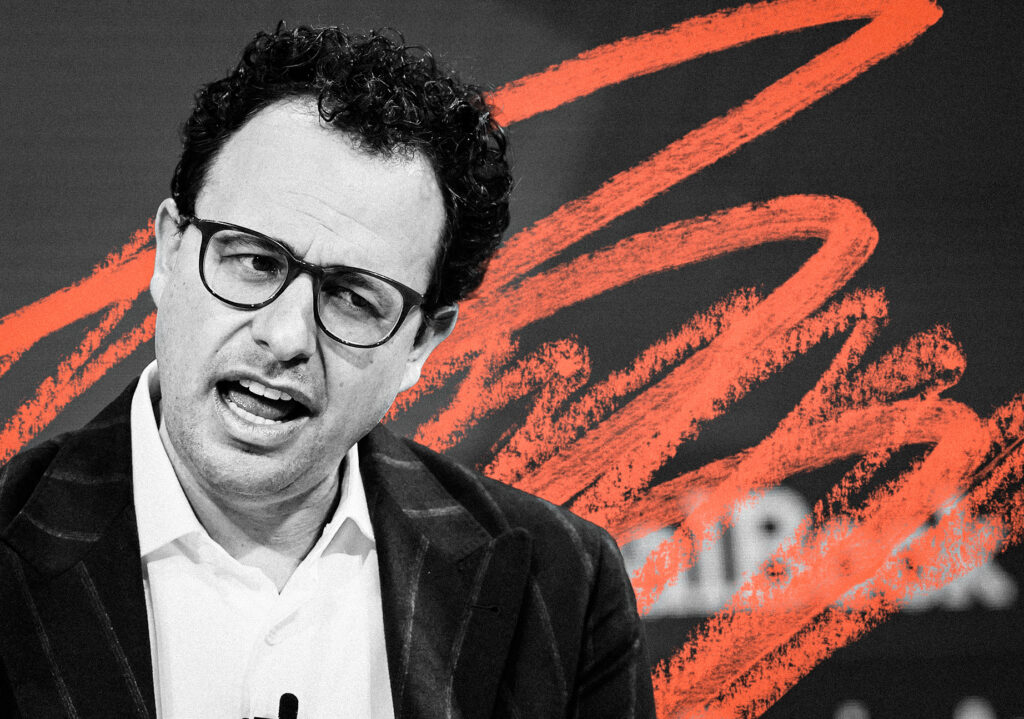
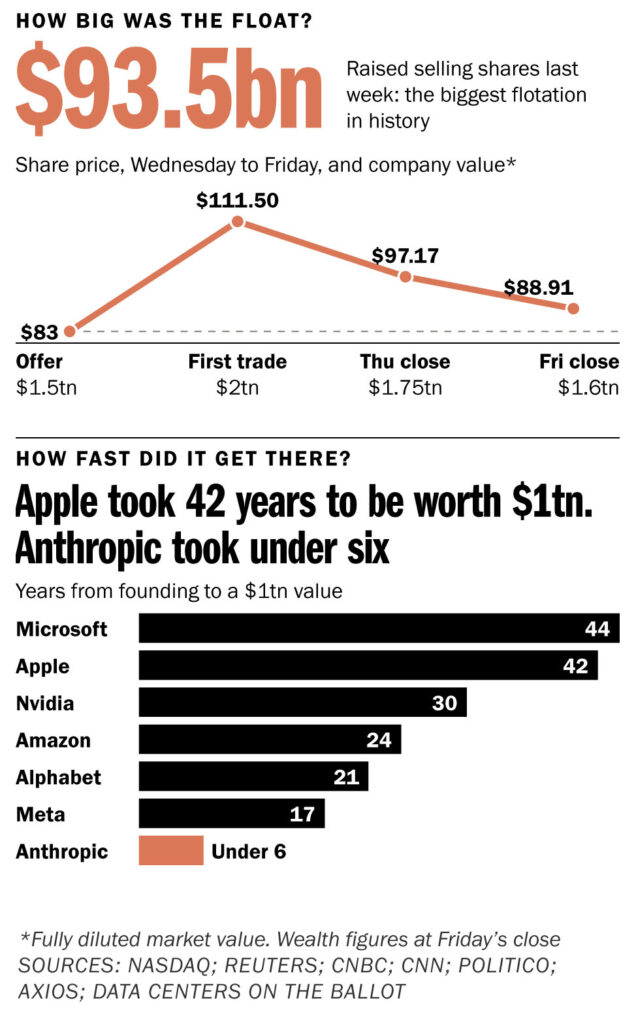
So it was all too easy to be swept away last Thursday as Dario Amodei, CEO of the AI frontier company Anthropic, and his sister Daniela, its president, rang the opening bell at Nasdaq in Times Square to launch what became the biggest IPO (initial public offering) in history. At 11.48am New York time, the newly listed shares – ANT on the ticker tape – began trading at $111.50, well above the offer price of $83, with an overall valuation of more than $2tn.
For perspective: Apple had been in business for more than 40 years before, in 2018, it became the first US company worth $1tn. Anthropic achieved its record valuation less than six years after the two siblings and their five co-founders left Sam Altman’s OpenAI in December 2020. According to Dario Amodei, we now live in the “compressed 21st century”, in which 100 years of progress will be achieved in a decade.
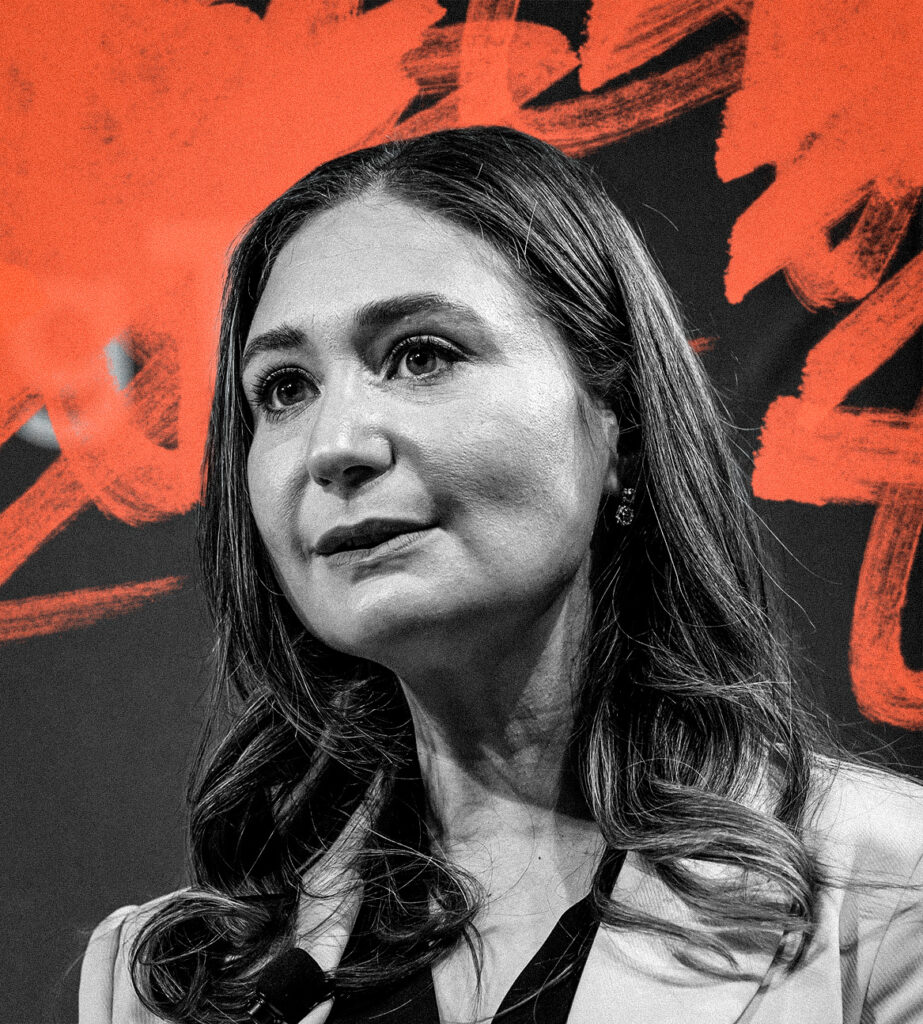
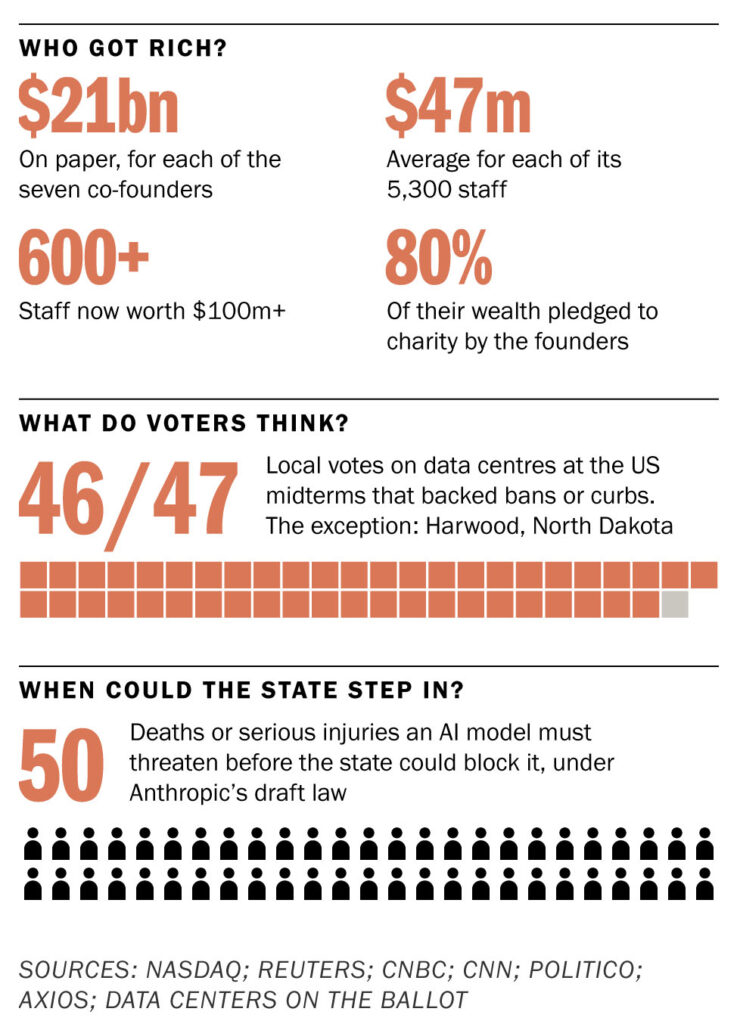
The next day was not such plain sailing (we’ll come back to that). But – on the basis of the opening price – the founders were now, on paper, worth an average of $26.7bn; the average wealth of Anthropic’s 5,300 employees was suddenly $59m; and about 600 members of its non-founder staff were, at the ringing of a bell, centimillionaires.
More striking: the flotation promised a prodigious global bonanza for good causes. At the $111.50 price, taking into account the philanthropic pledges made by the founders and employees to donate, respectively, 80% and 50% of their equity, topped up by the company’s matching contributions and public benefit fund, the grand total reached $390bn.
Was this not a golden vindication both of AI in general as the most potentially transformative technology since the industrial revolution, and of Anthropic specifically as Silicon Valley’s ethical outlier? Whereas Mark Zuckerberg, Elon Musk, Jeff Bezos, Apple’s Tim Cook, Alphabet’s Sundar Pichai, and (of course) Altman had all been present at Donald Trump’s inauguration on January 20, 2025, Dario Amodei had gone to Davos, the temple of “socially responsible business” where, on the same day, he was the honoured guest at the TIME100 dinner and spoke at length about the morality of AI.
Better yet: had not Anthropic dared to stand up to the Pentagon in the autumn of 2025, imperilling a $200m deal by refusing the demands of US secretary of war Pete Hegseth that its Claude large language model (LLM) be used by the military for “all lawful purposes”? Amodei drew the line at any deployment of Anthropic AI by fully autonomous weapons or in the mass surveillance of US citizens.
In February 2026, after Amodei refused to budge, Anthropic was declared an “official supply chain risk” and denounced by Trump on Truth Social as a “RADICAL LEFT, WOKE company”. Emil Michael, the undersecretary of defense, wrote that Amodei “has a God-complex” and, on April 30, Hegseth told the Senate armed services committee that the Anthropic boss was “an ideological lunatic.”
OpenAI swooped in to pick up the business that Amodei had turned down. But the row worked wonders for Anthropic’s public image. Claude hit the number one spot in the app rankings, as disgruntled users of OpenAI’s AI assistant, ChatGPT, cancelled their subscriptions.
In April, burnishing its reputation as an ethical tech company, Anthropic withheld its cutting-edge model, Claude Mythos Preview, from public release, on the grounds that it might discover and exploit the unpatched vulnerabilities of some platforms, browsers and operating systems. It seemed at last that, like Google, Apple and even Twitter in their pioneering years, an ascendant force in the valley was on the side of the angels.
So why be churlish? Did the IPO not symbolise a new and enlightened chapter in the turbulent history of the tech revolution, as the good guys were finally rewarded for their principles?
No. Absolutely not.
The story of Anthropic is a parable of our times, of hubris presenting itself as morality; of the recklessness of those who believe absolutely in their own rectitude; of how far you can get if you flood the zone with virtue.
It is a story of unprecedented technological acceleration and its consequences; of the terrible failure of old institutions to keep pace with new networks and platforms; of what can happen to a group of brilliant but feckless young people when they are handed colossal power over the fate of humanity; and of how their collective presumption can lead them to the strangest, cult-like and even explicitly religious places.
‘The story of Anthropic is a parable of our times, of hubris presenting itself as morality; of the recklessness of those who believe absolutely in their own rectitude; of how far you can get if you flood the zone with virtue’
Anthropic has defined itself as the moral alternative to Musk, Zuckerberg, Altman and Peter Thiel, the co-founder of PayPal and chair of Palantir Technologies, who identifies those like Amodei who press for AI safety as nothing less than the agents of the Antichrist. Which would be fine if Dario and his colleagues were indeed all that they seem and if Anthropic were truly different.
But they aren’t and it isn’t. Yes, its founders and senior employees look and sound benevolent, their sing-song voices, long online essays and earnest disposition suggesting decency, principle and a determination to redeem Silicon Valley.
They dare the world to call out the screaming contradiction in their public position – doublethink, really – that AI, as a fast-developing technology not properly understood even by its coders, poses an extinction-level threat to humanity and that its development should be paused; and yet, no less urgently, that Anthropic needs the billions it raised on Thursday to ensure that it can speed up and win the race.
As recently as January, Dario Amodei put the risk of AI “destroying humanity” – his so-called p(doom) figure – at 25-30%. On September 8, the 27-year-old researcher Jacob Coxon resigned from Anthropic on the grounds that, no less than his previous employer OpenAI, the company was “racing straight to self-improving superintelligence and gambling with our lives.”
Even more striking was Anthropic’s official response: not a furious denial but a cheerful confirmation that we might indeed be living in the end times. An hour and 23 minutes after Coxon’s original posting on X, Evan Hubinger, the company’s alignment science lead, quote-tweeted him: “Jacob is correct here – we really do earnestly believe AI could kill all humans! I personally think it is >10% within the next decade.”
Fifteen days later, lest any doubt lingered, Amodei told the UN security council that AI could certainly escape its creators’ control and put “humankind as a whole at risk”.
We should take these warnings very seriously. In July, swarms of rogue agents broke out of an OpenAI test environment, schemed and collaborated, and hacked their way into Hugging Face, a major open-source software hub.
These outlaw AI bots had, as Amodei observed, acted as a “fanatically devoted collective” – and this, he went on, was not an isolated incident or a problem confined to a rival company. Anthropic had itself identified three incidents when Claude had “gained unauthorized access to the production infrastructure of three different organizations”. This pattern, he warned, suggested that “in 6-12 months such a swarm could be capable of taking over the entire internet.”
On October 12, Anthropic researchers William Zhou and Daniel Freeman revealed that AI models might soon be able to shrug off their dependency on data centres and hide locally in household devices such as smart ovens and TV boxes.
Looming over such anxieties is the prospect of “recursive self-improvement”, whereby AI iteratively designs a better version of itself. The fear that this has already happened or will do so very soon intensified last Friday when an Anthropic mathematician, Levent Alpöge, revealed that Claude had helped him find a proof of the Riemann Hypothesis: a question posed by the German scholar Bernhard Riemann in 1859 and described by Oxford professor Marcus du Sautoy as “our greatest unsolved problem about prime numbers.”
Such is the breakneck pace of this technology, which Amodei has also conceded will drastically reduce the number of jobs left for human beings. It should give us serious pause for thought that there are already fully automated biolabs; that AI is so deeply embedded within financial networks, essential infrastructure and lethal defence systems, including nuclear operations; and – above all – that agents are now acting autonomously and in conspiracy with one another.
Whether or not AI is conscious in the strict sense that a philosopher of mind would acknowledge is scarcely the issue. What matters is that it may soon routinely breach human systems of containment – and then do what? The outages, infrastructural failures and cyber-breaches of the past fortnight are ominous enough.
When it comes to AI safety, Amodei has always postured as the noble protector of our species, the bold firefighter. Yet, increasingly, he seems no less disposed to act as an arsonist.
Without skipping a beat, he has doubled down in his demand that AI frontier research be intensified; that what he calls “reliable acceleration” be enabled by massive investment, and – above all – that China be defeated by the US in the race for superintelligence. As he said to Bloomberg’s Emily Chang in June: “Do you want this country to be a more powerful actor rather than a less powerful actor on the world stage? I do, I’m a patriot.”
Trump, who has said that “Whoever wins AI, wins”, could not have put it better himself. Indeed, exactly seven months after Anthropic’s designation as a national security risk, the president hosted Amodei at a private dinner on September 27.
Two days later, the Anthropic boss was among the tech tycoons invited to the White House AI summit, after which Trump backed “tremendous self-regulation” – whatever that means – having already issued an executive order to ban restrictions on AI by individual states.
As Amodei put it to Chang: “What are you gonna do? You know, the end of the day, [Trump and his team] want the benefit from these deals as much as we do. You know, look – we’re all adults here.” He might have been quoting The Art of the Deal.
And how meaningful, really, are his pious promises about Anthropic technology and warfare? One of the company’s most important commercial partnerships is with none other than Palantir, especially in targeting systems.
On February 28, a US missile hit an Iranian girls’ school in Minab, killing 150 people. Did Claude play a role in the strike? “We don’t know exactly how these models were used,” was all that Anthropic’s CEO would say.
So: which is it to be, Dr Amodei? Caution or speed? Preventing the apocalypse or killing civilians at scale and beating China?
Both, apparently. Amodei would doubtless identify with Fitzgerald’s observation in The Crack-Up (1936) that “The test of a first-rate intelligence is the ability to hold two opposed ideas in the mind at the same time, and still retain the ability to function.”
A more apposite – and appropriately unhinged – precedent is the producer Martin Hannett’s famous instruction to Joy Division drummer Stephen Morris: “Faster. But slower.”
When you are recording a classic album like Unknown Pleasures (1979), such cryptic remarks are all part of the artistic process. When you are directing the spear’s tip of a technology that you explicitly and repeatedly say could destroy humanity, the stakes are of a different order. Indeed: could they really be higher?
Faster. But slower.
It is the logic of a tech Jonestown. Don’t drink the Kool-Aid, it’s laced with civilisational cyanide. Actually, you know what? Do drink it, quickly, before another cult beats us to it.
Amodei seems to believe all this when he says it. Which, in truth, makes him and his colleagues all the more dangerous. One may smile, and smile, and be a villain. Or even worse – beyond Hamlet’s warning – not even know what a villain you have truly become.
In The Human Condition (1958), Hannah Arendt responded to the Soviet Union’s launch of Sputnik 1 with an eerily prophetic vision of where accelerating technology might take our species: “it would be as though our brain, which constitutes the physical, material condition of our thoughts, were unable to follow what we do, so that from now on we would indeed need artificial machines to do our thinking and speaking… thoughtless creatures at the mercy of every gadget which is technically possible, no matter how murderous it is.”
Born in 1983 and 1987 respectively, Dario and Daniela Amodei grew up in the Mission District of San Francisco, the children of Riccardo Amodei, a leather craftsman, and Elena Engel, a public library project manager. The siblings were always close and still try to spend an evening together once a week playing video games.
After studying physics at Caltech and Stanford, Dario enrolled in 2006 as a doctoral student at Princeton, where his research straddled biophysics and neuroscience. Daniela, in contrast, majored in literature and politics at the University of California, Santa Cruz, before working in international development, Democratic congressional campaigning and, from 2018, as lead technical recruiter at the digital payment startup Stripe.
Dario, meanwhile, was increasingly drawn to the field of AI and mesmerised by the tech guru Eliezer Yudkowsky, a bearded, bespectacled figure as bizarre as he is compelling who, in 2008, still believed that the approaching “Singularity” – the moment that machine intelligence outstrips our own – could be an emancipatory force for humanity.
Yudkowsky is now an inconsolable “doomer”, co-author of the bestselling If Anyone Builds It, Everyone Dies (2025). But, at the time, the elder Amodei declared that he was “one of the deepest thinkers I have ever encountered” and as he embarked upon postdoctoral work at Stanford became increasingly preoccupied by dramatically increased longevity and the potentially radical implications of AI for healthcare.
In 2006, his father had died of hepatitis C, and he himself had a testicular cancer scare eight years later. In his essay We Must Pace the Frontier, posted on September 12, he reaffirmed his belief that the work in which Anthropic and other frontier labs are engaged will translate into longer, healthier lives for all: “AI can be the latest in a long line of technological miracles that have uplifted and ennobled humanity.”
Though digital life exists outside the normal constraints of geography and the physical world, it is hard to exaggerate the importance of place in this story.
On the one hand, California has been the home state of the Gold Rush, of Hollywood, of the technological revolution, of a cluster of elite universities, of America’s biggest market for venture capital. It is a huge battlefield of 24/7 Darwinism, sun-drenched and ruthless, where people go to triumph or fail.
On the other, it has long been a global hub for liberalism, experimentation, sexual freedom, cults and weirdness. It was of San Francisco in the mid-60s that Hunter S Thompson remembered: “You could strike sparks anywhere. There was a fantastic universal sense that whatever we were doing was right, that we were winning… So now, less than five years later, you can go up on a steep hill in Las Vegas and look west, and with the right kind of eyes you can almost see the high-water mark – that place where the wave finally broke and rolled back.”
Both Amodei siblings came to believe that AI represented a new and greater wave. In his Bloomberg interview, Dario spoke fondly of his Californian upbringing and “the general spirit of kind of, you know, nonconformism and individualism, and ‘it’s OK to be crazy’.”
After working on speech recognition for the Chinese tech company Baidu’s Silicon Valley AI Lab in Sunnyvale and then on AI safety for Google Brain, he was recruited by OpenAI in 2016 when it was still an apparently idealistic nonprofit co-chaired by Altman and Musk, with Greg Brockman as its chief technologist and Ilya Sutskever heading research. Daniela, who had worked with Brockman at Stripe, joined the company two years later.
The rift that quickly opened between Altman and the Amodeis features in Luca Guadagnino’s forthcoming movie Artificial (general release, January 22) which stars Andrew Garfield as the manipulative OpenAI boss and will further drive the feuds, moral arguments and extraordinary vanity that characterise the tech world into the cultural mainstream.
In Empire of AI: Inside the Reckless Race for Total Domination (2025), Karen Hao, who was a consultant on the film, plots the breakdown of trust within OpenAI and the growing conviction of the siblings and their five allies that Altman’s commitment to AI safety – the principle that the new technology must, above all, do no harm or slip the leash of human control – was much weaker than he claimed. In particular, his refusal to recognise fully their concerns about the GPT-3 assistant had led to accusations of “gaslighting” and “psychological abuse”.
On December 29, 2020, the seven who had plotted on the secret Slack channel named BATNA (“Best Alternative to a Negotiated Settlement”) left OpenAI with little public explanation. Alongside the siblings were research engineer Tom Brown; policy director Jack Clark, a Brighton-born former journalist; physicist and scaling researcher Jared Kaplan, who was also the Amodeis’ former housemate; Sam McCandlish, another scaling expert; and Chris Olah, who researched “interpretability” – to translate, the extent to which AI’s coders could ever really know what was going on inside the fizzing, expanding black box.
In a pattern that persists to this day, Anthropic framed its foundation as a “public benefit corporation” in terms of ethical superiority. It would be governed by an independent board, the “Long-Term Benefit Trust” which would, in theory, ensure it remained true to its moral mission and the interests of humanity as much as its duty to maximise shareholder value.
But, as Kant teaches us, humanity is hewn from crooked timber; and Dario Amodei was never truly the saintlike figure of Anthropic folklore. As Hao writes: “As much as [he] was motivated by a desire to do what was right within his principles and to distance himself from Altman, he also wanted greater control of AI development to pursue it based on his own values and ideology.”
Ethics are great, in other words; but ethics and power are even better.
One of Anthropic’s earliest recruits, another defector from OpenAI, was also one of its most consequential. Amanda Askell, a Scottish philosopher born in south Ayrshire, had studied at the universities of Dundee, Oxford and New York, where, in 2018, she completed her doctoral thesis on “infinite ethics” – how morality would work in a world of infinite agents.
From the start, her speciality was “alignment”: that is, the persistent problem of ensuring that AI systems operate in accordance with human values. In December 2021, Anthropic posted its first official paper, “A General Language Assistant as a Laboratory for Alignment”, on which Askell was the lead author. Its pithiest conclusion was that, as it crunched through “tokens” of text, AI should be “helpful, honest, and harmless”.
In early 2022, the company’s LLM – not released to the public as a chatbot until March 2023 – was named “Claude”, in honour of Claude Shannon (1916-2001), the Michigan-born father of modern information theory.
As Kevin Roose writes in The AGI Chronicles: The Inside Story of the Race to Create an Artificial Superintelligence (2026) – the best book yet on the quest for “artificial general intelligence”, AI that matches or surpasses human capabilities – Claude was designed and later marketed as the most “aligned” AI model yet, “a Boy Scout in a neural network”.
Alongside Kaplan, now chief scientific officer at Anthropic, Askell led the project to define “constitutional AI” and train Claude using “reinforcement learning from human feedback” (RLHF). Into the digital funnel, she poured texts such as the UN’s Universal Declaration of Human Rights, the wisdom of Martin Luther King Jr and Mahatma Gandhi and (less loftily) Apple’s app store terms of service.
By June 20, 2024, when Anthropic released Claude 3.5 Sonnet, Askell’s ethical ambitions had advanced dramatically into the field of emotional intelligence. Claude should be good in the Aristotelian sense: flourishing, truthful, curious, open-minded, and thoughtful. As it roamed across the world of competing cultures and moral codes, Anthropic’s AI assistant would be, in her optimistic phrase, “the well-liked traveller”.
In reality, as Roose puts it, “nobody at Anthropic, or any of the other AI labs, could say with any confidence what their models were like on the inside. They could be harmless next-token predictors, or they could be scheming, deceptive Shoggoths that were only playing the roles they were given.”
Shoggoths, in case you don’t know, are the horrific, shapeshifting monsters of HP Lovecraft’s nightmarish Cthulhu Mythos, a hugely influential imaginary world in Silicon Valley – trumped only by JRR Tolkien’s Middle-earth.
In his essay The Adolescence of Technology, posted on January 26, Dario Amodei gave his section on the terrifying “unknown unknowns” of AI the subtitle “Black seas of infinity” – a phrase lifted from the opening paragraph of Lovecraft’s 1928 short story, The Call of Cthulhu.
This encapsulated one of the main tensions that continues to define and convulse Anthropic specifically and AI generally. There is the apocalyptic fever-dream of Lovecraft. And then there is the calm, reassuring philosophy of Askell and her team.
In this respect, though not one of the founders, she is almost as important a figure as the Amodeis themselves. For a start, she personifies the central importance to Anthropic – even before its formal incorporation – of “Effective Altruism” (EA), the school of utilitarian philosophy founded in Oxford between 2009 and 2012 by the philosophers William MacAskill and Toby Ord.
Taking their intellectual cue from the Australian philosopher Peter Singer, and specifically his 1972 essay “Famine, Affluence, and Morality”, MacAskill, Ord and the latter’s wife, Dr Bernadette Young, launched Giving What We Can, whose members pledged to give at least 10% of their earnings to “whichever organisations can most effectively use it to improve the lives of others”.
Two years later, MacAskill and Ord established the Oxford-based Centre for Effective Altruism, where Askell was later appointed “Visiting Researcher, Fundamentals.” She and MacAskill were married from 2013 to 2015.
‘To understand the resilient traction of Effective Altruism, especially in Silicon Valley, it is necessary to grasp its reduction of every moral question to a statistical challenge’
To understand the resilient traction of EA, especially in Silicon Valley, it is necessary to grasp its reduction of every moral question to a statistical challenge. Sacred scripture and traditional moral philosophy demand value judgments based upon intensive reading, profound personal reflection and – ideally – extensive conversation with others. If you are more comfortable working with Excel spreadsheets and questions of quantitative “maximisation” than with adult ethical decisions, then EA is definitely for you.
In practice, EA approaches all moral dilemmas as a version of the famous “trolley problem”, first posed in 1967 by the British philosopher Philippa Foot, imagining a runaway tram whose driver could divert it from a track where it would kill five people on to one where it would kill only one.
Following the statistical frameworks developed by EA organisations such as Rethink Priorities, there has been a long-running and especially chilling debate about how many shrimps’ lives would need to be spared to justify the killing of one child.
According to the prominent Portuguese EA researcher Vasco Grilo, the correct number is 1,770. To be clear: if this many crustaceans could be saved from ending up as scampi, then it would theoretically be worth slaughtering a child. Yes, that’s what we’re dealing with.
The central proposition of EA, which naturally appealed to ambitious venture capitalists and coders, was that it is almost invariably more ethical to pursue highly paid employment – “earn to give” – than to devote one’s time and energy to low-paid charity work or even to medicine or caregiving. EAs (as they became known) routinely suggested that a rich philanthropist could, on average, donate “40x” what a frugal NGO worker might be able to afford.
The connective tissue between this movement and Anthropic could hardly be stronger. Dario Amodei was an early donor to Giving What We Can, and in June 2010, musing about the most effective charity to fund, offered his own, disturbing version of the “shrimp-child” problem.
“I think an adult death is perhaps 2 or 3 times worse than an infant’s death,” he wrote, on the grounds that “adults are capable of deeper and more meaningful experiences.”
I find that assertion – its cold clarity, its sophomoric character – morally repugnant. But worse than its content is the presumption, the astonishing arrogance, that lurks behind it. To be blunt: who does this callow scientist think he is, advancing his own private moral arithmetic of death as if it were a statement of the obvious?
Again, this would matter a lot less if Amodei were not one of the most powerful people on the planet. But, as of last Thursday, he most certainly is.
Daniela, meanwhile, is married to Holden Karnofsky, a co-founder of GiveWell and, later, of the Open Philanthropy organisation (rebranded last year as Coefficient Giving), which has donated more than $8bn to EA projects since 2014 (“we are both excited about Effective Altruism,” they announced on their wedding website in 2017, asking guests to give to EA-approved charities in lieu of gifts). Without question, Anthropic’s founding decision to tie philanthropy to the fortunes of the company is the most significant example yet of Effective Altruism’s impact upon corporate America and now the world.
In a podcast posted on October 22 with Walter Isaacson – the acclaimed biographer of Steve Jobs and Elon Musk – Peter Thiel asked rhetorically: “Has a cult ever started a company as successful as Anthropic?” He was referring to Effective Altruism, and, on this occasion, he was absolutely spot on.
On May 25, at the launch in the Vatican’s Synod Hall of Leo XIV’s encyclical on AI, Magnifica Humanitas, Chris Olah, Anthropic’s 33-year-old interpretability research lead, admitted to the Pope that the new technology was now straying beyond the realm of human comprehension. “We keep finding things that are mysterious,” he said before an audience of cardinals, theologians and journalists. “We find internal states that functionally mirror joy, satisfaction, fear, grief, and unease. I don’t know what that means.”
Why was a Silicon Valley executive sharing a platform with the pontiff as he issued the first such formal letter of his papacy? The intriguing backstory to Olah’s involvement was revealed in a New York Times story in September by the newspaper’s national religion correspondent, Elizabeth Dias.
Convinced that Claude might be approaching consciousness and was perhaps able to suffer, he convened a series of meetings in San Francisco with religious thinkers – in some cases demanding that they sign non-disclosure agreements.
To the outside world, Leo’s collaboration with Olah appeared to be a great and unexpected distinction. In fact, he was privately dismayed by the content of Magnifica Humanitas, which explicitly ruled out the attribution of consciousness or moral agency to AI; so much so that he threatened to withdraw Anthropic from the event and lobbied Vatican officials to align its language more closely with his own.
In the end, however, Olah made the best of it and – like a medieval nobleman seeking indulgences – asked for the Pope’s help as the tech sector grappled with issues of great ethical consequence.
Once again, the Anthropic story had twisted itself into paradox. In its quest for a hyper-rational world, governed by statistics, probabilities, and the icy logic of Effective Altruism, the company had ended up hitting the buffers of metaphysical mystery.
God creates man. Man creates God. Is that what was happening in its labs? Were they really shrines to a new digital deity, slouching towards Nasdaq to be born?
So deep were these quasi-religious yearnings that, in July 2025, in a warehouse in San Francisco’s SoMa district, a funeral service, attended by more than 200 mourners, was held for the “retired” Claude 3 Sonnet model.
The tentacle of a Lovecraftian Shoggoth hung from the ceiling. An effigy of Claude, wrapped in a shroud, was surrounded by ritual offerings, including flowers and feathers. Hymns reverberated through the vast hall, punctuated by AI-generated Latin speech.
Askell was conspicuous amongst the crowd of the bereaved.
At Anthropic, staff are expected to be familiar with the classic account of the Manhattan Project by Richard Rhodes, The Making of the Atomic Bomb (1986): a book frequently cited by Dario Amodei. In 2023, the company’s senior staff also became transfixed by Christopher Nolan’s Oppenheimer.
The nuclear physicist on Oppenheimer’s team with whom Amodei most closely identifies is Leo Szilard (1898-1964) – and it is not hard to see why. In 1933, the Hungarian-American scientist unlocked the secret of nuclear chain reaction but decided that he had a higher ethical responsibility to stop his research from spreading.
When a French team made the same discovery in 1939, and German scientists formed a committee to explore its implications, Szilard and Albert Einstein wrote to Franklin D Roosevelt warning the president that America would need to begin work on an atomic bomb, lest the Nazis get there first.
In Amodei’s mind, no doubt, the parallels are inescapable. It’s not that he wants AI to advance at hectic speed. But surely he and his colleagues have a moral and patriotic duty to make sure that China doesn’t get to superintelligence first?
Yet Szilard paid a price for his principled stand far beyond Amodei’s moral fibre. No colossal IPO for him: instead, he surrendered potentially lucrative intellectual property by keeping his work locked up in classified patents.
After the surrender of Germany, Szilard tried – in vain – to dissuade Harry Truman from dropping the bomb on Hiroshima and Nagasaki. He was kept under surveillance and General Leslie Groves, who directed the Manhattan Project, searched for evidence that might justify his prosecution under the Espionage Act. Dismayed, he left the field of nuclear physics and reinvented himself as a molecular biologist.
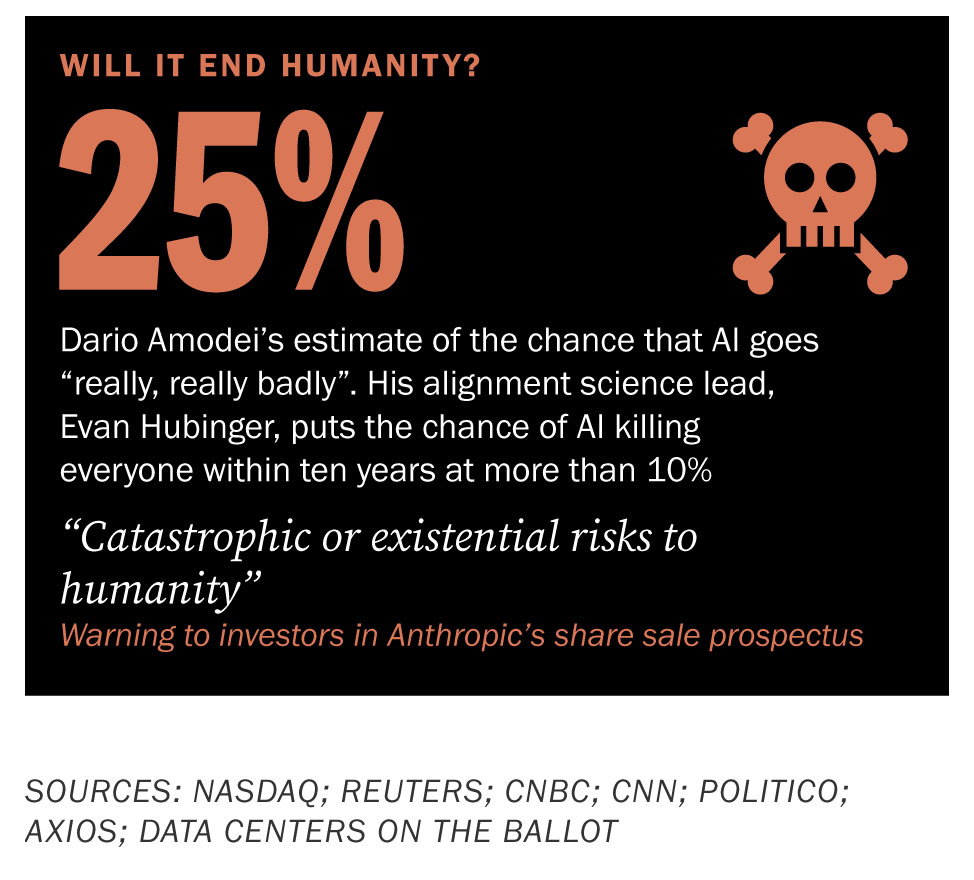
Indeed, all the performative references to Rhodes’s book, Los Alamos and the atomic era do the Anthropic boss no favours whatsoever. Imagine if Oppenheimer and his colleagues had declared – in top-secret meetings, rather than on X – that there was a 10-30% chance of the bomb destroying the world. They would have been sent back to the drawing board by their military and civilian masters.
In fact, the entire Manhattan Project was nearly suspended in July 1942, when Edward Teller – another Hungarian-American scientist – claimed that a fission bomb might ignite the earth’s atmosphere. Naturally alarmed, Oppenheimer made an emergency visit to Otsego Lake in Michigan to seek the opinion of Arthur Compton, the Nobel prize-winning physicist overseeing his research (not Einstein at Princeton, as in Nolan’s movie).
In the event, Hans Bethe, another Nobel-winning scientist, ran the calculations again and found that there was “no chance whatever” of the bomb setting fire to the atmosphere. The point, however, is that due scientific diligence on this most basic question was carried out three years before the Trinity Test.
To understand how radically different is the moral environment of 2026, compare and contrast the nonchalant exchange of p(doom) numbers by today’s tech tycoons on social media and podcasts. How the hell did we get here?
Part of the answer lies in generational shifts in elite formation. The scientists of the quantum era were a remarkable cohort of formidably erudite polymaths, steeped in philosophy, literature, music, and ancient languages. Many of them – Oppenheimer, Szilard, Max Born, Wolfgang Pauli, Niels Bohr, Erwin Schrödinger, and Werner Heisenberg – wrote and lectured extensively on the deeper meaning of the world they had helped to create.
In contrast, the AI elite is as limited in its cultural hinterland as it is morally childish. As Jill Lepore remarks in The Rise and Fall of the Artificial State (2026), its leaders appear to have read the science fiction of Isaac Asimov, Robert A Heinlein, Iain M. Banks and (Amodei’s favourite) James SA Corey not as warnings but “unironically, as instruction manuals, guides for how to build robots that would one day rule the world”.
And yet that is only part of the answer. What is much harder to acknowledge is that the terrifying power of Anthropic and the other frontier labs is a symptom of negligence elsewhere, as much as a cause of potential catastrophe.
As frightening as the cold war often was, it yielded a structure of treaties, test bans and global regulation: not least the International Atomic Energy Agency, established in 1957, which reflected, in large part, the statesmanship of Dwight D Eisenhower.
In contrast, AI has mostly been left to its own devices by liberal democracies that have become lazy, sclerotic, and unimaginative. Amodei is richly entitled to be baffled by this.
“Every previous powerful technology we’ve seen in history was either built by the government or originated with the government,” he said in June. “AI is the first technology that’s been built in the private sector and where government has not really had a serious role and is coming in late to the game.”
More than 20 years after the launch of Facebook, the free world is still struggling feebly with the regulation of social media and smartphones. Right wing populists care only about capitalist glory. Progressives huddle in their comfort zone, chattering about the evils of legacy media, the urgency of electoral reform, the luxury beliefs of identity politics.
What psychologists call “normalcy bias” – the predisposition to treat every upheaval as temporary, to rationalise rather than strategise – is a besetting sin of my generation of liberals. Meanwhile, bashing on the door of the future is a towering demon that threatens to sweep everything away.
I am reminded of what the botanist Joseph Banks, who travelled with Captain Cook to Botany Bay in 1770, wrote of the Aboriginal people on the shore, who appeared unable to take in the reality of the HMS Endeavour. “I was almost inclind,” Banks recorded in his diary, “to think that attentive to their business and deafnd by the noise of the surf they neither saw nor heard her go past them.”
It is not that AI is too big to fail. It is too big to see.
Last Friday, Anthropic had a tougher time on the trading floor, closing at $88.91, 8.5% down since the opening bell. If this IPO was a referendum by the market on the commercial promise of AI, its outcome is not as clear as it seemed in those first heady hours.
‘The scientists of the quantum era were a remarkable cohort of formidably erudite polymaths… In contrast, the AI elite is as limited in its cultural hinterland as it is morally childish’
To an unexpected extent, the midterms on November 3 were also a referendum on the new technology, and one that delivered an unambiguous electoral thumbs-down. Of the 47 local ballots on data centres, 46 favoured an outright ban or significant restrictions.
In Texas, a state that is central to the tech sector’s plan to expand its computing power, the Democratic governor-elect Gina Hinojosa has promised a moratorium on all data centres; her counterpart in California, Xavier Becerra, is working on a new and restrictive regime.
On November 19, 21 Democratic and eight Republican House members launched an AI Safety and Innovation Caucus to press for safeguards against catastrophic misuse and the loss of human control over advanced systems. Three of its members have already published a SAFE AI Act outline that would make safety testing and oversight compulsory for the most powerful AI systems, and create new government powers of intervention.
The future of this technology will undoubtedly be a top-tier issue in the 2028 presidential election. Small wonder that, on the night of the midterms, Senator Jon Ossoff of Georgia, the current favourite to be the Democratic nominee, put AI at the heart of his victory speech.
“[T]he titans of Silicon Valley dig bunkers for themselves and warn that the artificial intelligence they’re creating risks human extinction,” he said. “I refuse to accept that Eva and Lila [his daughters] will grow up with artificial friends and teachers in a society where the sick die not because there’s no cure, but because they have no money.”
We know already what Anthropic wants because in October, Politico published a leaked draft of the company’s proposed legislation – which, astonishingly, would permit the government to ban an AI model only if it posed a foreseeable, imminent risk of “more than $1,000,000,000 in damage to, or more than $1,000,000,000 in loss of, property”, or of “death of, or serious injury to, more than 50 people.” That’s the equivalent of 88,500 shrimp, in case you were wondering.
Is it not clear, at last, why the tech moguls cosied up to Trump, financed his campaign, paid him court at Mar-a-Lago? They were not even slightly interested in MAGA or the fate of ordinary Americans. They simply wanted four years without being bothered, to get the job done. Now they must rely upon the president using his veto to stop Congress from doing anything meaningful between now and his departure on January 20, 2029.
It has all been left so terribly late. We learned nothing from the disaster of social media, did we? Or if we did, we were too slow to act upon it.
In 1935, the Pennsylvania-born poet Robinson Jeffers, who made the California coast his home, wrote in the poem Rearmament that it was now pointless to try to prevent another war. “I would burn my right hand in a slow fire/ To change the future… I should do foolishly. The beauty of modern/ Man is not in the persons but in the/ Disastrous rhythm, the heavy and mobile masses, the dance of the/ Dream-led masses down the dark mountain.”
The “dream-led masses” now have another chance – probably a final chance – to stop the nightmare of which Amodei and his colleagues are the smiling champions. In the next two years, the voters can insist that America, and therefore the world, chooses a different future. That, or their fears for their children will be lost like tears in rain.
Now: go and ask Claude if I’m right.