Three years ago, a simple question became a viral meme: how often do men think about the Roman empire? And the answer was: pretty often. Indeed, some men seem to dream daily of Octavian’s victory at Actium, of Marcus Aurelius in his imperial field tent composing the Meditations, or of standing sentry at Vindolanda, beneath the rising line of Hadrian’s Wall.
In my case, however, it is the Middle Ages to which my imagination is captive. It’s all in a day’s work to find myself suddenly distracted by the coronation of Charlemagne in Rome in AD800; or by Saladin crushing the Crusader army at Hattin in 1187; or by the Cathar heretics of Montaillou; or by the enduring enigma of the Knights Templar.
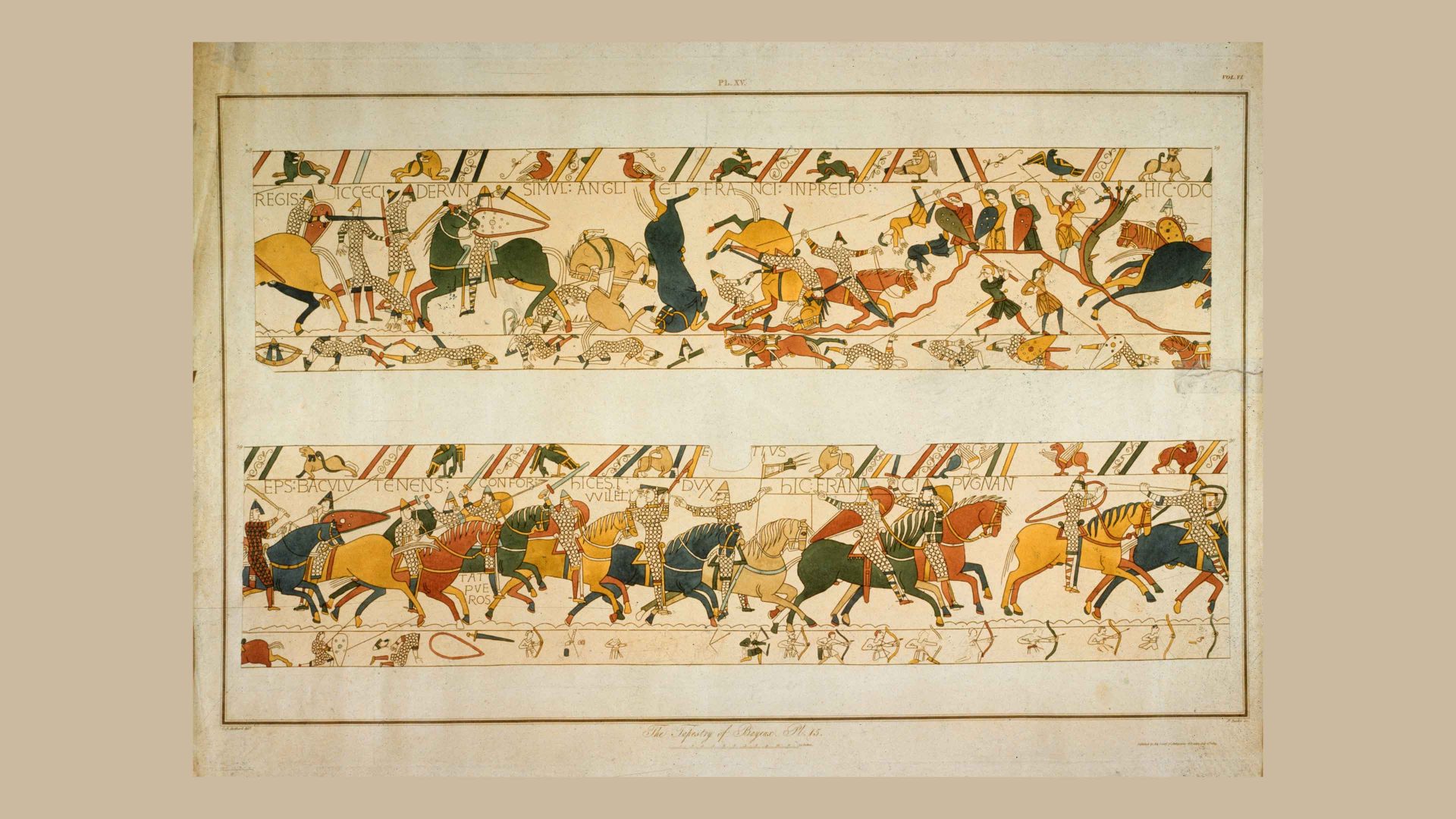
So you may imagine how thrilling I find the prospect of the Bayeux Tapestry exhibition at the British Museum, which opens on September 10 and runs until July 11. And I am clearly not alone.
When the first block of tickets went on sale on July 1, the online queue surged to 80,000, generating about £2.5m – the biggest single day for sales in the museum’s 273-year history. If you haven’t booked yet, the next tranche of timed admission slots will be released on October 21.
It is hard to exaggerate the cultural significance and potential impact of this historic temporary transfer from Le Musée de la Tapisserie de Bayeux as it undergoes refurbishment. As Philippe Bélaval, Emmanuel Macron’s envoy for the arrangement has said: “Such a loan will only happen once and never again.”
Most scholars of the Anglo-Norman era agree that the 68-metre-long visual chronicle of the struggle for the English throne, culminating in William of Normandy’s defeat of Harold Godwinson at Hastings in 1066, was created by highly skilled embroiderers working in southern England, probably in the vicinity of the great libraries of Canterbury. On which basis, this is the first time in nearly 1,000 years that it has returned to these shores.
Suggested Reading

The Democrats’ secret plan to elect JD Vance
What is the power of the tapestry? Probably commissioned by William’s half-brother Bishop Odo of Bayeux, perhaps for the consecration of his cathedral in 1077, it has long cast a historic spell, revered and coveted by the mighty for its talismanic force.
In 1803, Napoleon moved the treasure from Bayeux to Paris to be displayed in the Louvre – presumably to rally public support for his planned invasion of England. Heinrich Himmler, concluding dementedly that the Normans’ partially Viking ancestry meant they were exemplars of Aryan exceptionalism, set up a team (the Sonderauftrag Bayeux) within his pseudoscientific Germanic heritage unit, the Ahnenerbe, to study the tapestry as a precious record of racial supremacy.
In August 1944, as the liberation of Paris became inevitable, the Reichsführer-SS sent an urgent coded message ordering that the tapestry be despatched immediately to Germany. But the French resistance thwarted his plan, saving the artefact from an uncertain fate as the Third Reich ended in conflagration.
The tapestry, which will be displayed flat for the first time, has a much less toxic but still powerful grip upon the English imagination: its aesthetic and its storyboard style, relished and replicated by the antiquarian revivalists of the 19th century, has long been instantly recognisable and often mimicked.
When a Game of Thrones Tapestry was first exhibited in 2017, its iconographic ancestry needed no explanation. The following year, the Sun made use of the same cultural shorthand to mark Brexit in its “Bye-EU” Tapestry.
Yet one of the perils of such familiarity is anachronistic projection and a tendency to underestimate the radical strangeness of the Middle Ages. There is a reason why professional medievalists often mine the work of great anthropologists such as Max Gluckman, Clifford Geertz and Mary Douglas: they recognise that the societies they study were far more distant from our own in assumptions, rituals and habits of mind than is frequently imagined.
A prime example: the tapestry has often been approached as the birth certificate of the English nation. In his History of England (1926), for example, GM Trevelyan wrote explicitly of “the fate of the English race itself after Hastings, fallen to rise nobler, trodden under foot only to be trodden into shape.”
This interpretation was sufficiently entrenched by 1930 for it to be lampooned by WC Sellar and RJ Yeatman in 1066 and All That. The Normans’ victory was, on balance, “a Good Thing, as from this time onwards England stopped being conquered and thus was able to become top nation.”
So it was no accident that Nigel Farage wore a Bayeux Tapestry tie during the 2014 Rochester and Strood by-election. The problem with this nationalist lens is that it completely misrepresents the dynamics of power, culture, lineage and trade in medieval Europe.
Yes, the Normans’ suppression of the indigenous Anglo-Saxons was brutal even by the standards of the time – most horrifically so in the Harrying of the North (1069-70). Paul Kingsnorth’s wonderful Booker-longlisted novel The Wake (2014) imagines, in a “shadow tongue” version of Old English, the freeman Buccmaster leading a guerrilla resistance of “grene men” tired of being treated as “fuccan swine in our own land”.
But William’s triumph did not mark the victory of one nation over another, Year Zero for what we now call England, so much as the decisive moment in a four-way succession struggle, in which the other three contenders were Harold; Harald Hardrada of Norway; and Edgar Ætheling, who as grandson of Edmund Ironside and great-nephew of Edward the Confessor (both kings) had the best technical claim to the throne.
Indeed, the world that spawned the tapestry was much more European, interdependent, polycentric and entangled than proto-nationalist. As the great cultural historian of medieval mentalities Jacques Le Goff writes in The Birth of Europe (2005): “what served as frontiers in the Middle Ages up until the eventual creation of states were zones that constituted meeting places, where plenty of clashes occurred, but also many trading deals and much intermingling.”
Bear this in mind when – as will surely happen – the display of the tapestry triggers a fresh round of online culture wars. Instead, look through this portal-in-time for the symbolic universe and ancestral cosmology encoded in its linen and thread.
The laziest caricature of the Middle Ages presents them as a brutish, cruel and regressive interlude between classical antiquity and the Italian Renaissance. This is plainly an absurd verdict upon an era that bequeathed to us (for instance) Chartres cathedral, consecrated in 1260; the Summa Theologica (1274) of St Thomas Aquinas; Giotto’s Arena Chapel frescoes (c. 1303-05); and Dante’s Divine Comedy (1321).
In The Discarded Image, published posthumously in 1964, CS Lewis sought a reprieve for what he called the “Medieval Model”: a majestic synthesis of Christian theology, classical philosophy, mythology, astronomy, and poetry. “At his most characteristic,” he wrote, “medieval man was not a dreamer nor a wanderer. He was an organiser, a codifier, a builder of systems.”
In 1964 – the year of A Hard Day’s Night, the Rolling Stones’ first album, Stanley Kubrick’s Dr Strangelove, and Joe Orton’s Entertaining Mr Sloane – Lewis’s plangent defence of the medieval mind might have seemed fogeyish, irrelevant, even reactionary.
In 2026, the cultural landscape is very different and, though the Middle Ages remains a world apart, its maps of meaning have also become newly legible and often surprisingly resonant in our dislocated, fragmented age, with its yearning for belonging, anchored identities and coherent narratives.
Take the tapestry’s principal moral theme, which is Harold’s apparent perjury: in Normandy, he swears allegiance to William and then, after Edward the Confessor’s death, seizes the throne in violation of his oath. What matters profoundly is that this is not merely a breach of contract between two medieval powerbrokers; it is an offence against the sacred order because, as the embroiderers show, Harold makes his pledge upon two sacred reliquaries. When he breaks this promise, he effectively hands divine sanction to William’s act of conquest.
Suggested Reading
Nolan’s true message? When reading dies, so does civilisation
Another world – remote, superstitious, irrelevant to our own? Perhaps not. In August, the Kremlin ordered the despatch of holy relics of the Orthodox saint, Dmitry Donskoy, the 14th-century Grand Prince of Moscow, to the Ukrainian front line – there to ward off AI-powered drones and Storm Shadow cruise missiles.
Visitors to the British Museum will behold scenes saturated in the sacred: Harold and his knights stop at the church at Bosham before setting sail for Normandy; the hand of God is depicted consecrating Westminster Abbey; in their encampment at Hastings, a feast for William and his lieutenants, stitched to resemble the Last Supper, is blessed by Bishop Odo; when William is told that Harold is approaching, he is holding a cross-bearing banner traditionally identified as a gift from Pope Alexander II.
The modern reflex, once again, is to see all this as intriguing but culturally obsolete. Yet we live in an age when pilgrimage is once again booming, most spectacularly in the case of the Camino de Santiago in Spain. In 1984, only 423 pilgrims officially completed the sacred 480-mile journey from Saint-Jean-Pied-de-Port in the French Pyrenees to the Cathedral of Santiago de Compostela in Galicia. By 2025, the annual total had passed 530,000.
The more rigorous varieties of Christianity – especially Orthodoxy and traditional Catholicism – are enjoying an unexpected surge. Religious apocalypticism and demonology have returned to the mainstream with a vengeance.
Meanwhile, the value of the global astrology market is forecast to grow from $12.8bn in 2021 to $22.8bn by 2031. One of the tapestry’s most famous panels portrays Harold being crowned – as Halley’s comet scorches above him, a terrible omen of what is to come. “ISTI MIRANT STELLA” reads the caption: “These men marvel at the star.” Are those who will behold this scene at the British Museum truly so different?
Lewis was quite explicit that he did not hope for a return to the medieval era. He was simply warning – presciently, as it transpired – of the loneliness of a world where “a man today… feels himself confronted with a reality whose significance he cannot know, or a reality that has no significance; or even a reality such that the very question whether it has meaning is itself a meaningless question.”
Historians (or their LLM successors) may yet record that modernity was the true interlude: between the Middle Ages and the hypermodern age of AI, transhumanism, haptics and digital disembodiment.
As Marc Andreessen, the tech venture capitalist, said in 2024: “Medieval people were psychologically better prepared for the era ahead of us with AI, and robots, and drones everywhere than we are.”
Which is true. The men and (tiny number of) women portrayed in the tapestry would have found the apparent magic of AI less metaphysically disruptive than we do. In Andreessen’s words: “The medievals would have said: ‘Oh, it’s just another spirit.’”
Once more, we find ourselves in the borderlands between the rational and the irrational, between science and enchantment. Peering down at the ancient linen, we shall behold a world remote from our own – yet whispering thousand-year-old messages that haunt us anew.