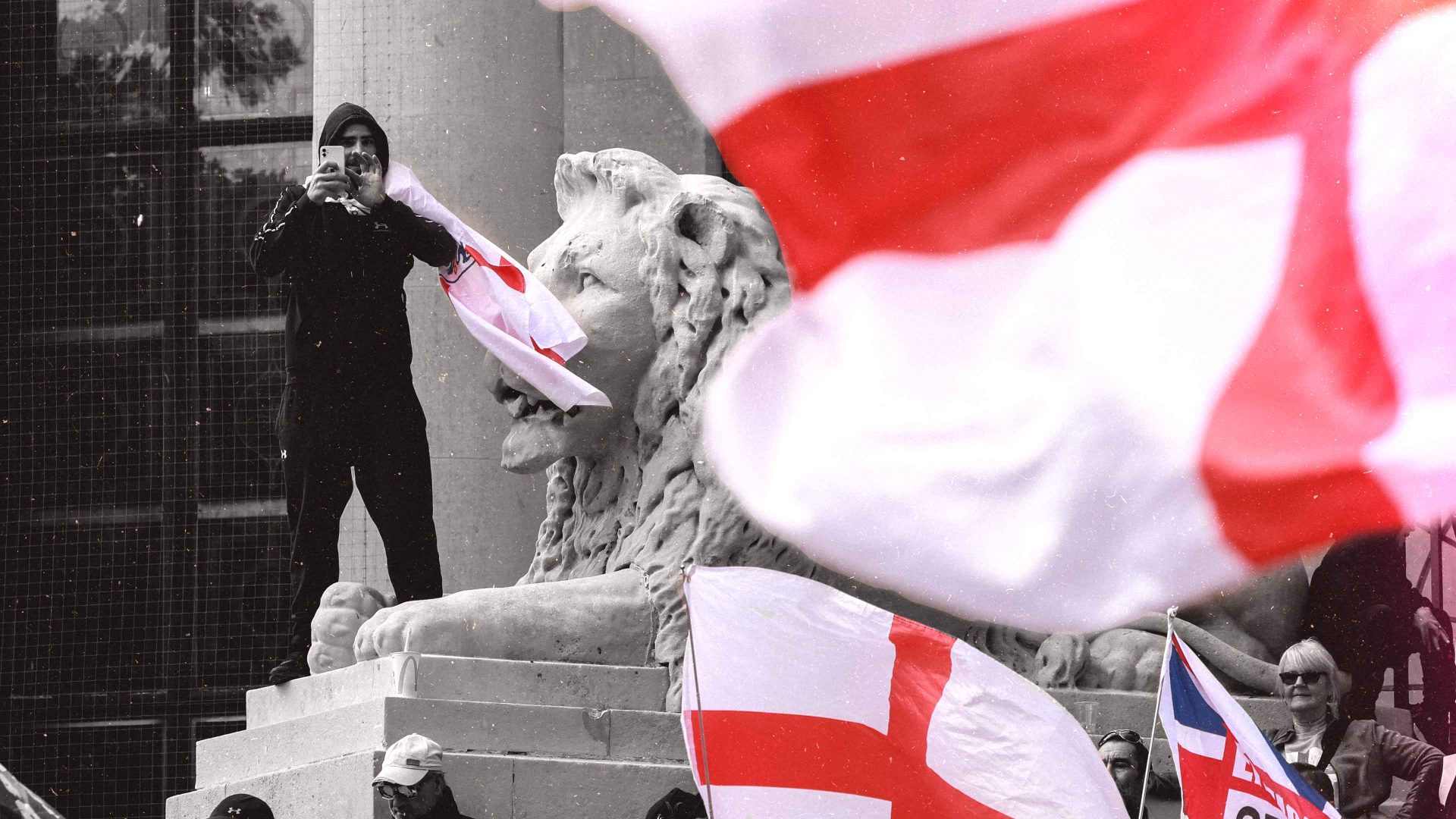
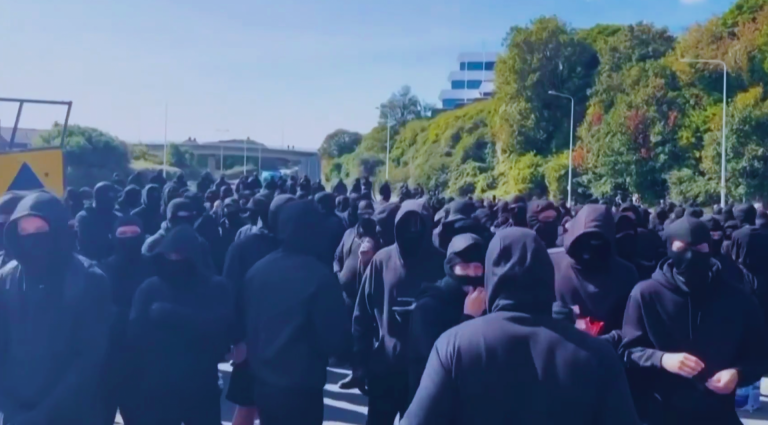
On this much all reasonable people can surely agree: we cannot have black-uniformed mobs threatening to blockade port towns, or anywhere else for that matter. We just can’t.
So if Andy Burnham decides that new measures are required to thwart the mobile guerrilla campaign of Patriot Platform, the far-right anti-migrant group led by Daniel Thomas, AKA Danny Tommo, he should take them.
You will struggle to find a more consistent supporter of the right to protest than me. But the sustainability of rights depends upon a clear distinction between healthily dissonant pluralism and Hobbesian disorder.
So, following the protests at Dover and Portsmouth on September 5 and 6 respectively, home secretary Shabana Mahmood was quite right last Thursday to urge senior police officers to make “full use” of their powers to deter these proto militias that have been acting with “obvious malign intent”.
According to a Guardian investigation posted on Saturday, at least 28 anti-migrant vigilante groups have formed in the past 18 months – and that tally includes only those that have actually “taken the law into [their] own hands in the name of opposing migrants or asylum seekers.” This can no longer be dismissed as an occasional flare-up of drunken hooliganism; it is an organised, networked, increasingly consequential movement.
Yes, Tommo is a thug who spent two years in prison for attempted kidnapping. But he also served as a tank driver in the King’s Royal Hussars. As a former bodyguard to his mentor Tommy Robinson and now one of his most trusted lieutenants, he has clearly been developing new forms of operational discipline and digital mobilisation, as was evident from his (undetected) flash deployment of hundreds of men from all over the country. Contempt for his bigotry should not blind us to his abilities. This was real tradecraft.
What raw nerve is he seeking to strike? It remains baffling to many that the undoubtedly sharp decline in the number of boat crossings is absolutely not taking the heat out of the issue. Which shows, in turn, how little has been learned in the decade since the Remain campaign confused a fusillade of statistics for a persuasive narrative.
By now, every progressive should have taken on board the painful but indisputable lesson that you cannot address political anger by throwing facts at the problem. On the night of the Portsmouth protest, BBC News posted an elegant graphic illustrating the marked reduction in small boat crossings.
Meanwhile, in Portsmouth, Alex Whyte, sister of Rhiannon Whyte, the asylum hotel worker who was stabbed 27 times in October 2024 by a Sudanese national in Walsall, was on-site at the protests, streamed live on YouTube, praising the “patriots”. Which was likely to have more impact?
Progressives have long accorded special authority to “lived experience”. So they really ought by now to have grasped the complex dynamics of what political scientists call “issue salience” and “experiential intensity”. In their 2019 UC Berkeley paper The Muted Consequences of Correct Information about Immigration, Daniel J Hopkins, John Sides and Jack Citrin presented comprehensive research to demonstrate that “providing accurate information does little to affect attitudes toward immigration. This is true even when people’s misperceptions are explicitly corrected.”
Their key finding was that “attitudes toward immigration may be largely symbolic in nature… and therefore grounded in stable psychological predispositions that enable people to resist information that challenges their existing beliefs.”
The foot soldiers of Patriot Platform are not waiting for a single number on a metaphorical score board to tick down to an acceptable level. They are responding to a deeply ingrained cluster of prejudices and convictions: a sense of siege, a belief in the poisonous “great replacement theory”, a primordial fear that the boats are a marine taxi service for sexual predators, and, increasingly, a demotic Christian nationalism.
In their worldview, the arrival of the dinghies is a proxy for a perceived collapse in national cohesion; a sense that they are ignored, despised by the liberal elite, and denied a fair shake in life; and, most alarmingly, a complete breakdown in their belief that conventional politics can change anything.
“Christ is King!” they bellow. “We keep our morals, our Christian faith and our integrity at the front of every move we make,” Tommo posted on X on September 7. Cynical religious cosplay or sincere faith? The problem with almost any appeal to the sacred is that, in the absence of windows into men’s souls, it is impossible to assess its authenticity.
Suggested Reading

The right wing mob’s dirty little secret
It is some consolation that the nascent militia movement in this country is not yet remotely comparable to the American far-right ecosystem of Proud Boys, Oath Keepers and Three Percenters that formed the vanguard of the January 6 insurrection. Most importantly, we have no counterpart to the second amendment: “A well regulated Militia, being necessary to the security of a free State, the right of the people to keep and bear Arms, shall not be infringed.”
That said, there is a deeper tradition than is usually acknowledged of militia-yeomanry in this country – a history recounted in Ian FW Beckett’s The Amateur Military Tradition 1558-1945 (1991). As the author notes, “their most enduring raison d’être was the threat to stability posed by foreign invasion, internal disorder or both.” Subconsciously or otherwise, Tommo draws upon this folkloric English legacy in mustering a new force against what he (falsely, but with resonance) calls an “invasion” of illegal migrants.
I do not think, in any case, that the US is the principal model he is emulating. In June, he travelled to Northern Ireland during the anti-migrant riots that began in Ballymena and spread throughout the province and “came away inspired”. Many of the “Belfast lads” he lionises are historically linked to loyalist groups such as the Ulster Volunteer Force and Ulster Defence Association.
The wearing of the black balaclava has long been a visual signature for paramilitaries in Northern Ireland across the sectarian divide. Now it has been adopted by anti-migrant cadres on the mainland; what Jonathan Hall KC, the independent reviewer of terrorism legislation, described on BBC Newsnight last week as a “paramilitary vibe”. This connection across the Irish Sea is one to monitor with the utmost vigilance.
No less significant will be the precise role that groups like Patriot Platform – still in beta mode – come to occupy in political discourse. One of the most striking moments at the Portsmouth protest was Tommo’s angry speech to Hampshire and Isle of Wight police officers, which followed a well-established and disturbing page in the paramilitary playbook.
“Your grandfathers, June 6, 1944, invaded the beaches of Normandy to protect your grandparents from the invasion by the Nazis and now you are part of the invasion of our own country. You should put all your gear down… Now we’ve got another demographic of men coming into our country and raping and sexually assaulting children. Have some fucking balls. It’s not worth the two grand you’re getting a month.”
Ironically, this was precisely the pressure exerted by the veteran Freikorps – the precursors to the Nazi SA and Brownshirts – upon the Reichswehr, the regular armed forces of the Weimar Republic. A crucial staging-post on the road to the Third Reich was the infamous refusal of General Hans von Seeckt to deploy his troops against the mutinous Marinebrigade Ehrhardt during the Kapp Putsch of March 1920: “Reichswehr schießt nicht auf Reichswehr” (“Reichswehr does not fire on Reichswehr”).
Tommo was invoking a similar, imagined solidarity – and failing miserably. The police officers at Portsmouth were visibly unimpressed by his pound shop St Crispin’s Day speech.
Of course, all such tactics look absurd – until they don’t. The Proud Boys were a joke drinking club for overweight chauvinists in Fred Perry shirts until they became a dangerous armed militia.
At present, there is little evidence of systematic infiltration by the far right of the police, UK Border Force or veterans’ groups: only isolated cases such as Benjamin Hannam, a member of National Action, the proscribed neo-Nazi organisation, who in 2021 became the first serving British police officer convicted of a terrorism offence.
Suggested Reading

Nigel Farage and the politics of murder
But Tommo’s unheeded plea to the police disclosed one of the far right’s latest ambitions: which is to seek support from within its ranks and (perhaps) the armed services. To be clear, there is no evidence of a response to the plaintive appeals of this extremely online jailbird. But it is, at minimum, useful to know what the ethnonationalists in the field are thinking and planning.
In hypermodern politics, movements prosper when each part of the whole understands instinctively its particular function and sticks to it rigorously. When Robinson stood as a candidate for the European Parliament in 2019, he was utterly humiliated, gaining only 2.2% of the vote. He has not repeated the error, focusing instead – like Tommo – upon social media and street level activism.
After the £72m donated to Nigel Farage in less than 48 hours by two crypto billionaires, it is wildly premature to write the political obituary of the Reform UK leader. But as he faces police questioning over the party’s finances, investigations by parliamentary standards commissioner and the Electoral Commission, and the dismal prospect of another by-election in Clacton, there are signs that he is starting to lose the dressing room.
In an interview with the BBC’s Laura Kuenssberg, Farage was categorical that “I deplore” the action in Dover, which he described as “wrong at every level”. In sharp contrast, his party chairman, Lee Anderson hailed the “decent patriotic Brits who’ve had enough”, while Suella Braverman (who finished sixth in the 2022 Tory leadership contest) is now clearly on manoeuvres for the top job in her new party and has aligned herself with the protestors who are “angry, scared and feel like this government is actively trying to destroy the country. Enough is enough.”
This is a hugely divisive challenge for Reform. In 2018, Farage resigned live on his LBC show from the UK independence Party because of the advisory role that the then leader Gerard Batten had given to Robinson. He has long presented himself as a one-man firewall against militant nativism. “I’ve done more to drive the far right out of British politics than anybody else alive,” he claimed during the 2024 general election campaign.
But now – alarmed, no doubt, by his dire summer – some of his colleagues are embracing a quite different strategy; one that interprets Patriot Platform as the spear’s tip of a much larger, mostly silent constituency.
It is as though they have swallowed whole G.K. Chesterton’s famous poem, “The Secret People” (1907) and its menacing refrain that “we are the people of England; and we have not spoken yet.” It is as though they expect that silence to be broken soon.
What is certain is that the Dover and Portsmouth protests represent something new, kinetic and unsettling. They also drew attention to the fact that Andy Burnham has yet to speak at any length on the matter of immigration, border control and integration – issues to which he devoted only two boilerplate paragraphs in his statement to the Commons on September 1.
Over to you, prime minister.
 Most popular

Emily Maitlis’s diary: As I was saying to George Clooney just the other day…

History says Polanski is going to win the St Pancras by-election


The uncomfortable truth about Ariana Grande

BORN IN THE FIRES OF 9/11