
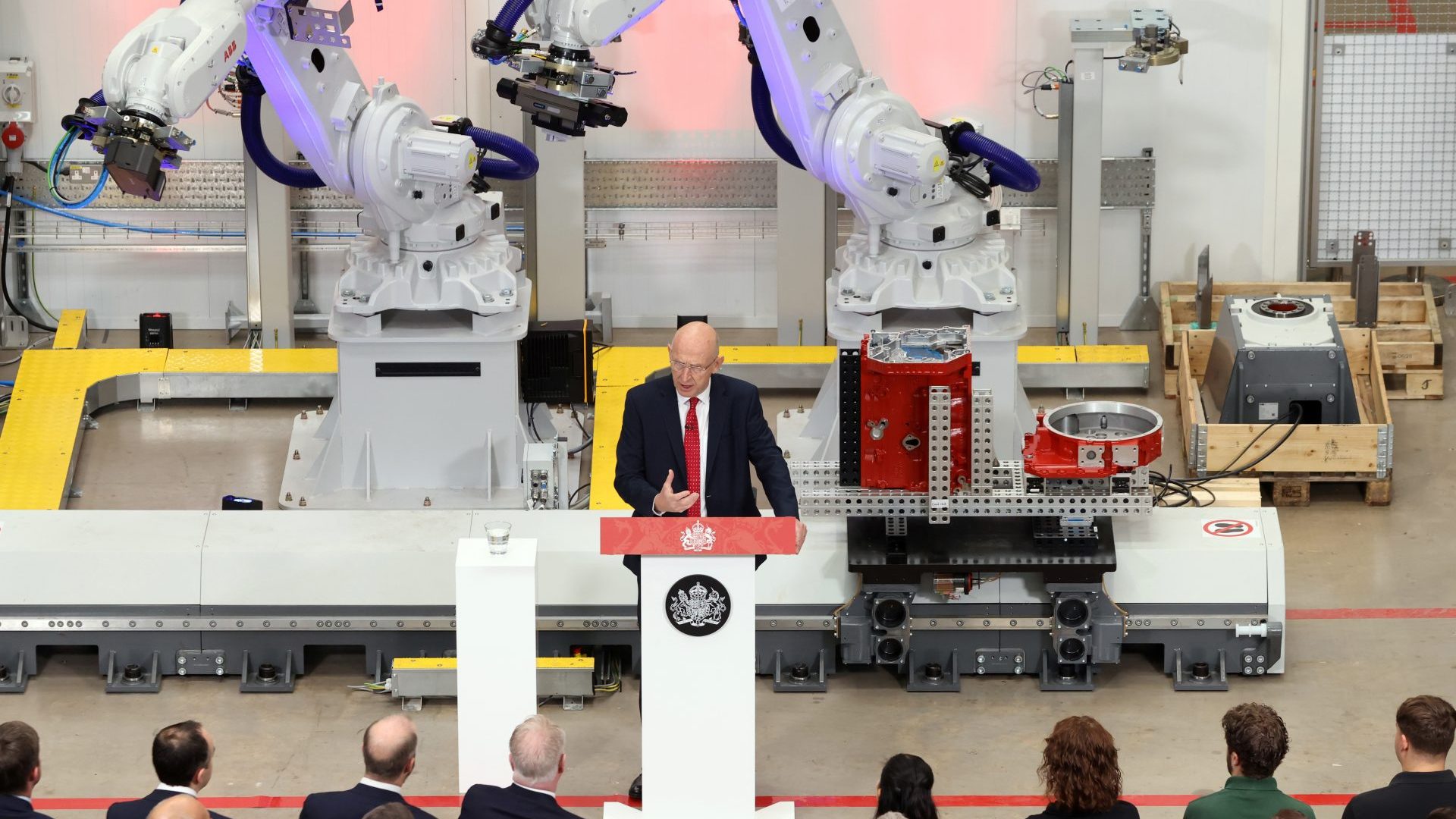
3,572 words. That’s the length of the much-trailed “Growth Speech”, delivered in the West Midlands this week by the chancellor John Healey.
For context, that’s about 300 words less than The Communist Manifesto, about 500 more than the French Declaration of the Rights of Man and of the Citizen, and almost exactly the same as the standard English translation of Franz Kafka’s The Metamorphosis.
Healey’s speech is unlikely to be studied for as long as any of those, or indeed be remembered much beyond the day on which he gave it. But what’s interesting is what wasn’t in it. Because, in a speech intended to address what the UK needs to do to inject urgently-needed growth into its economy, the chancellor did not once mention the very glaring elephant in the room.
The word “Europe” was uttered once in the speech, in the sentence: “The UK is home to nearly half of the most innovative companies in Europe”. The EU was not mentioned once, nor was the word “Brexit” uttered.
In that, as in so many ways, Healey’s speech could have been given by Rachel Reeves, which makes it even more curious that Andy Burnham felt it necessary to prematurely terminate her political career. Healey’s message was essentially that growth was at the heart of the government’s agenda, but not at the expense of upsetting the many people who voted to leave the EU a decade ago and who have since died.
As Naomi Smith, chief executive of Best for Britain, said immediately following the speech: “The best way to write the next chapter of Britain’s growth story is through EU membership. It is the route that will remove restrictive trade barriers and deliver transformational growth in every region and nation of the UK, worth £873m a year for the West Midlands alone.
“The chancellor’s optimism and his eagerness to turn the corner on a decade of stagnation and short-term growth spurts has to begin with a stated intention to join the EU, because that is the only long-term plan capable of delivering real change.”
Worryingly, though, Healey’s unwillingness even to mention the UK’s relationship with its biggest trading partner comes just as concerning noises are emerging from the continent. The whisper is that Burnham’s much-vaunted reset at the EU-UK summit, expected to take place in November, may prove to be a damp squib, largely due to his insistence on sticking to the same red lines that Keir Starmer set out during his wasted time in office.
A well-sourced report for the Politico website this week suggested scepticism in Brussels about just how seriously the new prime minister is on improving the current deal. Burnham claims to want one that would “add percentage points to our growth” while simultaneously holding firm on strict manifesto red lines on a customs union, free movement and rejoining the EU single market. Commissioners are understandably uncertain how he intends to square that circle, saying, “Those things are not compatible”.

Instead talks are expected to focus on the much more limited areas of agrifood, carbon markets and youth visas, all of which began under Starmer last year. Negotiations on UK participation in the EU’s internal electricity market are expected to continue, but are unlikely to make much progress this year.
As it is, the deals under negotiation are estimated to be worth just 0.3 % to 0.7 % of GDP over 10 years, according to the Centre for European Reform – hardly the “percentage points” of growth Burnham wants to see.
The irony is that, in his initial appearance at the Commons despatch box, Burnham was explicit that, along with the legacy of Margaret Thatcher, Brexit was to blame for the UK’s current poor economic performance. The comments earned him a few scalding headlines in newspapers that still trumpet their pet policy but, really, who cares?
The anti-European press are on their last legs, Reform are on their knees and the Conservatives are still not worth the length of this sentence. Andy Burnham has a whopping majority, plenty of goodwill, public opinion on its side and a European Commission, still reeling from the defeat of Iceland’s referendum on opening accession talks, keen for a good story to tell.
In short, it should be a no-brainer. At the very least, he could urge his chancellor to talk about it.
 Most popular

Emily Maitlis’s diary: As I was saying to George Clooney just the other day…

Books are the key to understanding the world. That’s why Putin wants to burn them


BORN IN THE FIRES OF 9/11


The uncomfortable truth about Ariana Grande