
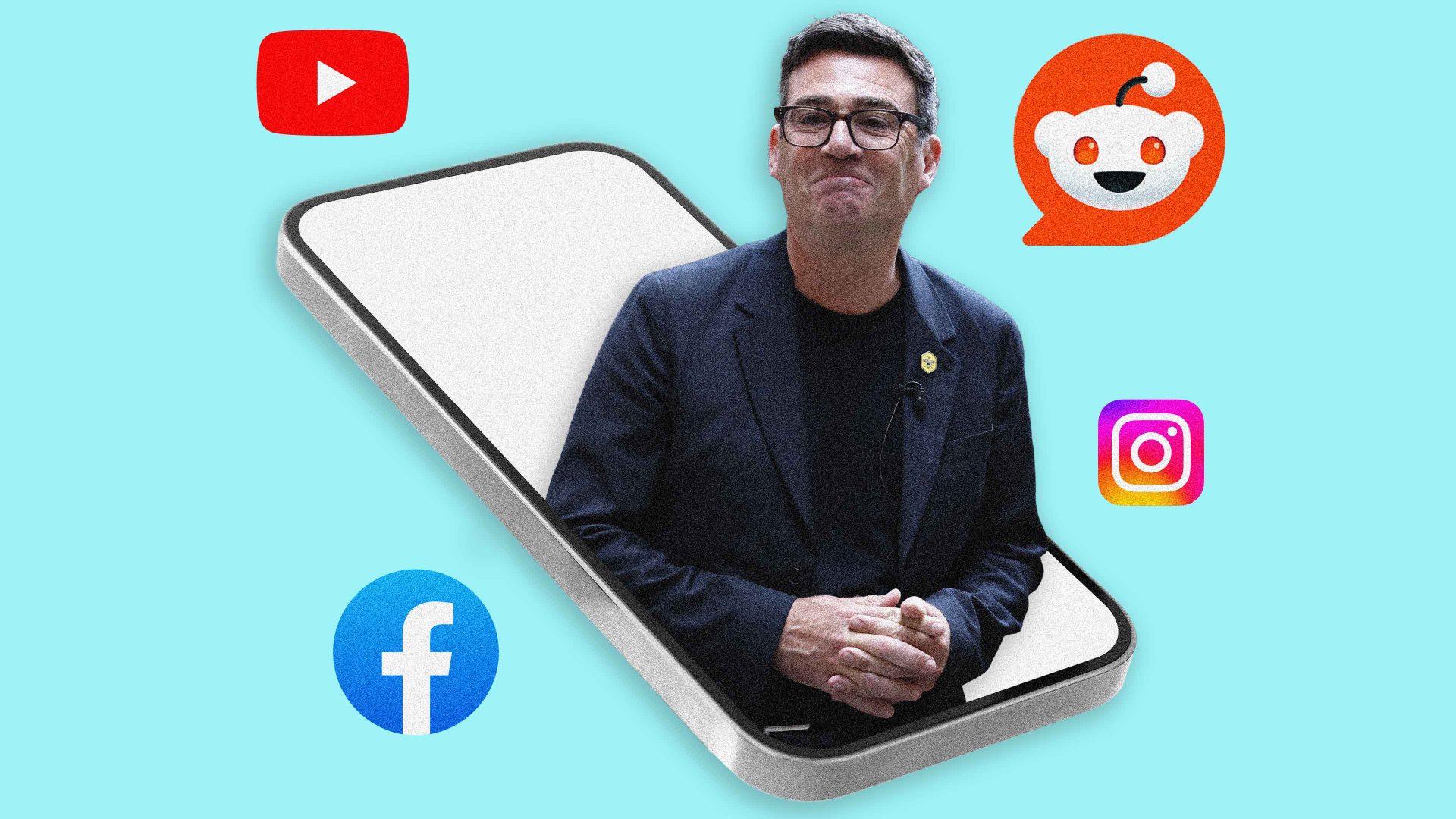
Change! Change is coming! Exactly how the seemingly-inevitable Andy Burnham era will differ from the past two years of Labour government (beyond being “more Northern”) remains to be seen. But political commentators seem convinced that at least one aspect is set to prove fresh, different and modern – his approach to comms.
Burnham’s decision to take his first post-byelection questions from punters (and a typically-pugnacious Kemi Badenoch) on Reddit rather than the lobby raised a few journalistic hackles. That, combined with his lack of engagement with the press pack during the byelection campaign, prompted allegations from the right-wing media that this was less about connecting with the public and significantly more about “dodging scrutiny”.
It’s not just him, though. Nigel Farage’s weekly press conferences have been replaced in recent months by statements streamed on YouTube, or dispatches sent directly to supporters via his Substack. One would have to be some sort of leftist conspiracist to tie this to swirling controversies around his financial backers.
Suggested Reading

We regret to inform you that Tommy Robinson has a new podcast
Even Keir Starmer has been attempting to engage voters directly via email. Are we entering a new era of political engagement, using new social platforms to bypass journalists and avoid “Real Questions”?
Er, no, of course not. Much as the UK’s political journalists might complain they’re being marginalised in favour of direct-to-supporter videochats and softball Q&As with handpicked questions, it’s worth pointing out that this isn’t anything new at all.
For my sins, I spent two decades working in communications – this included a brief, abortive stint at the DWP press office in 2008, when one of my solitary achievements was engineering a revolutionary approach to PR for then-secretary of state (and now incoming Burnham chief of staff) James Purnell: an online Q&A with The Sun’s readers on its then-nascent blog.
At the time, this really did feel new and fresh. Engaging what was then the biggest paper in the country’s readership was rightly seen as a key way to reach voters directly. The idea of sitting a minister of state in a room with a keyboard, some aides and a direct line to voters was a no-brainer.
Questions were lightly moderated to ensure not too many “fuck off, Labour scum” comments slipped through, and the team approached it as we would have done any other media engagement, with rigorous briefings and an expectation that, among the softball questions there would be tricky ones.
Memories have faded, but a sign that the wheels were coming off Gordon Brown’s stint as PM came when he tried a similar approach with a Q&A on Mumsnet in 2009. His failure to answer a question about his favourite type of biscuit saw him labeled “insincere” and “inauthentic”, and while there’s obviously no way of proving this directly led to his downfall… well, draw your own conclusions.
Burnham’s choice to record down-the-camera videos answering questions from commenters on Facebook and Instagram is also nothing new. David Cameron’s 2006 “WebCameron” experiment (even now it’s hard to type that without pretzeling with embarrassment) was widely mocked at the time.
But videos speaking directly to the electorate were a smart idea that were just a few years ahead of its time. Now they’ve been a staple of charismatic politicos in the US for a decade or more, refined by the new generation like AOC and Zohran Mamdani who have grown up on (smartphone) camera and have charisma to burn.
The sad truth for “traditional” media is that it’s simply not the go-to source anymore. According to a report by Reuters on news consumption, social media and video networks are now ahead of other news outlets as the most widely used source of global news, at 54% of all audiences.
Suggested Reading

How Gen Z fell for Andy Burnham
Meanwhile, since 2020, the use of both TV news and news organisations’ websites and apps has fallen by 13 and 12 percentage points respectively. Ofcom stats show social media is now used by half of UK adults to get their news. Reddit is the fourth most popular social media platform in the country. If you’re not talking to people on these channels, you’re not talking to them at all.
The idea that “only journalists” can hold politicians’ feet to the fire is also increasingly outdated. The ubiquity of smartphones means that any public appearance by any public figure is now an opportunity for awkward questions.
Responses, soundbites or even evasions can be clipped and broadcast in minutes to an audience of millions. It’s hard to feel hugely nostalgic for yet another round of press conference questions about personality politics from Messers Mason, Peston et al. And are sycophantic questions from sympathetic hacks really all that revealing anyway?
It’s also worth pointing out that this isn’t a binary distinction; Burnham’s since done traditional media rounds and the press conference isn’t dead… yet. The fact is, though, that politicians are right to turn their attention to channels that actually reach the voters they need to reach. If the lobby hacks want to regain their relevance, maybe it’s time they realised this too.
 Most popular
I was at Eton with Charles Spencer – this is how it explains his battle with the royals


Emily Maitlis’s diary: My deep dive into Jeffrey Epstein’s hidden empire – and the network that let him get away with it

The Greens’ foolish anti-Zionism vote is a disaster for Zack Polanski
Putin’s wartime economy is heading for catastrophe