The Garden of Remembrance was built to honour the memory of “all those who gave their lives in the cause of Irish Freedom”. On Saturday June 27, while tens of thousands flocked to Dublin to celebrate Pride, there were a few hundred anti-immigrant protestors who demanded a different version of Ireland, an Ireland with a hard border and one that’s not in the EU.
Ahmed, a taxi driver who picked me up on the way into Dublin, tells me that since moving to Ireland, he feels at home. A Celtic FC fan originally from Kenya, he made the move from Glasgow to Dublin with his family in 2020.
He says, “Ireland would be nothing without migrants. Look at all the doctors, nurses and taxi drivers that are here.”
“I mean, Irish people that are racist make no sense to me. There are millions of Irish people around the world.” He’s not wrong either, the Irish diaspora is estimated to be 50-80 million people.
I hop out into a carnival-like O’Connell St, named after the historic pioneer of peaceful protest, “The Liberator”, Daniel O’Connell.
Wading through the Liffey River is a boat with sailors cheering and proudly waving a rainbow flag at the stern. While walking through a sea of rainbows and signs that read “I’m 100% bisexual” or “Daddies and Mammies for trans rights!” Dublin city-centre’s heart was beating.
Turning off O’Connell St towards Parnell Square and waving goodbye to the bouncing Ryanair float, there is a stark contrast.
The noise drops, there is an ominous shift in vibe. There are a few hundred people gathered outside the front of the Garden of Remembrance where protestors are huddled around a DJ in a mobility-scooter blaring rebel songs in a tricolour balaclava.
Amidst the smell of alcohol, there was an air of disappointment for some of these online patriots. I heard a few murmurs in the crowd, “Very poor turn out to be honest.” Garbled text on AI-generated banners and signs bearing incorrect county and provincial crests were held by people wearing Make Ireland Great Again hats. It’s a phrase that has infuriated many people. Ireland’s history has been defined by colonial rule, famine, and the force in the Catholic Church. When was Ireland ever greater than it is now?
Suggested Reading
Tip Toe is wrong about progress against homophobia in Britain
Of course religion played a part. There were camo-wearing patriots carrying crucifixes and pictures of Jesus, while their oversized religious jewelry were sure to be front and centre of their outfits. Gaelic Football looked on, bewildered at the self-proclaimed Irish patriots in their Liverpool FC and Leeds FC tops.
I see a woman wearing an “ally” badge and with rainbow flags on both cheeks. Áine tells me she was walking past with her brother who is part of the LGBTQ+ community and she just wanted to have a look. “It’s creepily silent isn’t it?” she says. “It’s like there are two versions of Ireland on display today.” She’s not wrong, the question is which version is making an impact?
Just before 2pm there is a commotion as the arrival of recently-defeated Malachy Steenson is greeted with prophet-like handshakes from his loyal supporters. An Independent Councillor on Dublin City Council, Steenson is a hard right, pro-life fundamentalist who has been prominent in Ireland’s anti-immigrant protests. Steenson recently missed out on a seat in The Dáil, finishing 6th. Even Gerry Hutch, the alleged underworld boss, managed to come in fourth.
Nearby was Tom McDonnell, a Kildare Councillor who controversially said on Irish women and birth rates: “If we don’t have women breeding, we die out as a breed.” Last but not least, to document the day’s events was citizen journalist, and former National Party candidate, Philip Dwyer who was live-streaming throughout the day. It was a who’s who of the Irish far-right.
Billed as a “national rally” timed to coincide with Ireland’s assumption of the EU Council presidency on July 4th, Steenson tells me about his abject rejection of Brussels.
“We’re here to send a message to the government, and the European leaders that the Irish people are not compliant and will no longer abide by the dictats coming from Europe.” He adds, “We’re not going to abide by the EU Migration Pact. We’re not going to allow this country to be swamped.”
The EU was a common enemy at these protests, with one sign composed of a hammer and sickle saying “EUSSR” and another in which the EU flag was covered in swastikas. Though unclear whether the EU is Nazi or Communist, it is clearly an enemy.
Pepper claims he is not right wing, but working-class. In the middle of telling me this, he bizarrely breaks out into an impression of a posh south-Dublin accent, saying immigration doesn’t affect those in Dalkey or Killiney.
“Do you think Simon Harris or Micheal Martin care? Across the north-side and south-side of the city and the country people think the same. But the government will do what they do best and divide people.” Only a moment before, he’d told me Somalis should go back to their own country and that the government should look after the Irish.
Then there is a young member of The National Party. With his coat jacket draped over his shoulder and a bullhorn in his other, twenty-two year-old John McLoughlin from Waterford, chants, “Save the nation!”, “Execute the order!” and, “House the Irish, not the world!”
He tells me, “Every nation on the European continent needs remigration.” While the labels of far-right seemed to unsettle Steenson and Pepper, McLoughlin almost relished it. “I don’t care. I don’t care about the labels. Call us what you want.”
Suggested Reading
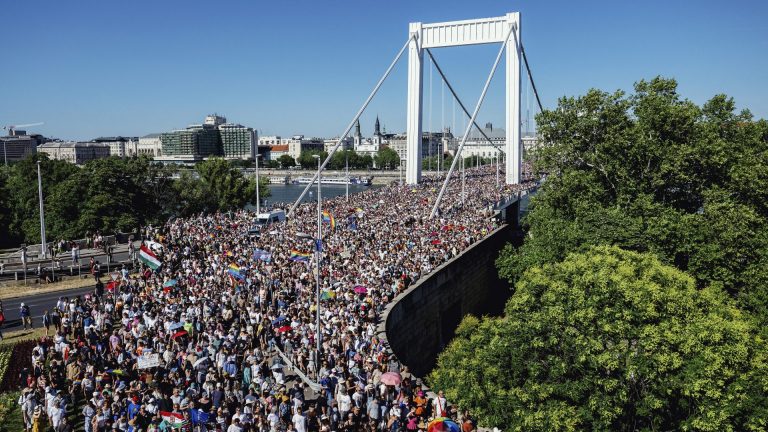
The pride of Budapest
When I asked about the Pride march that had passed down that exact same street an hour before, with a grin on his face he says, “I couldn’t care less.”
In a city where Pride had drawn tens of thousands, the arithmetic was not flattering for this radically different view of Ireland. Elsewhere in Europe, movements that once drew similar crowds have reshaped governments. Ireland’s trajectory is a bit different, perhaps down to its history with emigration to the US, the UK, and beyond. But, the conditions for a genuine far-right movement are there. Housing prices are shocking, trust in institutions is low, and the immigration debate is not going away.
But in the Irish hard right, there is an incoherence to their arguments and no structural end-goal other than an anti-government push.
As Tom, an older Dubliner who was returning from Pride put it, “They’re anti-migrant, they’re anti-pride, they’re anti everything.”
Smiling to himself and nudging my elbow, he finally says, “They don’t even get on with themselves.”