It is often assumed that the greatest challenge facing Nato is how to manage the explosive outbursts of one Donald Trump. There is no doubt that his approach to diplomacy has left officials at Nato HQ worrying what might come next. However, Nato’s diplomats and political staffers think they have broadly managed the chaos of Trump 2.0 well and that the alliance is in decent shape.
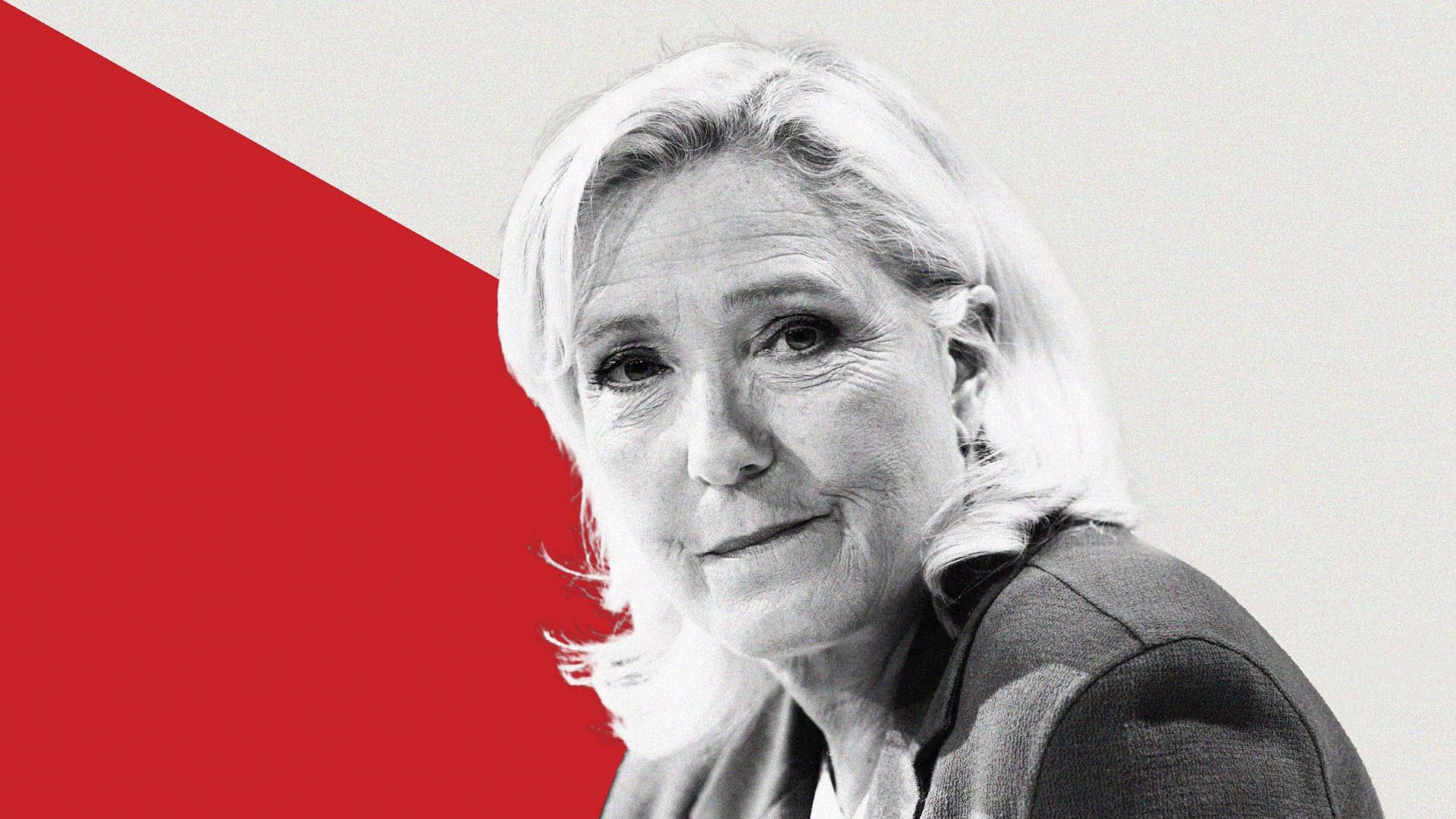
What is worrying some over in Brussels, though, is the prospect of another far-right Kremlin apologist taking control of a key Nato country next year: French presidential hopeful, Marine Le Pen.
Le Pen has built a career on telling voters that France is at risk of being overrun by radical Islamists. She has even said that Nato should “reorient itself toward the fight against Islamist fundamentalism,” which she claims is “one of the greatest dangers facing all the countries.”
While most European leaders would probably argue that honour belongs to Vladimir Putin, Le Pen has well-documented historic ties to the Russian butcher – and, despite her best efforts, has struggled to distance herself from him since the Russian invasion of Ukraine.
A 2023 inquiry – set up at the behest of Le Pen, concluded that her party, Rassemblement National, and its previous incarnation, Front National, had operated as a “communication channel” for the Kremlin, highlighting the parroting of Kremlin justification for annexing Crimea in 2014.
The list documenting examples of her contempt for western institutions is exhaustive and paints a picture of someone that European allies would not like to see running a key Nato member state that is also, among other things, a nuclear power and a permanent member of the UN Security Council.
Suggested Reading

What Andy Burnham can learn from, er… Marine Le Pen?
But Le Pen is, as things stand, the frontrunner in the presidential election that will take place in France in April next year. In her past two attempts, voters in the second round found her so distasteful they rallied behind another candidate to deny her the presidency. This time feels different.
“The political environment now is more favourable to her than it was in 2017 or 2022,” says Katy Brown, a research fellow at Manchester Metropolitan University who focuses on the far right. “Mainstream parties have long pandered to the far right in France, but it has accelerated even further under Macron. French politicians have made the far-right seem a lot less extreme by emulating their positions on immigration and Islam in particular.”
She cites multiple examples where Macron’s administration has cracked down on French Muslims by restricting how they are allowed to dress in public, but makes a particular mention of an incident in 2021, when Gérald Darmanin, Macron’s interior minister, accused Le Pen of being “too soft” on Islam. “In some areas, the mainstream has gone even further to the right than Le Pen,” Brown says.
Aside from her ambition to declare war on Islamism, Le Pen has said little recently about Nato. Something that has caught the eye of officials in alliance HQ, though, is her repeated promise to pull France out of Nato’s integrated military command.
Le Pen would not be the first French president to do this. Charles de Gaulle left the integrated command in 1966 over fears that the alliance was becoming dominated by the US and that French military independence was being undermined. Nicolas Sarkozy reversed this decision in 2009, arguing that France had participated in numerous Nato operations – Bosnia, Kosovo and Afghanistan – with no input on plans.
Suggested Reading
Le Pen may have made an even bigger blunder than Farage
France’s former ambassador to Nato, Camille Grand, says that this would once again be the case if Le Pen gets her way.
“France would lose a serious amount of influence within the alliance. It currently holds one of the most important commands in the alliance – Allied Command Transformation – which is critical at the moment because of the lessons learned in Ukraine,” Grand says. “And there are nearly a thousand French officers and personnel serving across the entire command structure, giving Paris a lot of overall influence that it would immediately lose. That’s before we even get to decision making.”
It would also cause problems for the alliance at large. As already discussed, France is a nuclear power with a large defence budget, experienced military and has recent experience of using its armed forces – something many European countries cannot say.
“It would create a gap for sure,” says Grand. “The French are active and committed across the whole Eastern flank from Estonia to Romania. They, along with the Brits, are known for thinking outside the box – a good example of this is the coalition of the willing.”
He described a moment in 2017, shortly after Macron had defeated Le Pen in the presidential election. “I got a round of applause. They had seen Brexit happen, Trump elected and were relieved. I think now it is possibly even more of a concern with a major war in Europe and America distancing itself.”
Officials currently working for Nato are acutely aware of the problems Le Pen could cause. Multiple people spoken to for this article, who declined to be named in order to speak candidly, were worried about the consequences of a Le Pen presidency.
Frontier states bordering Russia would almost certainly be very uncomfortable with Le Pen commanding the French armed forces. These countries, officials said, have already swallowed Trump’s ambiguity regarding whether he would come to the rescue of Lithuania or Estonia in the event of an invasion.
Very few at alliance HQ believe Trump would use the nuclear deterrent to protect anyone other than America itself. No one spoken to for this article thought Le Pen would either, a policy departure from Macron who wants France’s deterrent to serve as an umbrella for his European allies.
Beyond the hard military implications of a Le Pen presidency, she would also hold a veto over Nato’s decision making – be it support for Ukraine, agreeing to new members joining the alliance or even something as simple as cooperating with German and British counterparts.
A number of officials also expressed concern over Le Pen becoming a likeminded ally of Trump once in office. Trump’s tepid view of Nato is well known. Many in Brussels say that it is only the unity and commitment of the bigger European nations that has been able to placate Trump and stop him from doing immense damage to the alliance.
Suggested Reading

The end of Putin is at last on the table – but we must be sceptical
Having a French leader who is also sceptical of Nato and who views national security through a very narrow lens could encourage Trump – or whoever succeeds him as the leader of the MAGA movement – to pull even further away from the alliance.
Not everyone is so pessimistic. Kurt Volker, who served as American ambassador to Nato under George W. Bush, thinks that if she makes it to the Elysée, Le Pen could quickly realise how much France would lose from even a partial decoupling from Nato. “It would be, as you say in London, an ‘own goal’.”
Volker also doesn’t expect that Le Pen would suck up to Trump or make overt concessions to Russia, as even the European far-right is far from enamoured with Trump and is increasingly wary of Russian interference in their own countries.
However, he can see Le Pen making life difficult for her counterparts. “I suspect she will make decisions on a case-by-case basis. She could drag her heels or even block decisions on things like the Nato budget or joint programmes,” says Volker. “And I suspect those decisions will be made based on what she sees as being the most domestically advantageous political decision at the time.”
In short, Volker says that Le Pen could make life difficult for allies by creating “bureaucratic and budget headaches” that slow down things for others.
There is still a while to go before the election and it is still possible that Le Pen will end up being defeated in April. But her strong polling has been enough to create a sense of anxiety in Brussels among officials who have so far weathered the storm from Trump’s America. The threat Le Pen presents is subtly different to that posed by Trump, but could be equally as damaging for the alliance.
The fear with Trump was that he would simply leave the alliance by loudly slamming the front door. Le Pen could quietly slip out of the back, leaving structural damage to a Nato that has slowly rebuilt itself over the past decade.
Whereas a potential US departure would be mostly about capability and firepower, a French step back would swing a wrecking ball at the most important currency cornerstone allies have reinforced since the full-scale invasion of Ukraine: the political will to actually do something.
For Nato’s diplomats, the importance of the looming French election is clear. The alliance survived the loud unpredictability of Trump’s first two terms by keeping its head down and waiting out the storm. But if France flips, there may be few places left to take shelter.
 Most popular

The problem is they just don’t care about us any more

The New World at 500: Independence isn’t our marketing slogan. It’s our business model


Churchill, the Beatles, St George: All the English heroes who aren’t actually English

Sorry Nigel, but the polls show you’ve had it