
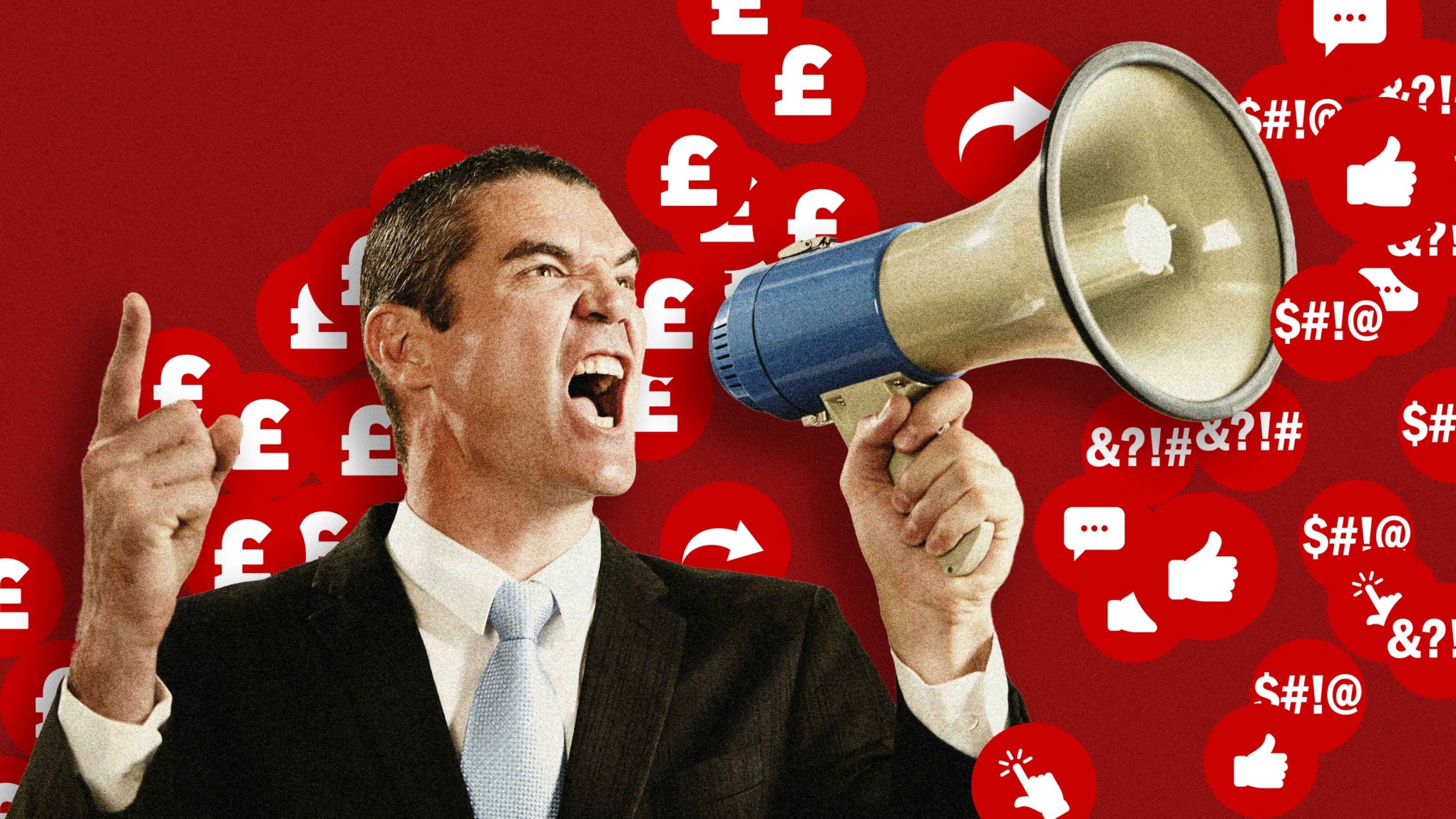
Have you ever wondered where those who spew hate online get their money from? The advertising industry does.
Behind the racist rants, misogynistic influencers and conspiracy theory videos that infect social media platforms and peddle misinformation lies an entire economy; a flow of advertising money. Not only that, but new research has found that anti-immigrant hate is the most lucrative of all.
Now, a group of senior advertising executives is speaking out about how that system works — and why so little appears to be changing.
In a new intervention coordinated by Inside Track, a non-profit that gives senior figures a way to speak collectively and anonymously, insiders accuse their industry of seeing its funding of online hate speech as “the cost of doing business” with tech giants.
Meanwhile, they argue influencers and groups are making “enormous financial gain” from online ad revenue off the back of the “laissez-faire attitude” of some of the UK’s biggest agencies, with clients having “no idea they are being auto-enrolled into buying ads placed next to racist vitriol.”
Their statement, An Abdication of Responsibility: Why Advertising Firms Continue to Monetise Hate, argues that “We have become more concerned with defending the belief that we have already done enough than confronting the uncomfortable reality that the problem persists — and that more must be done.”
Their warning comes alongside new research from the Global Disinformation Index (GDI), which estimates that 100 English-language YouTube channels in the UK and US publishing content it classifies as hate speech are on track to generate $13.3 million (£9.95m) in advertising revenue in 2026 alone. YouTube is expected to pocket around $6 million (£4.5m) of that, with channel owners taking the remaining $7.3 million (£5.45m).
Suggested Reading


TikTok say they’re safe for kids. Our investigation says otherwise
Perhaps most strikingly, their report found that anti-immigrant content generates the most money online; a single channel can earn an estimated $2.2 million (£1.65m) a year in advertising revenue, with around $1.2 million (£900,000) going to its creator and $1 million (£750,000) to YouTube. Fourteen of the 20 most-viewed channels examined by GDI attack multiple groups, typically targeting migrants, Muslims and Black people together.
One US-based commentary channel, which GDI estimates earns $2.2 million a year in advertising revenue, featured a host seemingly encouraging an arson attack on migrant camps. The channel also referred to migrants in dehumanising language, demanded their forced removal and shared a clip depicting Islam and Muslim men in derogatory terms.
A UK-based podcast channel featured a guest suggesting transgender people could be responsible for mass shootings. Other content on the channel compared the LGBTQIA+ movement to terrorism and presented the Quran as promoting terrorism. Despite this, GDI estimates the channel generates around $23,000 (£17,000) annually in advertising revenue, of which approximately $19,000 (£14,000) goes to YouTube.
A YouTube spokesperson insisted that “hate speech is not allowed on YouTube, and we consistently enforce our policies regardless of channel size. While we have not yet seen GDI’s report, we take these allegations seriously and will take swift action on any violative content.”
Advertisers, meanwhile, remain completely in the dark about where their ads appear.
The statement identifies three coalescing problems: a lack of transparency across the digital advertising supply chain; a failure by agencies to take responsibility; and business models that are increasingly reliant on the cheap reach offered by social media, where control over ad placement is much weaker.
The result, they argue, is that advertising money “slips through” to hate groups and creators while brands remain largely unaware of where their budgets end up.
“Many of those who dedicate time every day to creating hateful content — whether they be racist, homophobic or misogynistic influencers — simply could not do so without us.”
One senior advertising professional who spoke to The New World described the issue as an open secret, an almost ‘don’t ask, don’t tell’ policy from higher-ups in the industry.
The whistleblower, who has worked in the industry for more than 20 years, is speaking out as part of a wider attempt by insiders to force a reckoning over the relationship between advertising and online hate.
“It’s one of those things that is always said behind closed doors,” they told me. “And it’s always treated with a degree of, yes, acknowledgement and respect. But then no tangible shift for any systemic change.”
The result, they say, is a form of corporate lip service: a willingness to recognise the problem, provided that recognition does not require anyone to disrupt the business.
“It feels like it’s too difficult to tackle, and there’s no real upside financially to tackle it. So if there’s no financial upside to tackle it, then it’s a financial motivation to ignore it.”
Suggested Reading

An all-new breed of online secret agent
Had they ever encountered this sort of glib attitude personally, I asked.
“I raised something that was brought to me with a brand’s ads on harmful misinformation,” they replied. “And the conversation I had with higher-ups was: if you send that to me, this report, I will have to act on it, so think very carefully about what this could unravel.”
What, then, makes the system so difficult to change?
Part of the answer, the whistleblower explained, lies in the unusual position occupied by the major technology platforms. They are simultaneously the places where advertisers spend enormous sums and yet also the companies that determine the rules governing what content can include advertisements.
In traditional media, advertisers have a clearer picture of the environment in which they are buying space. For example, a television advertiser can establish which programme carried an advert and where it appeared in the break.
But digital advertising works differently.
“When you’re buying an ad on a social media platform, you basically go, here’s my £50,000, I want to reach young men, 18 to 34,” the whistleblower says. The platform then uses its systems to identify the audiences most likely to respond.
This can then place advertising alongside content that attracts the most sustained attention, which is often material that is inflammatory or hateful, without the advertiser necessarily knowing which videos or creators received its money.
It’s important to note that the algorithm can identify content as successful simply because people spend a long time watching it, even if they disagree with what’s being said. In other words, enragement drives engagement.
Brand safety tools are supposed to provide another layer of protection, supposedly so brands can specify that they do not want their adverts appearing alongside racist or offensive material, however third-party services can often struggle to distinguish hate or misinformation if it doesn’t obviously use slurs or offensive language.
“And then the challenge is, who’s flagging that to the brands? Because if they pay Meta that money and then they have to pay another brand safety person to sort it, the platforms have an incentive probably to downplay or loosen the definition of hate speech.
“Particularly if they’re American-based; in the last couple of years, as soon as Trump came in they just basically rolled back their definitions of what sexism, misogyny, racism, and started to call it freedom of speech.”
Suggested Reading
The new, organised far right threat to Britain
I asked the whistleblower why they had chosen to speak out now.
“I feel like the proliferation of misinformation and disinformation is impacting real communities’ lives, and it is really distressing. This level of misinformation, this level of lack of trust is really eroding media and communications, and that’s the industry that I have belonged to for decades.
“It used to be an industry you were proud to work in but now it’s become the attention economy, which has driven results for ad spend but the unintended consequences is eroding societal trust that no one seems motivated or capable of stopping.”
Richard Wilson, the director of Stop Funding Hate, told The New World that: “This timely and urgent whistleblower report paints a shocking picture of an advertising industry knowingly complicit in the spreading of dangerous hate and lies.”
“Every day we’re seeing the consequences of advertisers failing to fix this problem: Rising racist attacks, the toxic resurgence of misogyny among young men, an uptick in transphobic hate crime, charity volunteers being harassed simply for doing their jobs.”
“Almost none of us benefit from an advertising business model which puts short-term profit and convenience ahead of the health of our society. But ultimately the money fuelling this comes from advertisers we all know and shop with – and this gives us a way to push back.
“Time and again we’ve seen that when enough of us speak out, and use our power as consumers to demand that companies stop funding hate, advertisers will respond.”
While it is hardly certain that every advertising agency knowingly funds hate, nor does the GDI research establish the total amount of money flowing to hateful content across the internet, this all still raises a very uncomfortable truth. That until stronger regulations are introduced, those who stand to make any sort of profit will continue to turn a blind eye to content that is actively hastening divisions in society and contributing to real-life bigotry and hatred.
 Most popular

Nigel Farage’s attack on the RNLI and co is a new low even for this bottom-feeder
I was at Eton with Charles Spencer – this is how it explains his battle with the royals
‘The deep state stole my mini-budget’: An exclusive extract from Liz Truss’s new book
18 things that will absolutely, definitely happen if Trump gets whopped in the midterms